
Reviewed · FOOD & DRINK
Boston Food & History: Pizza, North End & Freedom Trail
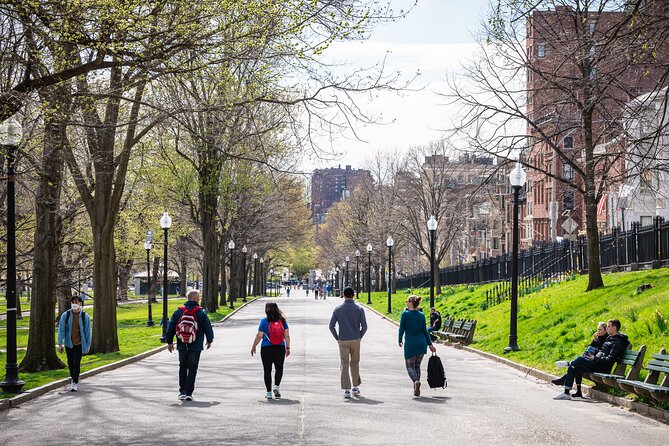
Boston tells its story one bite at a time. This five-hour walk pairs North End food stops with the Freedom Trail, giving you a useful first look at Boston’s Italian quarter, Revolutionary landmarks, harborfront, Beacon Hill, and two famous city parks. You start near the Boston Harbor and finish by the Boston Public Garden, so the route also helps you get your bearings.
I like the mix of fresh bread, pizza, an Italian deli sandwich, coffee, and pastry. I also like the small group size, capped at 12 people, which gives guides such as Nabil, Lexie, Bob, Claire, and Olivia room to answer questions and adjust the pace. The main catch is the distance: about 8 kilometers, or 5 miles, with much of it outdoors. On a hot, wet, or very cold day, this can feel like a serious walk.
In This Review
- The essential points at a glance
- Starting beside Boston Harbor and the Greenway
- Eating your way through Boston’s North End
- Old North Church and the Paul Revere story
- The Old State House and the Boston Massacre
- Old South Meeting House and the road to rebellion
- Old City Hall, King’s Chapel, and Granary Burying Ground
- Boston Common, Beacon Hill, and the State House
- Ending at the Boston Public Garden
- What the $90.86 price really covers
- The guide can shape the whole day
- Who should take this walking tour?
- Should you book Boston Food & History?
- FAQ
- How long does the tour last?
- How far do you walk?
- Where does the tour begin?
- Where does the tour end?
- What food is included?
- Can dietary requirements be accommodated?
- Is Old North Church entry included?
- How large is the group?
- Is the tour suitable for children?
- Is the tour accessible by public transportation?
- Can the food stops change?
- What is the cancellation policy?
The essential points at a glance
- Three North End food stops: Expect fresh bread, pizza, and a classic Italian deli sandwich, plus a hot Italian drink and pastry.
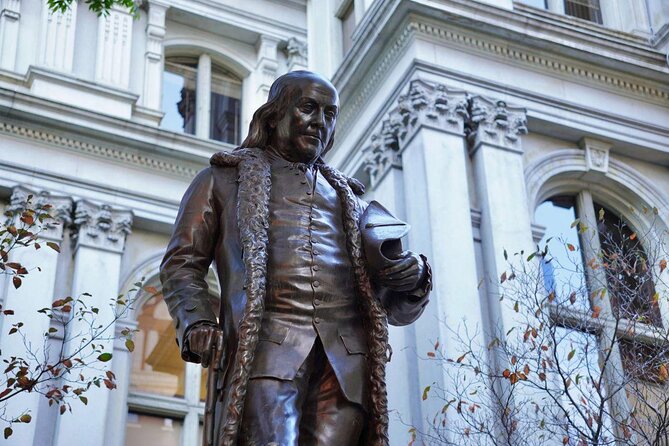
- A full Freedom Trail route: The walk covers Old North Church, Faneuil Hall views, the Old State House, Old South Meeting House, Granary Burying Ground, and more.
- About five hours on foot: This is a city orientation as much as a food tour, with roughly 5 miles of walking.
- A maximum of 12 people: The small group makes it easier to hear the guide and ask questions.
- A useful final stop: The tour ends at the Boston Public Garden, near Beacon Hill and central Boston sights.
- Local food businesses: The North End stops are locally owned, and food choices can change with availability.
Starting beside Boston Harbor and the Greenway
Meet at the Greenway Carousel on Atlantic Avenue. The opening stretch follows the waterfront and the Rose Kennedy Greenway, a long urban park with gardens, paths, fountains, plazas, art, and special lighting.
This is a smart beginning. Before the stories of Paul Revere and the Boston Tea Party take over, you see Boston as a working harbor city. The route offers views toward East Boston and the old wharfs along Atlantic Avenue. It also gives you a quick sense of how Boston’s old port fits beside its newer downtown streets.
The first section is short, listed at about five minutes, but it sets the tone. You are walking, not being driven past sights through a bus window. That means you can notice brick facades, narrow streets, harbor views, and the changes in the city block by block.
The Greenway is also a practical meeting point. The tour begins near public transportation, and you do not need to arrange a separate ride between the food and history portions.
More History Tours in Boston
- Boston: Freedom Trail History Small Group Walking Tour
★ 5.0 · 6,450 reviews - Tour of Historic Fenway Park, America’s Most Beloved Ballpark
★ 4.5 · 3,013 reviews - Boston: City Cruises Historical Sightseeing Cruise
★ 4.6 · 1,771 reviews
Eating your way through Boston’s North End
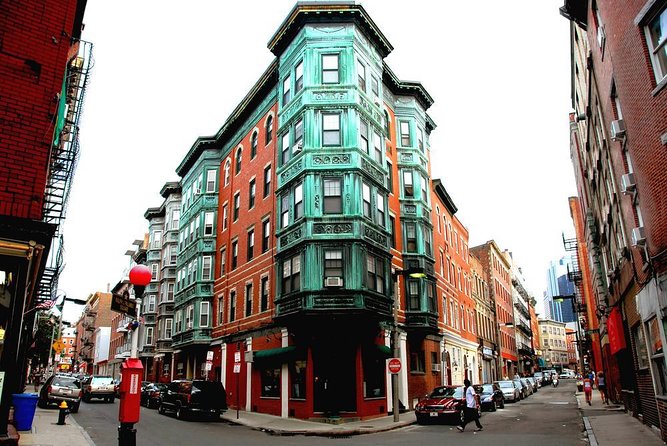
The North End is the food heart of the experience. It is also one of Boston’s oldest neighborhoods, with properties dating to the late 1600s and early 1700s. The tour spends about 80 minutes here, allowing time for food, short walks, and stories about the area.
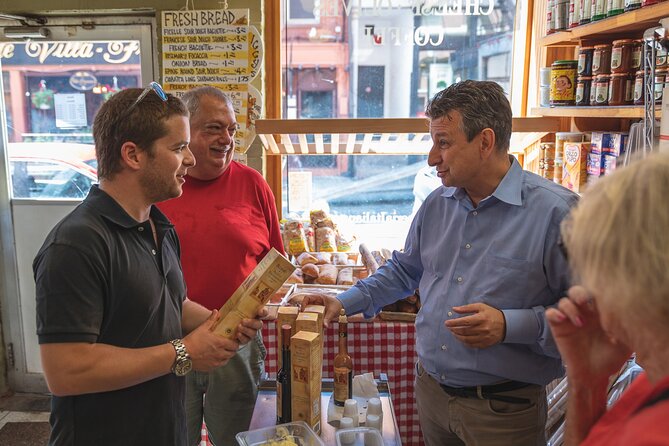
The first stop is a small Italian bakery known for bread made fresh each day. This is the sort of tasting I value on a food walk: simple, local, and tied to daily life rather than designed only for sightseeing. Fresh bread also gives you an early bite without filling you up before the later tastings.
Next comes an Italian salumeria, where you get a deli sandwich layered with cured meats and cheeses. It is a substantial part of the meal and one reason you should arrive hungry. The sandwich gives you a taste of the North End’s Italian-American food culture in a direct way, with no need for a formal restaurant stop.
Pizza is also included among the food tastings. The exact food lineup can change with availability, so you should think of the menu as a North End sampling rather than a fixed restaurant meal. The included food is intended to be filling, but additional drinks or snacks cost extra.
A coffee stop on Hanover Street adds a pause in the middle of the food section. You get an authentic Italian hot drink and pastry while taking in the main corridor of the neighborhood. Hanover Street can be crowded and lively, so this break is useful. It gives your feet a rest and lets you enjoy the setting instead of rushing from one food counter to the next.
The provider also includes a local surprise treat selected by the guide. That is a nice touch because the choice can reflect the day, the neighborhood, or what is available. Do not expect the exact same tasting on every departure.
Vegetarian, vegan, and gluten-free choices can be arranged if you give notice at least 24 hours before the start. Substitutions may not match the original items exactly, but the tour makes a real effort to handle dietary needs.
Old North Church and the Paul Revere story
After eating, the route turns toward the Freedom Trail and Old North Church. This is where the tour connects the North End’s streets with the events that helped set the American Revolution in motion.
The guide explains Paul Revere’s Midnight Ride and the church’s place in that story. When the church is open, entry is included. It is closed until the beginning of April, so during that period the stop takes place outside.
That seasonal note matters. If seeing the interior is important to you, check the operating date before booking. Even without entry, the exterior stop remains useful because it sits in the North End, close to several other major sites.
The route then passes through Downtown Crossing and near Faneuil Hall. From there, you can see Custom House Tower, once used for incoming goods and recognized as Boston’s first skyscraper. The walk is not limited to the painted Freedom Trail line. It also adds surrounding city sights that help explain Boston’s growth from port town to modern city.
The Old State House and the Boston Massacre
At the Old State House, the guide brings the Revolution into sharper focus. This is the spot where the Declaration of Independence was announced to Boston crowds in July 1776.
The building is also tied to the Boston Massacre. The stop covers the tension that led to the event and the way it became a powerful political tool. You spend only about five minutes here, but a good guide can make that short pause count by connecting the building, the crowd, and the larger conflict between Britain and the colonies.
I would not expect a long interior visit at every stop. This is an outdoor walking tour with brief explanations at many landmarks. That format works well if you want a broad introduction, but it may feel too quick if you prefer to tour each historic building inside.
More Food Tours in Boston:
- Boston North End Food Tour of 6+ Tastings, Cannoli, Lobster Roll
★ 5.0 · 1,404 reviews - Boston’s North End Food Tour: Italian Flavors & Heritage Walk
★ 5.0 · 1,322 reviews - Boston Pizza Lovers Food and History Walking Food Tour
★ 4.5 · 1,082 reviews - Boston’s North End Food and History Walking Tour
★ 5.0 · 459 reviews
Old South Meeting House and the road to rebellion
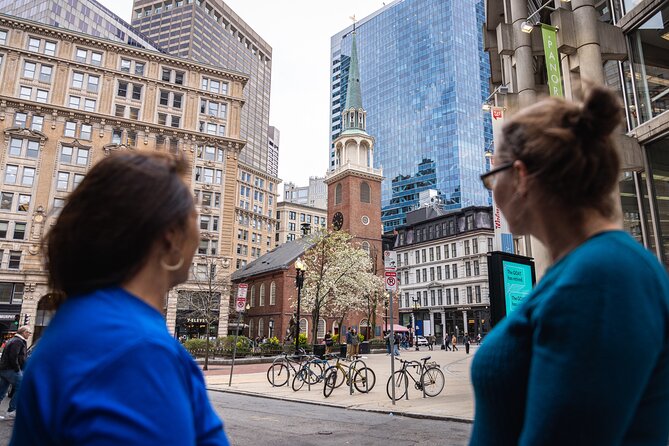
The next major point is Old South Meeting House, originally a church. Here you learn how Bostonians organized the protest that led to the Boston Tea Party in 1773.
This stop helps place the Tea Party in context. The event did not appear from nowhere. Arguments over taxation, representation, and British control had been building, and the meeting house served as a place where large crowds could gather and debate.
The route also passes the former site of Boston’s first bookstore and publishing connections tied to writers such as Henry David Thoreau, Nathaniel Hawthorne, and Henry Wadsworth Longfellow. The Paul Revere reference returns here through Longfellow’s famous poem, adding a literary layer to the political story.
Old City Hall, King’s Chapel, and Granary Burying Ground
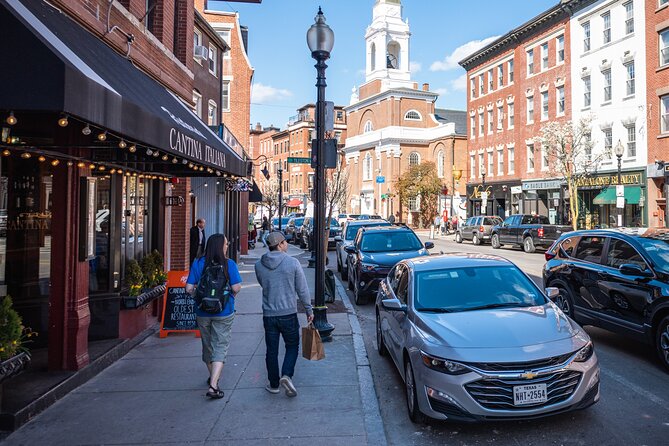
Old City Hall gives you a change of architectural mood. Its French design is more ornate than the brick colonial buildings nearby, and you can stop for a photo with the Bronze Donkey.
The site also connects to Boston’s civic and educational past. It served as the city council’s home during the 19th and 20th centuries and occupies the location of the first public school in America. The stop lasts about 10 minutes, enough for the story and a picture without turning the walk into a long building visit.
At King’s Chapel, the guide explains the history of the first Anglican church in New England and how its role changed over time. The stop lasts about 20 minutes, longer than several of the earlier points. If timing and access allow, you might hear the organist practicing on the oldest church organ in the United States.
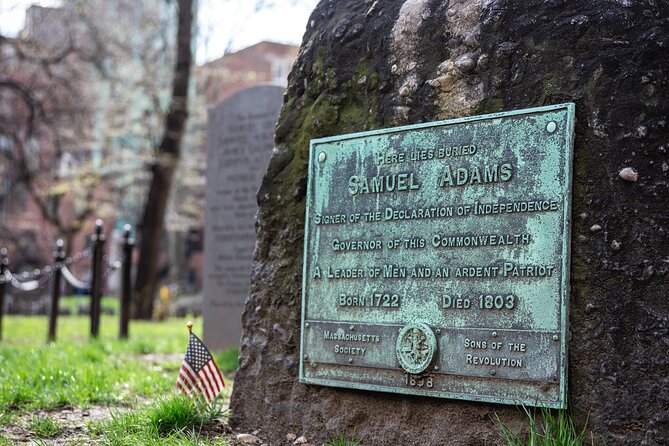
Granary Burying Ground follows. Dating to 1660, the cemetery was originally part of Boston Common. You pass the final resting places of John Hancock, Paul Revere, and Sam Adams. This is one of the places where the city’s past feels close and physical. The names are not just on a plaque. They are set among old gravestones in the middle of downtown.
Boston Common, Beacon Hill, and the State House
Boston Common is the oldest city park in the United States, with public use dating to 1634. The route passes memorials, fountains, and recreation areas, showing how the same open space has served residents for centuries.
From there, the walk heads toward Beacon Hill. You see cobbled streets, red-brick buildings, and classic Boston architecture. The neighborhood’s polished appearance hides a less agreeable past. Sailors and British soldiers once made the area unpopular with local residents, before it became one of the city’s most desirable addresses.
The tour also includes a stop at the Robert Gould Shaw and 54th Regiment Memorial. It honors one of the first African American regiments of the Civil War and its colonel. This is an important addition to a route often focused on the colonial period. It reminds you that Boston’s story did not end with independence.
At the Massachusetts State House, the gold-colored dome is hard to miss. The building occupies land once owned by John Hancock, and Paul Revere presided over its cornerstone ceremony in 1795. The guide explains how the building has continued to serve Massachusetts government.
This part of the route is especially good for first-time visitors because it links several major neighborhoods without requiring you to figure out the path yourself. The tradeoff is that you cover a lot of ground. Comfortable shoes are not optional.
Ending at the Boston Public Garden
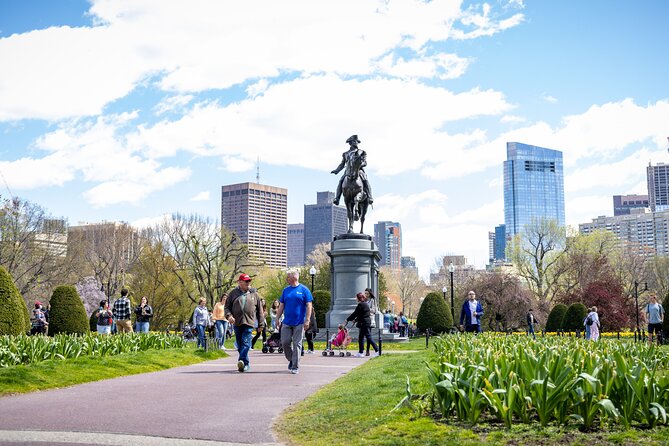
The tour finishes in the Boston Public Garden, the first public garden in America. It is a calmer ending after the city streets, cemeteries, and long run of historic sites.
The garden is still used for walks, exercise, leisure, and quiet breaks. The guide also explains how the land was used by Bostonians and British soldiers during the Revolutionary period and in the years since.
The endpoint, at or near 4 Charles Street, is useful. You are close to Beacon Hill, Boston Common, public transportation, and central restaurants. You can continue sightseeing, find lunch or dinner, or simply sit down after the 5-mile route.
What the $90.86 price really covers
At $90.86 per person, this is not the cheapest way to eat in Boston. You could buy a sandwich, coffee, and pizza on your own for less.
The value comes from combining food, a guide, local context, and a long city walk in one half-day outing. You get several tastings, a hot drink and pastry, entry to Old North Church when it is open, and an organized route through some of Boston’s best-known districts. You also receive suggestions for other places to eat and visit.
For a first visit, I think the price is reasonable if you would otherwise pay for both a food tour and a history tour. If you already know the Freedom Trail and mainly want a full meal, the cost may be harder to justify. The food is tasting-sized, though the portions can be filling, so plan around the tour rather than adding a large breakfast beforehand.
The guide can shape the whole day
The route carries a lot of history, and the guide’s delivery matters. Names associated with especially warm and engaging departures include Nabil, Lexie, Bob, Claire, Olivia, Tyler, Elon, Maddie, Allison, Ilan, Caitlin, and Tim.
The strongest guide style on this tour is friendly, clear, and willing to answer questions without turning the walk into a lecture. Lexie has been especially good with families, including making sure a 7-year-old stayed involved. Bob has handled rainy conditions by finding shelter when possible, while Olivia kept the mood upbeat during a very wet outing.
Weather can change the experience. In cold wind, you will spend much of the day outdoors. In rain, food stops and indoor pauses help, but you can still end up wet. In heat, the long route becomes tiring, and bringing your own water is wise. The tour does not promise a water bottle for each person.
Who should take this walking tour?
I would choose this experience if you are visiting Boston for the first time, enjoy trying several foods instead of sitting through one long meal, and want a guide to connect the city’s major landmarks.
It suits families, couples, solo visitors, and anyone with limited time. Children under 4 can join free, and reduced pricing applies from ages 4 through 11. The small group also helps solo participants meet others without the feel of a large coach tour.
You should think twice if you have trouble walking 5 miles, dislike eating on a schedule, or want lengthy interior visits at historic buildings. Most of the stops are viewed from outside, with Old North Church entry dependent on the season and availability.
The tour is entirely on foot, which keeps it simple and avoids vehicle traffic. It also directs money to locally owned North End food businesses, while the Old North Church admission supports preservation and education.
Should you book Boston Food & History?
Book it if you want one well-filled day to cover North End food, Revolutionary Boston, Beacon Hill, the harborfront, and Boston’s two historic parks. The strongest reasons are the local food stops, the small group, and the way the route gives you a useful map of the city.
Skip it if you want a relaxed food crawl with little walking. Also check the season if entering Old North Church is a priority. For most first-time visitors who can handle 8 kilometers on foot, this is a practical and satisfying introduction to Boston, with enough food to keep the history from feeling like homework.
FAQ
How long does the tour last?
The experience lasts approximately five hours. One departure ran closer to six hours, so avoid scheduling a tight appointment immediately afterward.
How far do you walk?
The route covers approximately 8 kilometers, or 5 miles. It is an active walking tour through several Boston neighborhoods.
Where does the tour begin?
It begins at the Greenway Carousel, 191 Atlantic Avenue, Boston, Massachusetts 02111.
Where does the tour end?
It ends at or near 4 Charles Street in the Boston Public Garden area, close to Beacon Hill and central Boston.
What food is included?
The food portion includes fresh North End bread, pizza, and an Italian deli sandwich. You also receive a hot Italian beverage and pastry, plus a local surprise treat selected by the guide.
Can dietary requirements be accommodated?
Vegetarian, vegan, and gluten-free options can be arranged. You must provide dietary requests at least 24 hours before the tour begins, and substitutions may differ from the original menu.
Is Old North Church entry included?
Entry is included when the church is open and available. The church is closed until the beginning of April, when the stop takes place outside instead.
How large is the group?
The maximum group size is 12 people.
Is the tour suitable for children?
Yes. Children under 4 years old can join free, and a reduced child price applies for ages 4 to 11.
Is the tour accessible by public transportation?
The meeting point is near public transportation. The tour itself is entirely on foot and includes about 5 miles of walking.
Can the food stops change?
Yes. The route and food inclusions may change based on availability on the day of the tour.
What is the cancellation policy?
You can cancel at least 24 hours before the start time for a full refund. Changes or cancellations made less than 24 hours before the start time are not accepted for a refund.
Just added in Boston
- View Boston Observation Deck Admission Tickets★ 4.5 · 314 reviews
- Delicious Donuts of Boston: A Sweet History Walking Tour★ 5.0 · 1,038 reviews
- Boston’s Freedom Trail: A Revolutionary Walking Tour★ 5.0 · 1,343 reviews
- Freedom Trail Walking Tour 250★ 4.5 · 1,118 reviews
- Sunset Sailing Cruise on a Tall Ship in Boston Harbor★ 4.5 · 414 reviews
- Narrated Sunset Cruise of Boston Harbor★ 4.0 · 532 reviews
- City Cruises Salem High Speed Ferry to/from Boston★ 4.5 · 727 reviews
- Boston’s North End Food and History Walking Tour★ 5.0 · 459 reviews
Food & Drink, compared.
New Orleans Food Walking Tour of the French Quarter with Small-Group Option
Read our review →
NYC Bus Tour of Brooklyn, Bronx, Queens: Art, Food & Sports
Read our review →
Savannah First Squares Culinary & Cultural Walking Food Tour
Read our review →
Chinatown & Little Italy Food Tour with 7 Flavorful Tastings
Read our review →
Food Tour with 5+ Tastings of Local Delicacies
Read our review →
Browse the lists this tour appears in