
Reviewed · WALKING TOURS
Boston’s Freedom Trail: A Revolutionary Walking Tour
Boston’s past is written in brick and stone. This 2.5-hour walk turns the Freedom Trail into a lively story of Redcoats, smugglers, patriots, abolitionists, and midnight riders. I especially like that you cover all 16 official sites in one outing, and that the guides connect the Revolution to later movements for women’s rights, education, immigration, and abolition. The main drawback is the pace: several miles and many centuries must fit into a single afternoon.
The $31 price is fair for a live guide, especially if this is your first visit to Boston. Guides such as Alfred, Alissa, Jim, Kenny, Julia, and Sam have earned praise for clear storytelling and humor. Still, you need comfortable shoes, decent mobility, and a willingness to keep moving. Some people have found it hard to hear or keep up when the group gets spread out.
In This Review
- Key points to know before you book
- Starting beside The Embrace and the Massachusetts State House
- Abolition, burying grounds, and Boston’s complicated ideals
- King’s Chapel and the first revolutionary sparks
- Printing, protest, and the Old State House
- Faneuil Hall and the voice of the crowd
- Paul Revere’s house and the North End
- Copp’s Hill, Bunker Hill, and Old Ironsides
- What the guides do best, and where the tour can slip
- Is $31 a good deal for 2.5 hours?
- Who should book this Freedom Trail walk?
- Should you book Boston’s Revolutionary Walking Tour?
- FAQ
- How long does Boston’s Freedom Trail walking tour last?
- Where does the tour begin?
- Where does the tour end?
- Does the tour visit all 16 official Freedom Trail sites?
- How much does the tour cost?
- What happens if bad weather cancels the tour?
Key points to know before you book
- All 16 Freedom Trail sites: You get a broad first look at Boston’s major Revolutionary landmarks in one continuous walk.
- A strong guide makes the difference: Alfred, Alissa, Jim, Kenny, Julia, Sam, and others have been praised for bringing the past to life.
- About 2.5 hours on foot: This is an active city walk, not a gentle hop between indoor attractions.
- Starts at The Embrace: Meet beside the Boston Common Visitor Information Center at 139 Tremont Street.
- Ends in the North End: Copp’s Hill Terrace gives you views toward Bunker Hill Monument and the USS Constitution.
- Good value for first-time visitors: You gain the route, background, and sense of place without having to research every stop yourself.
Starting beside The Embrace and the Massachusetts State House

The tour begins at The Embrace, the recent memorial to Martin Luther King Jr. and Coretta Scott King beside the Boston Common Visitor Information Center. It is a thoughtful starting point because the walk does not treat Boston as a city frozen in 1775. The opening reminder is that Boston’s fight for liberty continued through abolition, civil rights, education, immigration, and women’s rights.
From there, you head toward the Massachusetts State House. Its golden dome is one of Boston’s most recognizable sights, but the useful part of the stop is the older story beneath it. The cornerstone was laid by Samuel Adams in 1795, linking the new state government to one of the Revolution’s best-known figures.
This early section helps you get your bearings. Boston’s downtown streets are compact but not always simple, and a guide keeps the route moving while explaining how the old city grew around the modern one. The walking itself begins easily enough, but you should already be thinking about shoes and weather.
More Walking Tours in Boston
- Boston: Freedom Trail History Small Group Walking Tour
★ 5.0 · 6,450 reviews - Cambridge: Harvard University Student-Guided Walking Tour
★ 4.6 · 3,931 reviews - Harvard University Campus Guided Walking Tour
★ 4.5 · 3,632 reviews
Abolition, burying grounds, and Boston’s complicated ideals
One of the tour’s strengths is that it does not stop with the familiar patriot story. You visit a red brick church built in 1809 that hosted an abolitionist congregation. The guide explains the forceful anti-slavery speeches delivered there, including some of the earliest such speeches in America.
That stop adds needed balance. Boston’s language of liberty did not always match the way people were treated, and the city’s later reform movements deserve a place beside the Tea Party and the Battles of Lexington and Concord. I like this wider frame because it gives you more than a parade of statues and famous names.
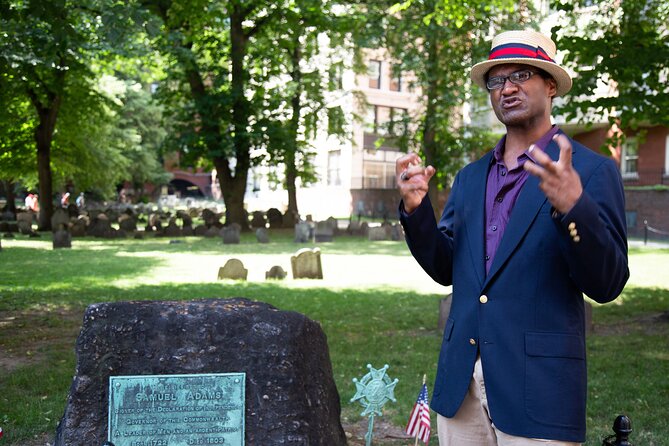
The next major stop is a burying ground dating to 1660. Here, the guide points out the graves of John Hancock, Paul Revere, and Samuel Adams. A cemetery can be easy to rush through on a self-guided walk, but a good explanation helps you understand why these people mattered and how their lives overlapped.
One caution comes from the schedule. At least one guide spent a long stretch in a cemetery, leaving the rest of the walk feeling rushed. If you use a walking stick or have trouble keeping up, tell the guide early. The group can include as many as 25 people, and it is harder to hear when you fall behind.
King’s Chapel and the first revolutionary sparks
King’s Chapel was built in 1754 as Boston’s first Anglican church. The stone building, adjoining burying ground, and underground crypts give the guide several angles to work with. You get a feel for the religious divisions of colonial Boston, not just the political ones.
Next comes the Old South Meeting House, a Puritan meeting house built in 1729. This is where the Boston Tea Party began, making it one of the most important stops on the route. The building was large enough to hold a crowd, and the guide explains how public debate and anger over British taxation gathered inside its walls.
This is an area where guide quality matters greatly. A short explanation can reduce the Tea Party to a familiar schoolbook scene. A good one explains the pressure building inside Boston and why the meeting became the launch point for civil disobedience.
The tour gives you the setting, but it may not satisfy every detail-hungry visitor. If you want a minute-by-minute account of the Tea Party, including exactly how many people took part, you may want to ask your guide directly. One person found this part less detailed than expected.
Printing, protest, and the Old State House
The tour then passes a 1718 brick building that once housed a colonial apothecary and later became the publishing house Ticknor & Fields. Its literary connection brings Boston’s cultural life into the story, with the guide discussing major writers published there.
This is a small but valuable change of subject. Revolutionary Boston was not only soldiers and angry crowds. It was also a place of medicine, publishing, books, and public debate. The building gives you a glimpse of how the city’s commercial life supported its intellectual life.
The Old State House, built in 1713, returns the focus to government. Its lion and unicorn symbols recall British rule, while the building itself served as the center of Massachusetts government under the Crown. The guide explains the speeches, arguments, and confrontations that took place inside.
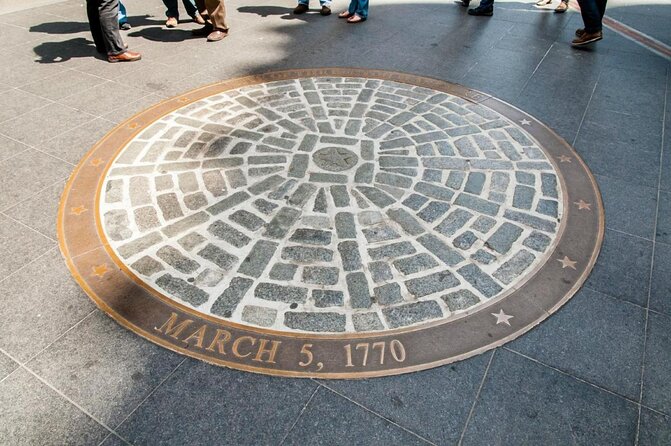
Just outside, a circle of stones marks the site of the 1770 Boston Massacre, then called the Bloody Massacre by many colonists. The guide reconstructs the night when British soldiers fired into a crowd and killed five colonists. This is one of the tour’s most useful moments because it shows how an event could be shaped into powerful political messaging.
You are not simply looking at a marker. You are seeing how the incident helped turn public anger into support for independence.
A different kind of day out entirely:
- Boston Duck Boat Sightseeing City Tour with Cruise Along Charles River
★ 4.5 · 9,378 reviews - Boston Hop-On Hop-Off Trolley Tour with 13 Stops
★ 4.5 · 5,576 reviews - Boston: City Cruises Whale Watching Cruise
★ 4.5 · 4,710 reviews - Boston Duck Tour: The Original and World-Famous
★ 4.6 · 3,935 reviews
Faneuil Hall and the voice of the crowd
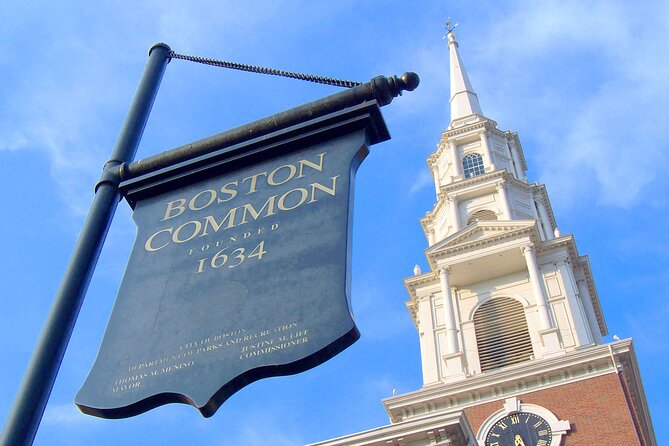
Faneuil Hall began as a marketplace in 1743, but its upstairs meeting hall became far more important. Its nickname, the Cradle of Liberty, reflects the speeches made there and the building’s role in public life.
The stop works best when your guide connects the noisy marketplace below with the political arguments above. Boston’s revolutionaries needed places to meet, persuade, organize, and spread their message. Faneuil Hall supplied that setting.
This section can feel crowded, especially when other groups are using the same Freedom Trail route. Several guides have been praised for steering their groups around congestion and keeping people together. Julia, in particular, was credited with managing construction and large crowds while still explaining the sites.
The large number of stops means you will not spend equal time everywhere. That is both the tour’s appeal and its limitation. You see the sweep of the trail, but a specialist tour of one building would give you more time inside it.
Paul Revere’s house and the North End

The route continues to Paul Revere’s House, a wooden building from 1680 and the oldest building in Boston. Revere lived there with his family, and the guide adds domestic details to the larger Revolutionary story.
I find this stop especially useful because it puts a real home behind a famous name. Paul Revere was not only the rider from the schoolbook legend. He was a working silversmith, a family man, and a participant in Boston’s political life. Seeing the modest house helps you picture the scale of the neighborhood and the people who lived in it.
The North End also gives the walk a change of atmosphere. Streets become tighter, buildings feel older, and the trail moves through a neighborhood rather than a cluster of civic monuments. Your guide may need to speak clearly and position the group carefully here, particularly with a full group of 25.
The tour then reaches Old North Church, built in 1723. Its famous signal involved one lantern if the British came by land and two if they came by sea. The guide explains how the signal was arranged by Paul Revere and why it mattered on the eve of the Revolution.
The itinerary notes that the church may be undergoing construction at times. Even if access or views change, the outside setting still carries the central story. Ask questions if you want to understand exactly what happened that night, since the details are much more interesting than the short version usually taught in school.
Copp’s Hill, Bunker Hill, and Old Ironsides
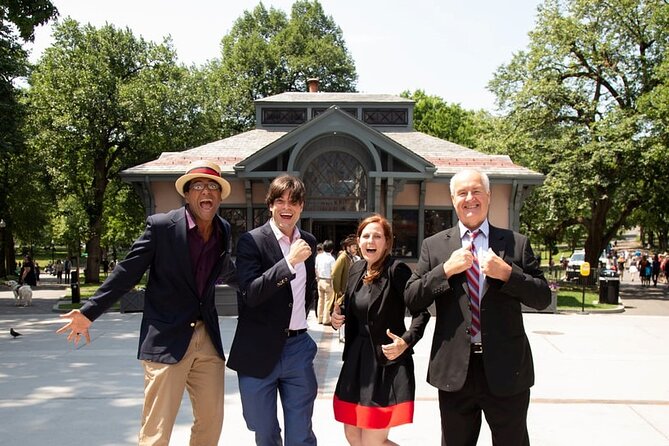
The final section takes you to Copp’s Hill Burying Ground, which dates to 1660. During the Battle of Bunker Hill, British forces used the cemetery for cannon emplacements. The guide explains the battle and points out notable Bostonians buried there.
From Copp’s Hill Terrace, you view the 221-foot Bunker Hill Monument across the water. The monument marks the place where colonial militia held hastily built earthworks and repelled two British attacks before retreating. The view gives you the battlefield context without taking the group across to Charlestown.
You can also see the masts and rigging of USS Constitution, known as Old Ironsides. It won battles in the War of 1812 and is the oldest warship afloat anywhere in the world. Ending here is smart: the tour finishes with a wide view that connects the Revolution, the early republic, and Boston Harbor.
The official end point is Copp’s Hill Terrace in the historic North End, near 7 Jackson Avenue, with views toward Bunker Hill Monument and USS Constitution in Charlestown. You should not expect the walk to include a full visit to either attraction. They are part of the closing view.
What the guides do best, and where the tour can slip
The strongest part of this experience is clearly the storytelling. Alfred has been praised for combining facts, humor, and a genuine affection for Boston. Alissa has been singled out for sharp wit, strong pacing, and an easy manner. Jim is known for clear explanations and amusing detail, while Kenny has impressed even people who already know a lot about American history.
Sam kept teenagers interested, which is a useful sign for families. Julia has handled construction and crowded trail conditions well. Charles R. was praised for maintaining a good pace even in the rain, and Eliot for speaking clearly and making the long walk easy to follow.
Of course, the guide you receive cannot be chosen from this list. The company’s rating is 4.9 from 1,343 reviews, with 97 percent recommending the experience, so the overall standard appears strong. Still, the individual guide shapes the day.
The main weakness is communication in a large group. One person found it hard to hear when the guide was not facing the group and suggested a louder speaker. Stay near the guide, especially at busy corners, and speak up if you cannot hear. A good guide can only help if you remain within the group.
Is $31 a good deal for 2.5 hours?
At $31 per person, I consider this a sensible introduction to Boston. You are paying for a route that covers all 16 official Freedom Trail sites, plus the explanation that ties them together. If you walked the trail alone, you could see many of the markers, but you would miss much of the political context and the connections between the people and places.
The value is highest on a first visit. You can use the walk to identify which buildings deserve a longer visit later. It also saves you from stopping every few minutes to consult a map.
The price is less attractive if you already know Boston well or want extended indoor access. This is a guided overview, not a museum tour, private tour, or slow architectural study. You see many places from the outside or at brief stopping points.
The tour is offered in English with a mobile ticket. Confirmation arrives at booking, and service animals are allowed. It runs near public transportation, but the important practical point is physical: you need a moderate fitness level and the ability to walk for roughly two and a half hours.
The experience requires good weather. You can cancel up to 24 hours before the start for a full refund, and if poor weather cancels the tour, you are offered another date or a full refund. Weather also affects the walk itself, so bring suitable clothing and do not assume a light drizzle will make the route easy.
Who should book this Freedom Trail walk?
I would choose this tour for a first-time Boston visitor, a family with older children, a couple wanting a strong introduction, or anyone who enjoys history but does not want to read every plaque alone. It is also a good first activity because it covers several neighborhoods and gives you a useful map of central Boston.
Families should note the praise for Sam’s ability to hold teenagers’ attention. History fans should look for guides such as Kenny, Alfred, Alissa, or Jim, whose storytelling has received especially warm attention, though guide assignments are not guaranteed.
I would think twice if you walk slowly, need frequent rests, or have difficulty hearing in a group. The route covers a lot, and one person found the pace too fast, especially after a lengthy cemetery stop. A private or shorter experience might suit you better, but no alternative is specified here.
Should you book Boston’s Revolutionary Walking Tour?
Yes, if you want the full Freedom Trail in one well-told walk. The tour gives you the key sites, the famous names, and the less familiar stories of abolition, publishing, religion, and civic protest. At $31, it offers solid value for a first look at Boston.
Book it when you can walk comfortably for 2.5 hours, stay close to the guide, and accept that some stops will be brief. If you want every detail of the Tea Party, the Boston Massacre, or Bunker Hill, use this as your orientation, then return to your favorite sites on your own.
FAQ
How long does Boston’s Freedom Trail walking tour last?
The tour lasts approximately 2 hours and 30 minutes.
Where does the tour begin?
It begins at The Embrace, beside the Boston Common Visitor Information Center at 139 Tremont Street, Boston, Massachusetts.
Where does the tour end?
It ends at Copp’s Hill Terrace in Boston’s North End, near 7 Jackson Avenue, with views of Bunker Hill Monument and USS Constitution.
Does the tour visit all 16 official Freedom Trail sites?
Yes. The tour is designed to cover all 16 official sites of Boston’s Freedom Trail.
How much does the tour cost?
The listed price is $31 per person.
What happens if bad weather cancels the tour?
Because the experience requires good weather, a cancellation due to poor conditions gives you the choice of another date or a full refund. You can also cancel for a full refund if you cancel at least 24 hours before the start time.
Just added in Boston
- View Boston Observation Deck Admission Tickets★ 4.5 · 314 reviews
- Delicious Donuts of Boston: A Sweet History Walking Tour★ 5.0 · 1,038 reviews
- Freedom Trail Walking Tour 250★ 4.5 · 1,118 reviews
- Sunset Sailing Cruise on a Tall Ship in Boston Harbor★ 4.5 · 414 reviews
- Narrated Sunset Cruise of Boston Harbor★ 4.0 · 532 reviews
- City Cruises Salem High Speed Ferry to/from Boston★ 4.5 · 727 reviews
- Boston’s North End Food and History Walking Tour★ 5.0 · 459 reviews
- Boston North End Food Tour of 6+ Tastings, Cannoli, Lobster Roll★ 5.0 · 1,404 reviews
Walking Tours, compared.

History and Hauntings of Salem Guided Walking Tour
Read our review →
New Orleans Premier Ghost, Voodoo and Vampire Walking Tour
Read our review →

Freedom Trail History Small Group Walking Tour
Read our review →
Historic Charleston Guided Sightseeing Walking Tour
Read our review →
New Orleans Food Walking Tour of the French Quarter with Small-Group Option
Read our review →
Cambridge: Harvard University Student-Guided Walking Tour
Read our review →Browse the lists this tour appears in