
Reviewed · WHALE WATCHING
Boston: City Cruises Whale Watching Cruise
The ocean decides what you see. That is the charm of this Boston whale watching cruise: you leave Long Wharf aboard a fast, comfortable boat and search the open waters for humpback, fin, and minke whales in their natural home. The trip includes Naturalists from the New England Aquarium, so the ride is not just a hunt for a splash. You get clear explanations about whale behavior, local marine life, and conservation.
I especially like the excellent onboard commentary and the choice between outdoor decks and a warm cabin with large windows. I also like the chance to see more than whales, including white-sided dolphins and, on lucky days, basking sharks. The main drawback is simple: these are wild animals, and the ride to the feeding grounds can be choppy, long, and occasionally fruitless.
The cruise costs $85 per person and lasts about 210 minutes, though three and a half to four hours is a more realistic planning estimate. That is a fair price if you value expert guidance and a serious chance to see whales, but you should leave room in your schedule in case the animals are farther offshore.
In This Review
- Key points before you book
- Leaving Boston from Long Wharf
- The ride past Castle Island and Boston Harbor Islands
- Reaching Stellwagen Bank National Marine Sanctuary
- Meeting humpback, fin, and minke whales
- What the Naturalists add to the trip
- Choosing between the open decks and indoor cabin
- Food, drinks, bathrooms, and comfort
- Is $85 a good value?
- Tips for getting the most from the cruise
- Who should book this Boston whale cruise?
- Should you book it?
- FAQ
- Where does the Boston whale watching cruise depart from?
- How long does the cruise last?
- Which whales can I see?
- Where does the whale watching take place?
- Is the boat comfortable in bad weather?
- Is the cruise suitable for people with motion sickness?
- Is food included in the ticket?
Key points before you book
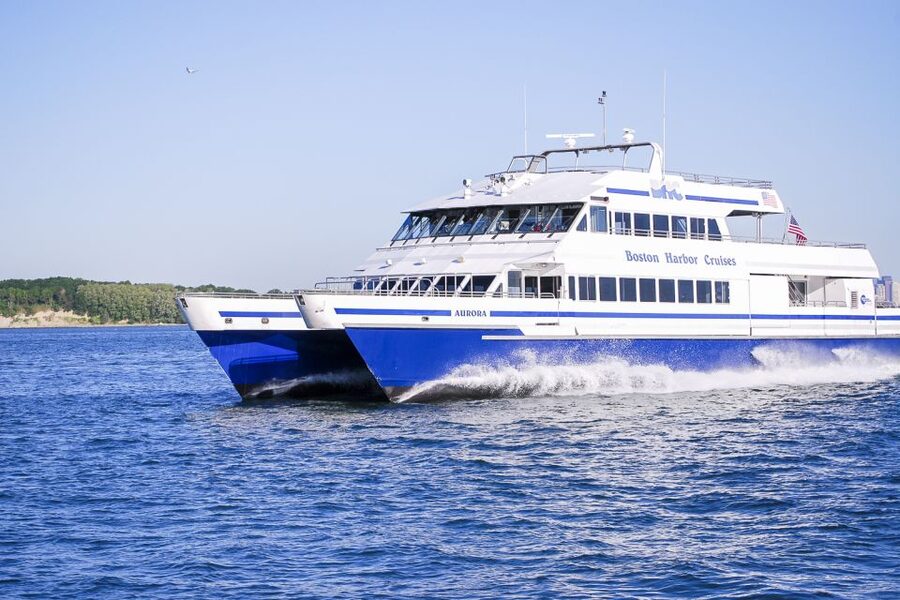
- Whale watching takes place at Stellwagen Bank: The main viewing period is about 1.5 hours, but reaching the sanctuary can take roughly 90 minutes each way.
- New England Aquarium Naturalists lead the commentary: Guides explain what you are seeing and help you identify individual whales and behaviors.
- The boat offers both outdoor and indoor viewing: You can watch from open decks or retreat to climate-controlled seating with tables and large windows.
- Humpback, fin, and minke whales are the main targets: White-sided dolphins and other marine life may appear as bonus sightings.
- Sea conditions matter: Wind and waves can make the outward journey rough, so motion sickness medicine and warm layers are sensible.
- A whale sighting is never guaranteed: If conditions and wildlife cooperate, the experience can be unforgettable. If not, you are still spending much of the day on open water.
Leaving Boston from Long Wharf
The cruise departs from One Long Wharf, between the Long Wharf Marriott Hotel and the New England Aquarium. This is a handy starting point if you are already exploring the waterfront, visiting the aquarium, or staying near downtown Boston.
You present your voucher at the boarding location for scanning. It is worth arriving with enough time to find the dock and get settled, especially if you want a good position outside. The boat has several viewing areas, but the best sight lines can become crowded once a whale appears.
Long Wharf also makes this easy to pair with other Boston plans. You can visit the waterfront before the cruise, then return to the same central area afterward. Just do not schedule a tight dinner reservation, airport transfer, or train connection immediately after the boat returns. The whale location may require extra travel time, and the average outing runs closer to three and a half or four hours than to exactly 210 minutes.
More Boat Tours in Boston
- Boston Duck Boat Sightseeing City Tour with Cruise Along Charles River
★ 4.5 · 9,378 reviews - City Cruises Boston Whale Watching Cruise by High-Speed Boat
★ 4.5 · 3,115 reviews - Boston: City Cruises Historical Sightseeing Cruise
★ 4.6 · 1,771 reviews
The ride past Castle Island and Boston Harbor Islands
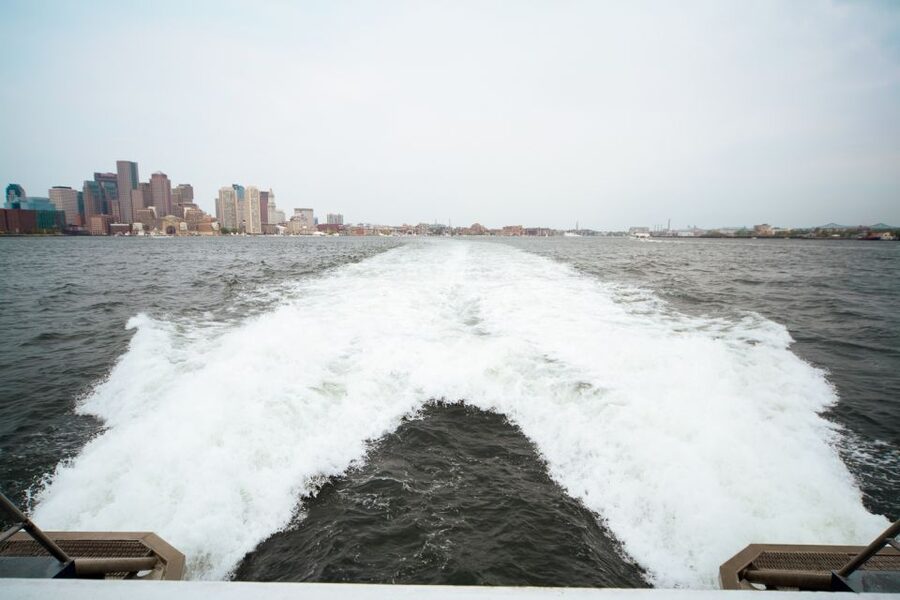
The first part of the cruise gives you a changing view of Boston from the water. Castle Island is passed rather than visited, so do not expect time ashore or a stop for photographs. Still, seeing the harbor from a moving boat gives you a useful sense of how Boston opens into Massachusetts Bay.
You also pass through the waters of Boston Harbor Islands National and State Park. Again, this is a scenic passage, not a landing. The islands and open harbor provide a pleasant start before the boat heads farther from the city.
The high-speed boat is designed to cover this distance efficiently. That matters because whales generally are not waiting just outside downtown Boston. The fast ride gives you more time in the feeding area, but it also means you should prepare for movement, wind, and spray.
The boat includes cushioned seating, tables, indoor climate-controlled space, and large windows. You can sit inside on the way out, then move outdoors when the naturalists begin tracking whales. If the sea feels rough, staying near the center of the boat may help, and crew members can advise you about locations with less motion.
Reaching Stellwagen Bank National Marine Sanctuary
The main event takes place at Gerry E. Studds/Stellwagen Bank National Marine Sanctuary. This protected marine area is an important feeding ground, which is why the cruise heads here instead of simply circling the harbor.
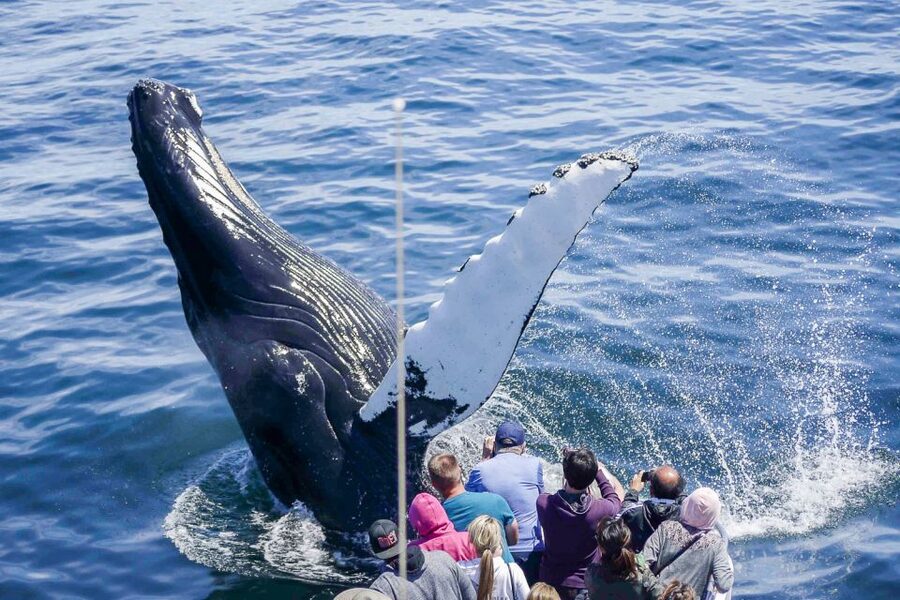
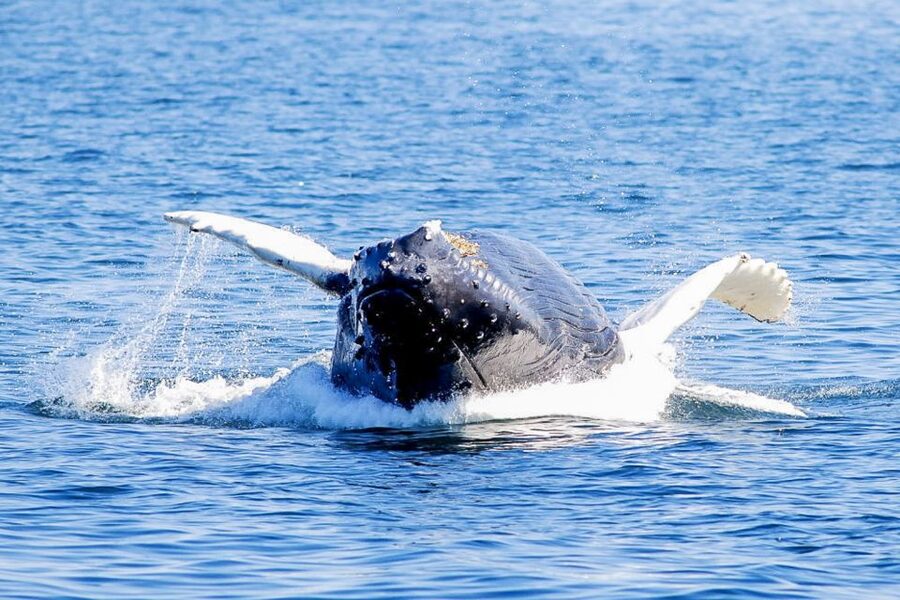
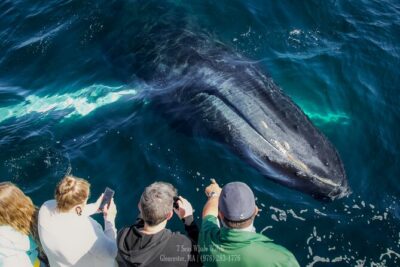
The scheduled whale watching time is about 1.5 hours. That may sound brief after the long ride, but it is enough time for several sightings when whales are active and grouped together. You might watch a humpback surface repeatedly, see a fin whale move through the water, or catch a minke whale appearing for only a moment.
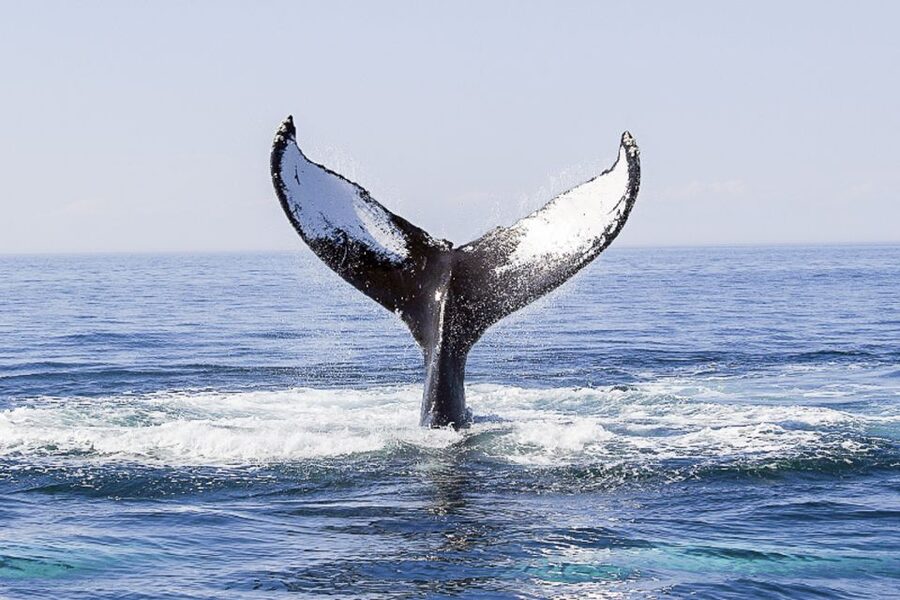
The guides help you understand where to look. A whale’s back, blow, fin, or tail may appear far from the boat, and without direction you can easily stare at the wrong patch of sea. The Naturalists also explain why a whale behaves differently from one moment to the next. A tail slap, breach, or prolonged surface visit is never guaranteed, so the guide’s interpretation makes ordinary sightings more interesting.
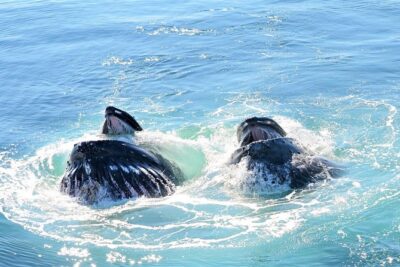
Several outings have produced impressive encounters with six or more humpbacks, groups of fin whales, and dolphins. One trip included a breaching humpback close to the boat, while another included a humpback kick feeding, a feeding method that is less commonly seen. These moments are luck, not part of the standard promise, but the sanctuary gives you a strong setting for them.
Meeting humpback, fin, and minke whales
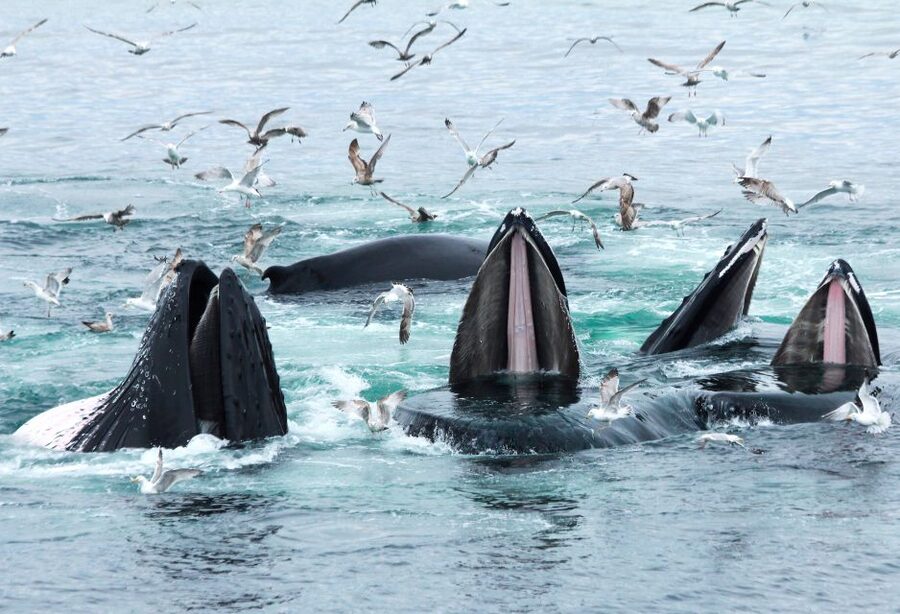
Humpback whales are usually the most dramatic animals to watch. Their large flukes, long pectoral fins, and habit of arching their backs before a deep descent make them relatively easy to identify. The scientific name, Megaptera novaeangliae, means big-winged New Englander, a fitting name for an animal with such long fins.
The Naturalists may identify whales by name when they recognize individuals. Specific whales seen on recent trips included Fern, Rocker, and Etch A Sketch. Individual identification adds something special: you are not simply looking at an anonymous animal, but learning about a known whale with a place in the local population.
Fin whales are larger and more streamlined. They can reach about 45 to 70 feet and weigh roughly 40 tons as adults. Their size can be hard to judge at sea, but when one surfaces near the boat, the length of its back becomes strikingly clear.
Minke whales are smaller and sleek, with a somewhat dolphin-like shape. They are the most abundant whale species in the world, but that does not make a sighting unimportant. Their quick appearances can be harder to follow, and seeing two on one trip can feel like a fortunate bonus.
White-sided dolphins may also appear. These playful North Atlantic mammals are found in waters from the area south of New England north toward Norway. A pod can provide a welcome change of pace while the boat searches for whales.
More Dinner Cruises in Boston
- City Cruises Boston Historic Sightseeing Harbor Cruise
★ 4.5 · 1,388 reviews - City Cruises Salem High Speed Ferry to/from Boston
★ 4.5 · 727 reviews - City Cruises Boston Codzilla High-Speed Thrill Boat Ride
★ 4.0 · 424 reviews - City Cruises Boston 90-Minute Harbor Sunset Sightseeing Cruise
★ 4.5 · 411 reviews
What the Naturalists add to the trip
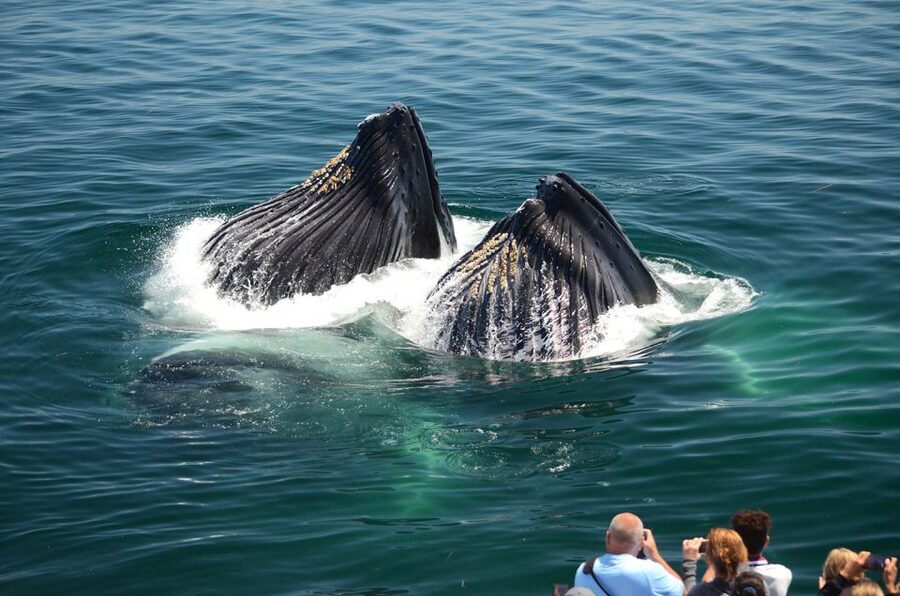
The New England Aquarium connection is one of the strongest reasons to choose this cruise. The Naturalists do not merely announce that a whale is nearby. They explain species, behavior, feeding patterns, and conservation work in a way that gives meaning to what you see.
The commentary continues during the journey to and from the sanctuary. Guides may walk through the boat, offer facts, answer questions, and point out details that would otherwise pass unnoticed. Amanda showed passengers a piece of an original humpback whale tooth on one trip, while Andrew was praised for his energy and enthusiasm on another.
Clear narration matters on a large boat. Some passengers have found the public address system difficult to understand, so standing near a guide or watching the guide’s direction can help. When the boat is crowded, it can also be hard to hear every word from the outer decks.
The tone is generally educational without turning the trip into a classroom. You learn about the animals while watching real behavior unfold. The conservation message is useful, too. The cruise helps connect visitors with the region’s marine research and the need to protect these animals.
Choosing between the open decks and indoor cabin
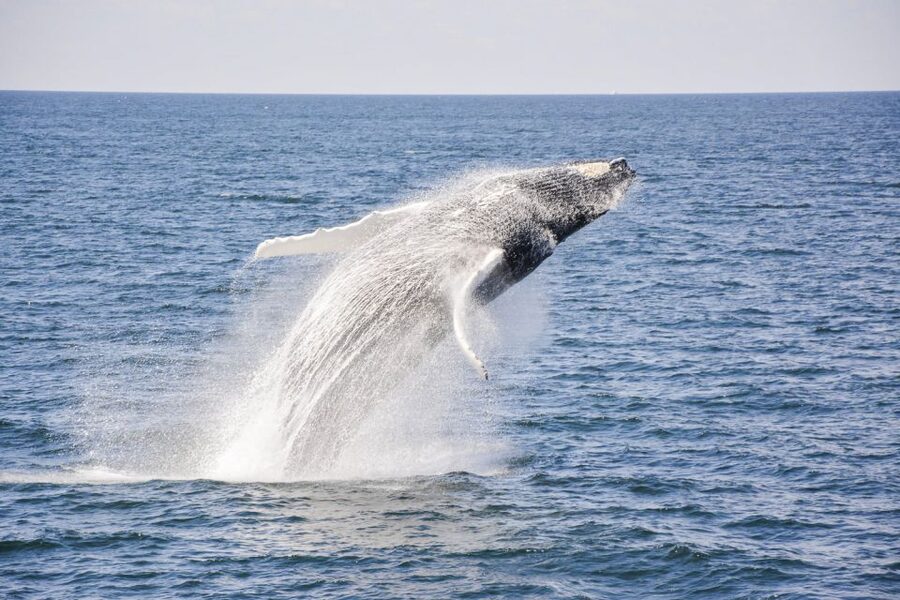
The boat gives you several ways to watch. The outside viewing decks offer the widest views and the clearest chance to photograph a whale as it surfaces. They are also the coldest and windiest places on board, even on a pleasant summer day.
Bring a jacket, long layers, sunglasses, a sun hat, and sunscreen. Several passengers found the upper deck noticeably cold in shorts, and a warm coat remains useful when the boat is moving quickly. Comfortable shoes are important because you may shift from one side of the boat to another as the guides track animals.
The indoor cabin has cushioned seating, tables, climate control, and large windows. This is a real advantage for families, anyone who needs a break from the wind, or passengers who find the sea uncomfortable. You may not get the same unrestricted view as you do outside, but you can still follow the action through the windows and listen to the commentary.
Crowding is the main practical issue. Once whales surface, people naturally move toward the front and sides. Some passengers have had trouble finding an unobstructed position, particularly when taller people hold the best spots. If you want to photograph everything, you may need patience and a willingness to move around rather than expecting one perfect seat.
Food, drinks, bathrooms, and comfort
A galley sells snacks and drinks during the cruise. The selection has been described as useful and varied, but food and beverages are not included in the $85 ticket. Bring your own expectations accordingly. A snack can be welcome on a four-hour outing, especially for children, but budget extra if your group plans to purchase food onboard.
The boat has indoor seating and tables, which makes eating easier than it would be on a small open vessel. Bathrooms are available, and they have been described as clean on recent outings.
The boat is large enough to feel stable to some passengers, but stability does not eliminate motion sickness. The ride out to the sanctuary can be bumpy, especially when the sea is rough. If you are prone to seasickness, take a preventative remedy according to your usual medical guidance and ask the crew which part of the boat has less movement.
This excursion is specifically not suitable for people with motion sickness. That warning deserves attention. Several passengers have felt fine, while others have seen people become ill during choppy conditions. A sunny day in Boston does not guarantee calm water offshore.
Is $85 a good value?
At $85, this is not a cheap harbor outing. It is a half-day commitment that includes the boat ride, outdoor and indoor viewing areas, a professional guide, and access to Naturalists connected with the New England Aquarium.
I consider it good value if seeing whales is high on your Boston wish list. The boat covers a lot of water, the crew works to locate animals, and the commentary gives the outing substance even between sightings. A memorable encounter with several humpbacks, dolphins, or a breaching whale can make the price feel modest.
The value is less certain if your schedule is tight or if you dislike long boat rides. About three hours is the minimum advertised duration, and the average outing may last three and a half to four hours. You also pay for the possibility of seeing wildlife, not for a guaranteed animal performance.
The cancellation policy helps with planning. You can cancel up to 24 hours in advance for a full refund, and the reserve-now, pay-later option keeps your plans flexible. For weather concerns, check the local operator’s current information directly because conditions and cancellations can change.
Tips for getting the most from the cruise
- Bring more clothing than you think you need. The open deck is colder than the city, and wind can build during the fast ride offshore.
- Take binoculars if you have them. Whales may surface at different distances, and binoculars help you follow animals beyond the closest group.
- Keep your camera ready, but do not watch the entire trip through a screen. A whale can appear and vanish before you frame the shot.
- Listen for the direction given by the Naturalists. Their guidance is often the difference between seeing a blow and missing it.
- Move around when it is safe and practical. The front, sides, and rear may offer different views, but crowded areas can limit sight lines.
- Leave extra time after the scheduled return. The animals may be far from Boston, and the boat may need more time to reach them.
- Expect the unexpected. A minke whale, dolphin pod, fin whale, tail slap, or breach can change the character of the whole trip.
Infant tickets must be purchased for infants to board. The cruise is wheelchair accessible, conducted in English, and smoking is not allowed.
Who should book this Boston whale cruise?
I would recommend it to families, couples, wildlife fans, and anyone who wants a break from museums and historic sites. It is also a good choice if you enjoy learning while you watch, since the Naturalists provide much more than basic announcements.
You should also book it if you can accept uncertainty. The best moments come from wild behavior, and there may be long stretches of travel before the first sighting. That is part of the bargain.
I would be cautious if you get motion sickness, dislike wind and cold, or need to be back at a precise time. The indoor cabin helps, but it cannot turn a four-hour ocean trip into a calm harbor ride.
Should you book it?
Book this cruise if you want a serious whale watching outing from Boston and can spare most of a half-day. The combination of a fast boat, indoor comfort, open viewing decks, and New England Aquarium Naturalists gives you a well-rounded experience, not just a boat ride with a hope of spotting a fin.
Plan carefully, dress warmly, and accept that nature sets the schedule. If you do, the reward can be remarkable: several humpbacks surfacing together, dolphins racing nearby, or a whale lifting its tail close enough to make the city feel very far away.
FAQ
Where does the Boston whale watching cruise depart from?
The cruise departs from One Long Wharf, between the Long Wharf Marriott Hotel and the New England Aquarium. Present your voucher at the boarding location for scanning.
How long does the cruise last?
The listed duration is 210 minutes, or three and a half hours. The average trip lasts about three and a half to four hours, and it may run longer if whales are farther offshore.
Which whales can I see?
The main species are humpback, fin, and minke whales. White-sided dolphins and other marine wildlife may also be seen.
Where does the whale watching take place?
The boat travels to Gerry E. Studds/Stellwagen Bank National Marine Sanctuary. The whale watching portion of the trip lasts about 1.5 hours.
Is the boat comfortable in bad weather?
The boat has outdoor viewing decks plus a climate-controlled cabin with cushioned seats, tables, and large windows. The sea can still be choppy, so bring warm, weather-appropriate clothing.
Is the cruise suitable for people with motion sickness?
The experience is not suitable for people with motion sickness. The ride to the sanctuary can be bumpy, and passengers prone to seasickness should take suitable precautions.
Is food included in the ticket?
No. Snacks and drinks are available for purchase from the onboard galley.
More Whale Watching Trips in Boston
- Juneau Wildlife Whale Watching
★ 5.0 · 7,379 reviews - Juneau Wildlife Whale Watching & Mendenhall Glacier
★ 5.0 · 6,236 reviews - Whale Watching Tour in Gloucester
★ 5.0 · 4,460 reviews - Maui Eco-Raft Tour: Eye-Level Whale or Dolphin Watching – Lahaina
★ 5.0 · 2,482 reviews
Just added in Boston
- View Boston Observation Deck Admission Tickets★ 4.5 · 314 reviews
- Delicious Donuts of Boston: A Sweet History Walking Tour★ 5.0 · 1,038 reviews
- Boston’s Freedom Trail: A Revolutionary Walking Tour★ 5.0 · 1,343 reviews
- Freedom Trail Walking Tour 250★ 4.5 · 1,118 reviews
- Sunset Sailing Cruise on a Tall Ship in Boston Harbor★ 4.5 · 414 reviews
- Narrated Sunset Cruise of Boston Harbor★ 4.0 · 532 reviews
- City Cruises Salem High Speed Ferry to/from Boston★ 4.5 · 727 reviews
- Boston’s North End Food and History Walking Tour★ 5.0 · 459 reviews
Whale Watching, compared.
Juneau Wildlife Whale Watching & Mendenhall Glacier
Read our review →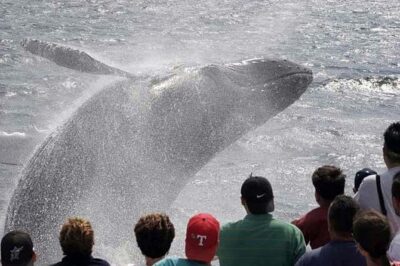
City Cruises Boston Whale Watching Cruise by High-Speed Boat
Read our review →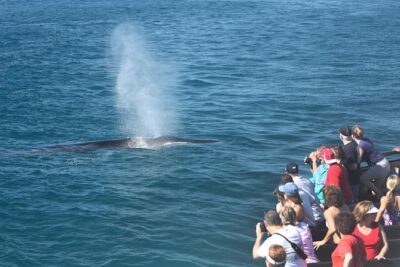
Whale Watching Trips to Stellwagen Bank Marine Sanctuary. Guaranteed sightings!
Read our review →
2-Hour Oahu Whale Watch from Ala Wai Harbor, Waikiki
Read our review →Browse the lists this tour appears in