
Reviewed · CITY TOURS
Salt Lake City Guided Bus Tour
Salt Lake City reveals itself quickly. This 2.5-hour guided bus tour links Temple Square, the Utah State Capitol, pioneer sites, grand churches, and Olympic landmarks without making you wrestle with city traffic or parking. I like the mix of short walks and comfortable sightseeing, and I especially like the live storytelling from guides such as Ann, Todd, Mark, Matthew, and Kristin. The main drawback is the brisk pace, with many stops lasting only a minute or two.
I also like that the tour works well for a first visit or a tight schedule. The Tabernacle organ recital can be a memorable finish, and the front screen on some vehicles shows interiors that you cannot enter. Just note that the vehicle may be a smaller minibus in winter, which can limit views from a middle seat.
In This Review
- Five useful things to know before booking
- Why this bus tour works for a first look at Salt Lake City
- Temple Square begins the story
- Capitol Hill brings government and grand views
- Pioneer history becomes easier to understand outside downtown
- Religious variety and military power appear on the same route
- The 2002 Winter Olympics leave a visible mark
- Architecture keeps the ride interesting
- What the timing feels like on the ground
- Is $69 a fair price?
- Who should book this Salt Lake City tour?
- Should you book it?
- FAQ
- How long is the Salt Lake City Guided Bus Tour?
- Where does the tour begin?
- Where does the tour end?
- What language is the tour offered in?
- Does the tour include Temple Square?
- Can I hear an organ recital during the tour?
- How many people can join the tour?
- What is the cancellation policy?
Five useful things to know before booking
- The route covers a lot in 150 minutes: Temple Square, Capitol Hill, pioneer landmarks, churches, Fort Douglas, and 2002 Olympic sites all fit into one loop.
- The Tabernacle organ is a major highlight: The recital and the building itself often provide the tour’s most moving moment.
- You get out at several important places: Temple Square, the State Capitol, and This Is the Place Heritage Park receive more attention than the one-minute drive-by stops.
- The live guide matters: Guides including Ann, Todd, Mark, Matthew, Grant, Kevin, and Kristin are praised for clear stories, local facts, humor, and useful suggestions for later sightseeing.
- Vehicle size changes by season: A larger coach may operate in the busier months, while winter departures can use a smaller Mercedes Sprinter-style minibus.
- The price is $69 per person: That is fair if you want orientation and transport, but less appealing if you prefer spending an hour or more inside each attraction.
Why this bus tour works for a first look at Salt Lake City
The tour begins at the Radisson Hotel Salt Lake City Downtown on West South Temple Street and returns there. That central start makes sense because much of the route circles the downtown core before heading toward Capitol Hill, the University of Utah area, and the pioneer sites above the city.
I see the tour as an orientation rather than a series of full museum visits. You are not signing up for long guided entries into every building. Instead, you get a broad view, brief walks, photo stops, and a running explanation of how religion, migration, government, military history, architecture, sports, and music shaped Salt Lake City.
That format has real value. On your own, you could visit Temple Square and the Capitol, but connecting them with Fort Douglas, the Cathedral of the Madeleine, This Is the Place Heritage Park, the Olympic sites, and the older civic buildings would take more planning. The bus handles the navigation while the guide supplies the context.
The group is limited to a maximum of 29 people. That is smaller than a big sightseeing coach, though not private or highly personal. The guides generally answer questions and walk off the bus at key stops, which makes the experience feel more engaged than a recorded city loop.
A few more options to weigh up in the USA
- New York City: Statue of Liberty & Ellis Island with Ferry
★ 4.6 · 18,683 reviews - New York City: American Museum of Natural History Ticket
★ 4.5 · 15,447 reviews - New York City: Top of the Rock Observation Deck Ticket
★ 4.6 · 14,488 reviews
Temple Square begins the story
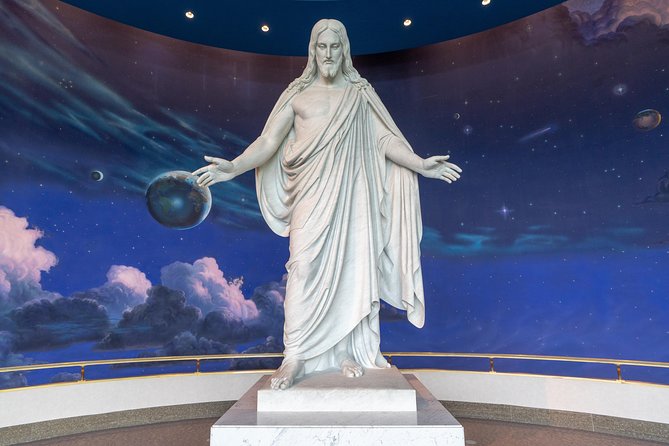
The first major stop is the Salt Lake Temple, the granite centerpiece of the city. You will mainly admire it from the outside, since the interior is reserved for Church members. The brief stop focuses on its long construction, pioneer craftsmanship, six spires, carved details, and Angel Moroni statue.
Temple Square receives more time, about 15 minutes. That is enough for a quick walk through the gardens and a few photographs, but not enough for a leisurely visit to every building. The grounds include the temple, Assembly Hall, Tabernacle, statues, seasonal plantings, and other places tied to the history of the Church of Jesus Christ of Latter-day Saints.
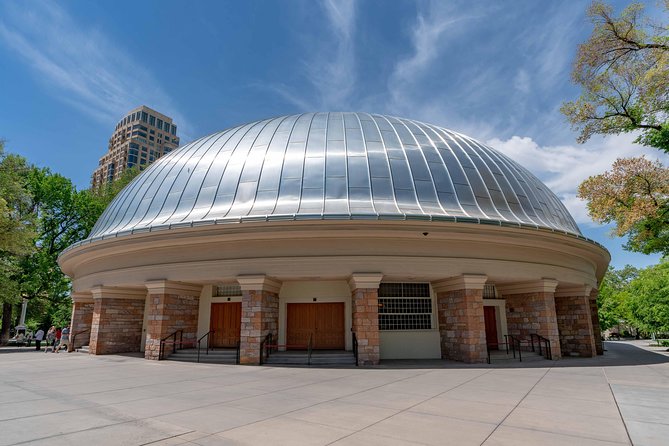
The Tabernacle is the tour’s strongest stop for many people. Its self-supporting dome, built in 1867, was designed for remarkable sound. The building is associated with the famous Tabernacle Organ, which has more than 11,000 pipes according to the tour information.
If a recital is taking place during your visit, you may hear the organ for roughly 15 minutes. That short performance can be the emotional high point of the morning or afternoon. Schedules and events can affect access, though. One recent departure could not stop at Temple Square because of an event, so keep your plans flexible rather than treating the organ recital as an absolute guarantee.
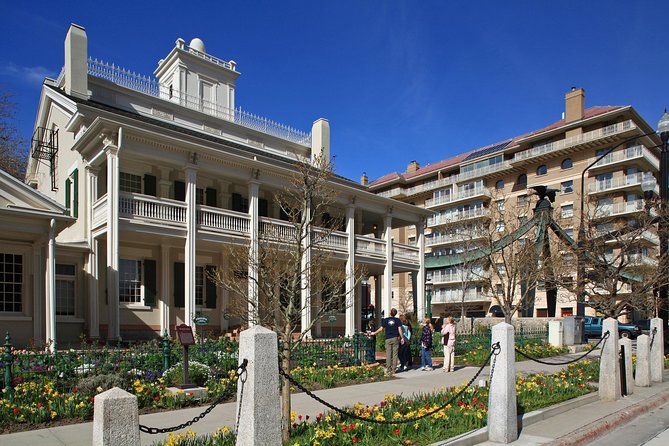
The nearby Assembly Hall, built with leftover granite from the temple, gives you a smaller and more intimate contrast to the Tabernacle. The guide also points out the Beehive House, Brigham Young’s former residence, the Joseph Smith Memorial Building, the FamilySearch Library, the FamilySearch Center, and the Church Office Building.
These downtown buildings explain how the city developed around a religious center. You will see pioneer-era homes, a former luxury hotel, a modern administrative tower, and a major genealogical institution within a few blocks. The result is more interesting than a simple temple visit.
Capitol Hill brings government and grand views
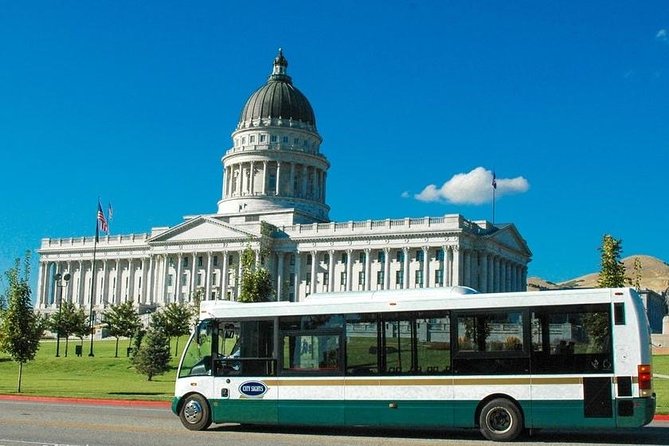
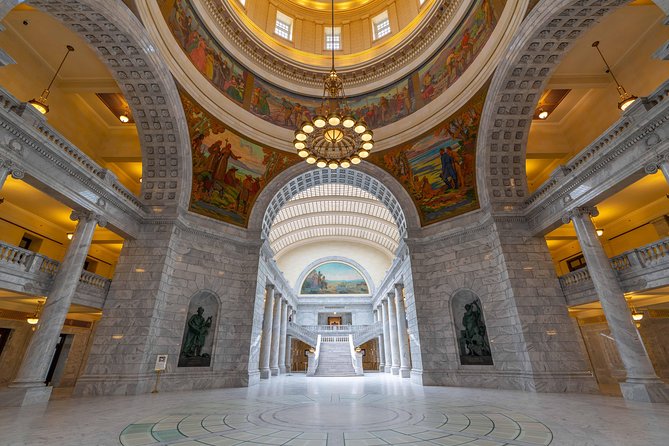
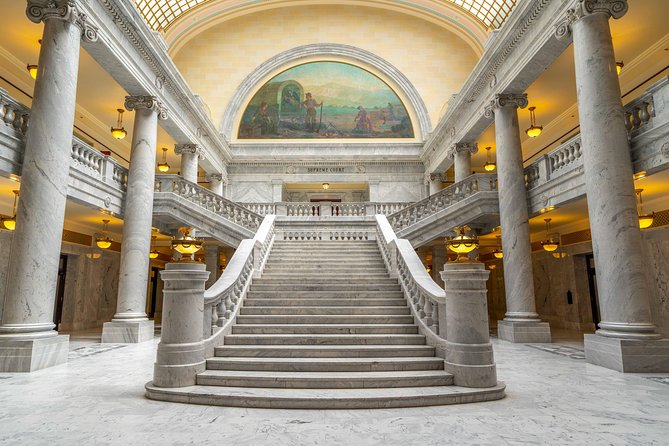
The Utah State Capitol is one of the tour’s longer stops, with about 20 minutes. The Neoclassical building dates from 1916 and has a copper dome, marble columns, murals, and a large rotunda. The grounds offer broad views across Salt Lake Valley toward the Wasatch Mountains.
This is a useful stop for two reasons. First, the building gives you a clear sense of Utah’s path from territory to statehood. Second, the hill provides one of the best photo settings on the route. If you care about architecture or city views, keep your camera ready here.
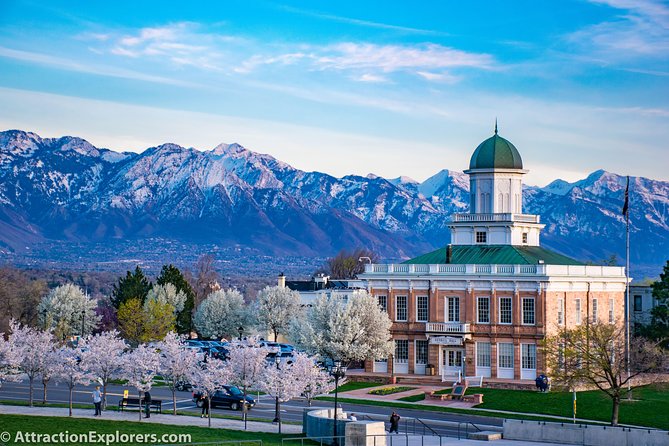
Capitol Hill also brings several smaller points of interest. Council Hall served as Utah’s territorial capitol from 1866 to 1896 and was later moved brick by brick to its present location. The Salt Lake Masonic Temple adds another formal architectural note, while the McCune Mansion recalls the wealth created during Utah’s railroad and mining era.
The City and County Building at Washington Square is another striking sight. Its sandstone Romanesque Revival design includes a clock tower, turrets, arches, and carved details. You may only have a short look, but the guide’s explanation helps connect the building to local government and the preservation of older Salt Lake City.
Eagle Gate and the Brigham Young Monument bring the story back to the early settlement. Eagle Gate once marked the entrance to Brigham Young’s property, while the nearby Meridian Marker identifies the point from which Utah land surveys were measured.
Pioneer history becomes easier to understand outside downtown
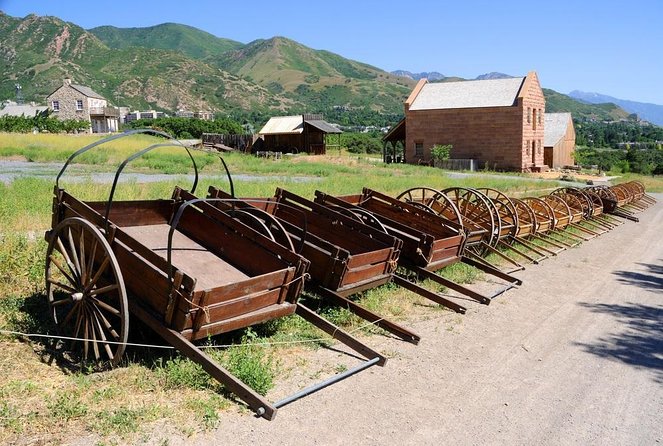
The tour heads toward This Is the Place Heritage Park, where you can look across the valley from the location associated with the arrival of the first Mormon pioneers in 1847. The stop lasts about 15 minutes, giving you time for photographs and a short walk.
The setting helps explain why the valley mattered. You can see the Wasatch Mountains, the Salt Lake Valley, and, depending on conditions, the Great Salt Lake in the distance. The guide places the journey in context, including the long overland route and the hardships faced by families traveling west.
A nearby section of the Mormon Pioneer National Historic Trail adds more background. The trail marks the route used by more than 70,000 Latter-day Saint pioneers between 1846 and 1869. You will not hike a long section during this tour, but the stop gives physical meaning to a story that can otherwise seem abstract.
The Mormon Battalion Monument adds a different side of pioneer history. It honors roughly 500 Latter-day Saint volunteers who marched about 2,000 miles during the Mexican-American War. Their military service, while their families continued west, shows the complicated relationship between the early Church community and the federal government.
The Deuel Pioneer Log Home offers a sharp contrast with the grand temple and Capitol. Built in 1847, the small cabin suggests how basic life was for the valley’s first settlers. I find this kind of stop useful because it keeps the story grounded in ordinary shelter, labor, and survival rather than only monuments and prominent leaders.
A different kind of day out entirely:
- NYC: SUMMIT One Vanderbilt Tickets
★ 4.7 · 51,195 reviews - NYC: 9/11 Memorial & Museum Timed-Entry Ticket
★ 4.8 · 31,428 reviews - NYC: Empire State Building Tickets – Observatory & Museum
★ 4.7 · 25,757 reviews - NYC: Empire State Building Observation Deck Tickets
★ 4.7 · 22,072 reviews
Religious variety and military power appear on the same route
Salt Lake City is strongly associated with the LDS Church, but the tour also shows its wider religious and civic identity. The Cathedral of the Madeleine is a beautiful example. Completed in 1909, it is Utah’s only Catholic cathedral and features Gothic Revival design, twin spires, stonework, and stained glass.
The stop is brief, about five minutes, so expect an exterior visit rather than a long interior tour. Still, its location and appearance make it one of the most rewarding photo stops. It also helps you see that Salt Lake City’s story is not limited to one faith tradition.
Fort Douglas adds a military chapter. Established in 1862, the fort was built during the Civil War era to protect overland mail routes and reinforce federal authority in Utah Territory. The old barracks and parade grounds sit near the University of Utah, overlooking the city.
The Fort Douglas Military Museum and Post Theatre are listed as separate points, but the time is very short. Think of them as viewed landmarks with commentary, not museum visits. The value comes from the guide explaining the tension between the U.S. Army and the early Mormon settlement, as well as the fort’s connection to Utah’s later development.
The 2002 Winter Olympics leave a visible mark
The Olympic portion of the tour includes Olympic Cauldron Park and Rice-Eccles Stadium. You also pass the Delta Center, home of the Utah Jazz, and the Gateway district, which was developed around the 2002 Winter Games.
These stops are mostly brief, often about one minute. You will not tour an arena or spend time inside an Olympic venue. Instead, the guide connects the cauldron, stadium, downtown redevelopment, and sports facilities to Salt Lake City’s Olympic moment.
Rice-Eccles Stadium hosted the opening and closing ceremonies. The Delta Center reflects the city’s professional sports identity, while the Gateway represents a former rail yard transformed into shopping, dining, public art, and open space.
For Olympic fans, this part of the ride adds welcome variety. For others, it breaks up the concentration of pioneer and religious history. The guide’s narration matters because the structures alone do not always tell you why they matter.
Architecture keeps the ride interesting
Several drive-by sights give the tour a broad architectural range. The City Creek Center shows modern downtown development, with outdoor public spaces and a retractable glass roof. The Salt Lake City Public Library, designed by Moshe Safdie and opened in 2003, adds a bold contemporary shape with curved glass and a rooftop garden.
Trolley Square offers a different kind of city story. The former streetcar hub now contains shopping and dining, but its brick barns and ironwork recall the era when electric trolleys connected Salt Lake City neighborhoods.
Abravanel Hall, home of the Utah Symphony, brings the performing arts into the picture. Its modern glass and bronze exterior differs sharply from the State Capitol, Assembly Hall, and Cathedral of the Madeleine.
You also pass the Governor’s Mansion in the Federal Heights area. The early 20th-century residence has served as Utah’s official governor’s home since 1937. Most of these places receive only a quick look, but together they show a city that moved from frontier settlement to state capital and modern regional center.
What the timing feels like on the ground
The published duration is about two hours and 30 minutes, though one account describes a tour closer to two hours and 45 minutes. That small variation is normal for a route affected by traffic, questions, and the timing of the organ recital.
The pace is purposeful. The State Capitol and Temple Square receive the most useful walking time, while many other stops are photo opportunities from outside. You should be ready to step off quickly, listen to the guide, take photographs, and return to the bus.
This is not the right choice if you want to sit inside every historic building or linger in one neighborhood. It is a strong choice if you want to cover ground without driving. Guides such as Grant and Matthew are praised for combining smooth driving with clear narration, while Ann, Todd, Mark, Kevin, Kristin, and others are noted for warmth, humor, and answers to questions.
The vehicle deserves attention. During busier seasons, a larger coach may be used. In winter, departures can operate with a smaller minibus. The smaller vehicle creates a more intimate setting, but a middle seat or seat on the wrong side can make it harder to see buildings while moving. Arrive early and ask about a window seat if that matters to you.
Is $69 a fair price?
At $69 per person, the tour is reasonably priced for a guided city overview that includes transportation, a live guide, several stops, and possible access to the Tabernacle organ recital. The value is strongest when you have only half a day, are visiting without a car, or want help deciding where to return later.
The price is less compelling if you already know Salt Lake City well or plan to spend most of your time inside Temple Square and the Capitol. Many of the 37 listed points are viewed from the vehicle, and some stops last only one minute.
I would think of the fare as paying for three things: the route planning, the local narration, and the time saved. You are buying an efficient first chapter, not a collection of full admissions. Mobile tickets are offered, the tour runs in English, and free cancellation is available up to 24 hours before departure. Service animals are allowed, and most people can participate.
Who should book this Salt Lake City tour?
I would recommend it to first-time visitors, solo travelers, couples, families, and anyone filling a non-ski day. It is also useful if you are staying downtown and want a quick orientation before choosing which museums, neighborhoods, or historic buildings deserve more of your time.
The tour suits you best if you enjoy stories, architecture, pioneer history, and city views. It is less suited to you if you dislike group transportation, need a slow pace, or want extended time at only one attraction.
Book it early if your schedule is tight. The experience is often reserved about 17 days ahead, and winter departures may use the smaller minibus. If Temple Square or the organ recital is a priority, confirm the day’s conditions and be prepared for event-related changes.
Should you book it?
Book this tour if you want an efficient, well-explained introduction to Salt Lake City. The strongest reasons are the broad route, the short walks at major sites, the State Capitol views, the pioneer stops, and the chance to hear the Tabernacle organ.
Skip it if you prefer independent wandering or want deep time inside each building. For most first-time visitors with limited time, though, $69 buys a useful map of the city, delivered with personality and far less hassle than assembling the same route yourself.
FAQ
How long is the Salt Lake City Guided Bus Tour?
The tour lasts approximately two hours and 30 minutes. Some departures may run closer to two hours and 45 minutes depending on traffic, questions, and stop timing.
Where does the tour begin?
The tour begins at the Radisson Hotel Salt Lake City Downtown, located at 215 W S Temple St, Salt Lake City, Utah 84101.
Where does the tour end?
The tour ends back at the same meeting point in downtown Salt Lake City.
What language is the tour offered in?
The tour is offered in English.
Does the tour include Temple Square?
Yes. The route includes Temple Square, the Salt Lake Temple exterior, the Tabernacle, the Assembly Hall, and other nearby sights. Access and stop arrangements can change because of events.
Can I hear an organ recital during the tour?
The itinerary includes time for an organ recital in the Tabernacle, but event schedules or closures can affect whether it takes place during your departure.
How many people can join the tour?
The maximum group size is 29 travelers.
What is the cancellation policy?
You can cancel for a full refund up to 24 hours before the experience begins. Cancellations or changes made within 24 hours are not accepted for a refund.
Just added in the USA
- Atlanta: Zoo Atlanta General Admission Ticket★ 4.5 · 712 reviews
- Zoo Miami: General Admission Ticket★ 4.5 · 868 reviews
- NYC: Woodbury Common Premium Outlets Shopping Trip★ 4.2 · 761 reviews
- Wynwood Art District 1-Hour Street Art Tour by Golf Cart★ 4.9 · 492 reviews
- Willow Beach: Black Canyon Kayak Half Day Tour-No Shuttle★ 4.9 · 323 reviews
- From San Francisco: Napa & Sonoma Valley Full-Day Wine Tour★ 4.5 · 513 reviews
- Newport Beach: 2-Hour Whale Watching Tour★ 4.2 · 1,375 reviews
- New York City: Private Walking Tour with a Local★ 4.6 · 771 reviews
City Tours, compared.

Boston Duck Boat Sightseeing City Tour with Cruise Along Charles River
Read our review →

New Orleans City Sightseeing Hop-On Hop-Off Bus Tour
Read our review →
Pearl Harbor, USS Arizona Memorial & Honolulu City Tour
Read our review →Browse the lists this tour appears in