
Reviewed · CITY TOURS
Tabernacle Choir Performance + Salt Lake City Guided Bus Tour
Music can make a city memorable. This half-day experience pairs the Tabernacle Choir with a guided bus circuit of Salt Lake City, giving you two things I especially like: a moving performance in a remarkable hall and a quick, useful introduction to Utah’s pioneer, religious, civic, and Olympic story. The air-conditioned vehicle and small group of up to 30 people also make covering a spread-out city easy.
I also like the personal touch of guides such as Matthew, Mark, and Todd, plus the occasional former choir member who answers questions on the bus. The main drawback is pace: with dozens of landmarks on the route, many stops last only a minute, and some people feel hurried, especially at the Capitol or Temple Square.
For $89, this is best viewed as a first-day orientation, not a deep visit to every attraction. You see far more than you could comfortably cover without a car, then hear one of America’s most famous choirs in its home city.
In This Review
- Key points to know before booking
- How the 3.5-hour outing works
- Hearing 360 voices in the Tabernacle
- The Tabernacle and Conference Center
- Temple Square, the city’s essential first stop
- Utah’s Capitol Hill and the best city views
- Pioneer roads, monuments, and the first view of the valley
- Churches, civic buildings, and a broader view of Salt Lake City
- What the short stops really mean
- Is $89 a fair price?
- Who will enjoy this tour most?
- Should you book the Tabernacle Choir and Salt Lake City tour?
- FAQ
- How long does the tour last?
- Where does the tour begin and end?
- Is the Tabernacle Choir performance on Sunday or Thursday?
- Where does the choir perform?
- Can children under age eight attend the Sunday concert?
- Is the Salt Lake Temple open to tour inside?
Key points to know before booking
- Sunday brings the full broadcast performance: You attend Music and the Spoken Word, a live program broadcast continuously since 1929.
- Thursday offers rehearsal access: The one-hour rehearsal lets you watch the conductor work with the ensemble and hear several pieces.
- The State Capitol is the most substantial sightseeing stop: You have about 20 minutes there, with time for architecture, Utah history, and views over the valley.
- Temple Square is the emotional center of the tour: You see the Tabernacle, Salt Lake Temple exterior, Assembly Hall, Beehive House, and other landmarks.
- Most landmarks are viewed briefly from the bus: This is a broad survey, with only a few chances to get out and explore.
- It suits car-free visitors particularly well: The route reaches downtown, Capitol Hill, the University of Utah area, historic neighborhoods, and Olympic sites.
How the 3.5-hour outing works
The tour begins and ends at the Radisson Hotel Salt Lake City Downtown, at 215 West South Temple Street. It is offered in English, uses a mobile ticket, and runs for about three and a half hours.
The exact order depends on the day. Sunday focuses on the choir’s full performance, while Thursday centers on the weekly rehearsal. Recent experiences have included the Sunday program first, followed by the bus circuit, while Thursday departures may finish with the rehearsal. Check the departure details for your date so you know when the music portion occurs.
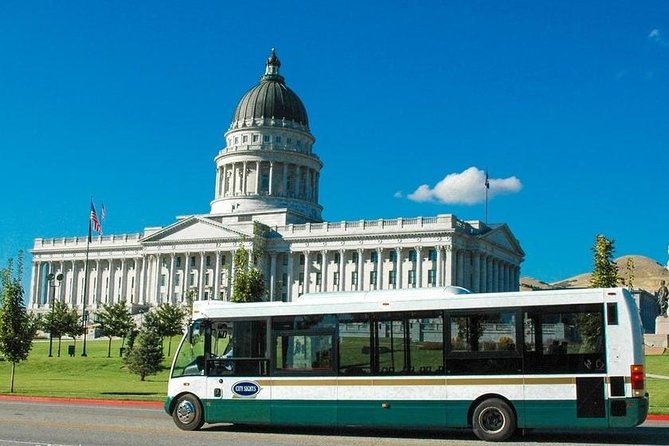
The bus matters here. Salt Lake City’s main sights are not all clustered around Temple Square. The route covers an estimated 18 miles and climbs toward Capitol Hill and the University of Utah, so you get a wider picture than a downtown walk would provide.
The group is limited to 30 people, which is small enough for guide interaction without feeling like a private tour. The vehicle is air-conditioned, a welcome feature in hot weather and useful after a morning spent moving between stops.
A few more options to weigh up in the USA
- New York City: Statue of Liberty & Ellis Island with Ferry
★ 4.6 · 18,683 reviews - New York City: American Museum of Natural History Ticket
★ 4.5 · 15,447 reviews - New York City: Top of the Rock Observation Deck Ticket
★ 4.6 · 14,488 reviews
Hearing 360 voices in the Tabernacle
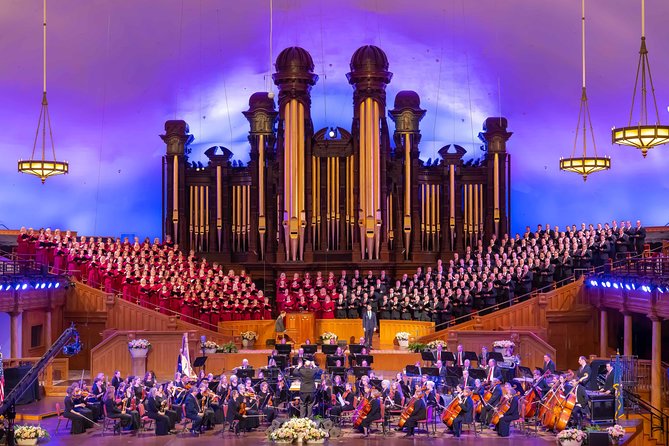
The choir is the reason to book this experience. Its 360 volunteer singers have performed for six U.S. presidents and earned Grammy and Emmy recognition. You do not need a special interest in church music to appreciate the scale of the sound. The combination of voices, organ, and, on some performances, orchestra can fill the room with startling force.
On Sunday, you attend Music and the Spoken Word, the world’s longest-running continuous network broadcast, airing since 1929. The program lasts about 30 minutes. It is more formal than a standard concert, with spoken material as well as music, but that format is part of the tradition.
On Thursday, you attend the choir’s weekly rehearsal for about an hour. This can feel more intimate and less polished in the best sense. You watch the conductor work through the music, hear more than one performance, and get a behind-the-scenes look at how the ensemble prepares.
A useful detail from the feedback is the presence of a former choir member on some departures. Bob and another former singer have shared personal insight about the choir’s work, adding context that a standard sightseeing guide could not provide. This is one of the tour’s most distinctive touches, though it may depend on the guide and schedule.
The Tabernacle and Conference Center
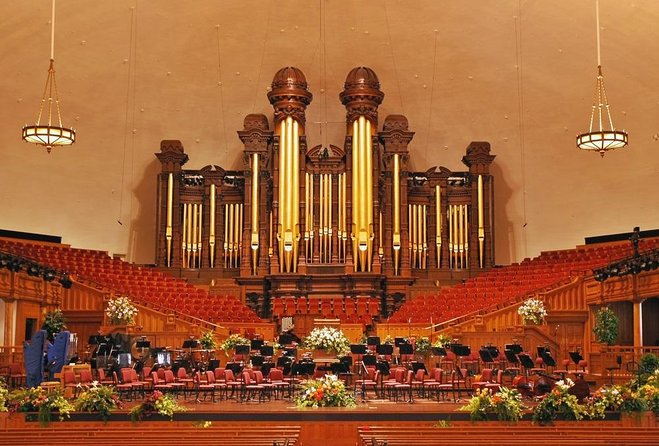
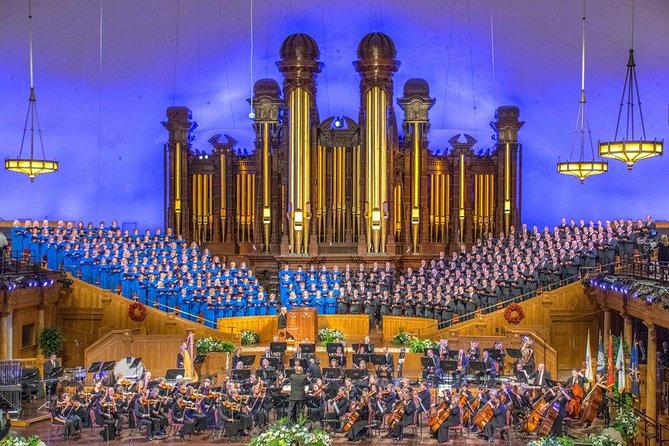
The performance venue changes by season. In fall, winter, and spring, the choir performs in the historic Salt Lake Tabernacle at Temple Square. Built in 1867 by Mormon pioneers, the building has a self-supporting dome about 150 feet wide and no interior pillars blocking the view.
Its famous acoustics are not just marketing decoration. The room was designed so that sound carries across the space with unusual clarity. The 11,632-pipe organ is an attraction in its own right, with an imposing facade and a sound that gives the choir’s music added weight.
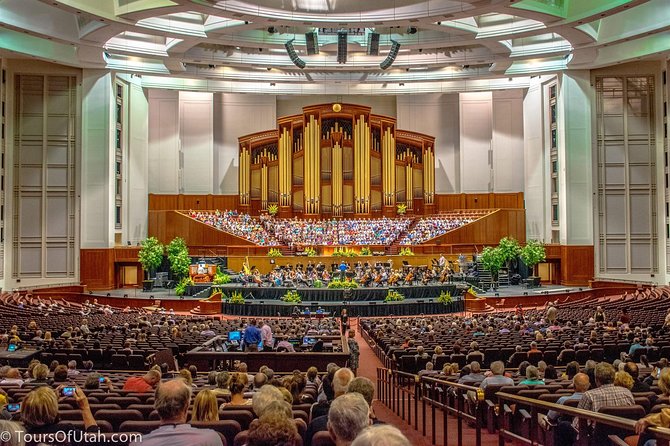
In summer, performances move to the LDS Conference Center. This modern auditorium seats 21,000 people and has a 7,667-pipe organ. Its rooftop garden, waterfalls, native plantings, bronze doors, and large-scale design offer a sharp contrast to the pioneer-era Tabernacle.
The short five-minute Tabernacle stop is not a separate concert. It is a quick look at the building and an explanation of its construction and acoustics. The concert or rehearsal is the real time commitment.
Temple Square, the city’s essential first stop
Temple Square is the spiritual and historical center of Salt Lake City. The core grounds cover about 10 landscaped acres, within a larger complex commonly described as 35 acres. Expect gardens, monuments, historic buildings, and views of the Salt Lake Temple’s granite towers.
You see the Salt Lake Temple from outside. The interior is reserved for Church members, so do not expect an indoor temple visit. The guide explains its 40-year construction period, the six spires, the Angel Moroni statue, and the hand-cut granite work that made the building the city’s defining symbol.
The Assembly Hall offers a gentler architectural counterpoint. Built in 1882 from leftover granite from the temple, it has a Gothic appearance, delicate spires, and stained glass. The Beehive House, once Brigham Young’s residence, recalls the political and social life of early territorial Utah. Its name comes from the beehive symbol on the roof, associated with industry and cooperation.
You may also see the Joseph Smith Memorial Building, once the Hotel Utah. The Beaux-Arts building opened in 1911 as Salt Lake City’s first luxury hotel and later became a Church memorial building. The FamilySearch Library and FamilySearch Center point to Utah’s worldwide role in genealogy and family records.
Temple Square is where the tour feels most cohesive. The architecture, faith, pioneer story, gardens, and music all connect. The limitation is time. A 10-minute Temple Square stop gives you an introduction and photos, not a full exploration.
A different kind of day out entirely:
- NYC: SUMMIT One Vanderbilt Tickets
★ 4.7 · 51,195 reviews - NYC: 9/11 Memorial & Museum Timed-Entry Ticket
★ 4.8 · 31,428 reviews - NYC: Empire State Building Tickets – Observatory & Museum
★ 4.7 · 25,757 reviews - NYC: Empire State Building Observation Deck Tickets
★ 4.7 · 22,072 reviews
Utah’s Capitol Hill and the best city views
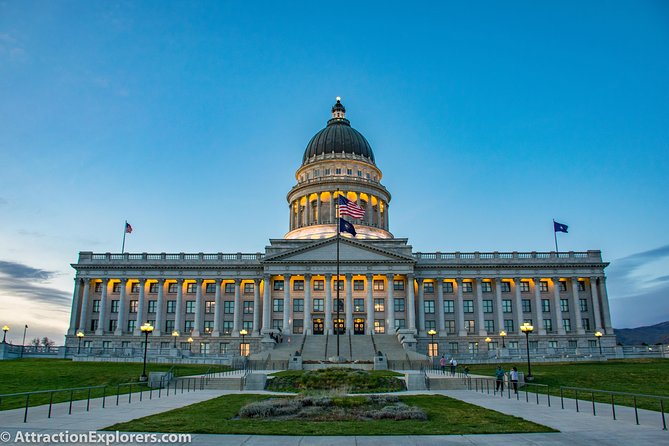
The Utah State Capitol is the tour’s longest stop, at roughly 20 minutes. Completed in 1916, the Neoclassical building rises above the city with a copper dome and sweeping views toward the Wasatch Mountains and Salt Lake Valley.
If the building is open for your visit, you may enter the rotunda and see its marble columns, murals, decorative details, and large chandelier. The Capitol is one of the few locations where the tour can feel like a proper visit rather than a quick photo pause. Still, 20 minutes is tight, and one person specifically found the Capitol visit rushed.
Capitol Hill also brings several brief sights: Council Hall, the former territorial capitol; the McCune Mansion, built in 1901 for railroad magnate Alfred McCune; the Salt Lake Masonic Temple; and the Governor’s Mansion. These stops are mainly exterior views from the bus or short pauses.
Council Hall has an especially unusual story. It served as Utah’s territorial capitol from 1866 to 1896 and was moved brick by brick in 1963 to save it from demolition. The McCune Mansion, with its red sandstone, imported marble, woodwork, and stained glass, gives you a glimpse of Utah’s wealthier turn-of-the-century era.
The Capitol section works best if you enjoy hearing the story while taking in the view. If you want to study the building’s murals or wander its grounds, plan a separate visit.
Pioneer roads, monuments, and the first view of the valley
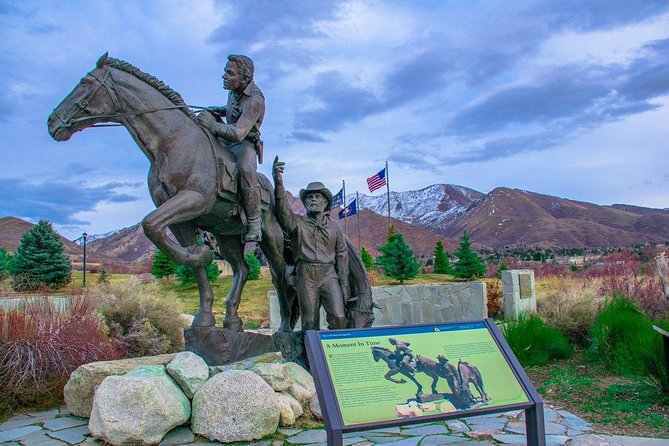
The tour explains the Mormon Pioneer National Historic Trail, the 1,300-mile route used by more than 70,000 Latter-day Saint pioneers between 1846 and 1869. The story includes handcarts, wagons, difficult weather, scarce supplies, and the search for religious freedom.
At This is the Place Heritage Park, you see the location where Brigham Young declared the valley was the right place in 1847. The site includes a 60-foot monument and broad views of the Salt Lake Valley, the Wasatch Mountains, and, in the distance, the Great Salt Lake.
The park itself includes living-history features such as train rides, a petting zoo, a Native American village, and a Mormon monument. The bus tour does not give you enough time to experience all of those attractions. Think of this as a scenic and historical stop, not a full park visit.
The Mormon Battalion Monument adds another layer to the pioneer story. It honors 500 Latter-day Saint volunteers who marched about 2,000 miles from Iowa to San Diego during the Mexican-American War. Their service and pay helped support the settlement of Salt Lake Valley, while their families continued west.
That story is useful because it complicates the usual pioneer narrative. Early Utah was not separate from the wider United States, even during periods of political tension. The guide connects military service, federal authority, migration, and settlement in a way that makes the city’s origins easier to understand.
Churches, civic buildings, and a broader view of Salt Lake City
Salt Lake City is more than Temple Square. The route passes the Cathedral of the Madeleine, Utah’s only Catholic cathedral, completed in 1909. Its Gothic Revival exterior, twin spires, stonework, and stained glass show the city’s religious variety and provide a strong contrast to nearby Latter-day Saint landmarks.
The City and County Building on Washington Square is another architectural highlight. Completed in 1894, it has Romanesque Revival details, sandstone walls, carved decoration, and a 256-foot clock tower. The building nearly faced demolition before preservation efforts saved it.
You also pass City Creek Center, a modern downtown shopping and dining district with a retractable glass roof, gardens, fountains, and a creek running through the property. It shows how the center of Salt Lake City has changed from pioneer settlement to modern regional city.
At the University of Utah area, the bus passes Fort Douglas, Rice-Eccles Stadium, Kingsbury Hall, and the Utah Museum area. Fort Douglas dates to 1862, when the U.S. Army established a presence overlooking the growing settlement. Rice-Eccles Stadium hosted the opening and closing ceremonies of the 2002 Winter Olympic Games, while Kingsbury Hall represents the university’s performing arts tradition.
The Olympic Cauldron at Olympic Cauldron Park recalls the 2002 Games, which brought athletes from 77 nations to Utah. The Delta Center, home of the Utah Jazz, adds the city’s professional sports story. These are quick exterior views, but together they show a Salt Lake City that is not frozen in pioneer history.
What the short stops really mean
The itinerary includes many named sights, but the timing tells you how to interpret them. Stops lasting one minute are generally photo opportunities or guided views from the bus. The Cathedral of the Madeleine, City Creek Center, Beehive House, Eagle Gate, the Joseph Smith Memorial Building, Abravanel Hall, and the FamilySearch buildings are not full indoor tours.
That is not necessarily a flaw. You can cover a lot of ground without parking, navigating, or checking opening hours. The tradeoff is that the guide must keep moving, and you may leave wanting more time at several places.
One piece of advice is simple: bring water and a fully charged camera. You will have repeated chances for mountain views, architecture, monuments, and city scenes, but not much spare time to search for supplies.
Is $89 a fair price?
At $89 per person, the value depends on how you use the tour. The Tabernacle Choir performance is the centerpiece, and the bus tour adds transportation, commentary, and access to a long list of sights in a single half-day.
If you have a car and several free days, you could visit many of these locations independently. You would also have more time at each one. But independent sightseeing requires planning, parking, route choices, and timing around the choir schedule.
For a first visit, a solo arrival, or a stay without a car, the price is easier to justify. You get an air-conditioned ride, a professional English-speaking guide, a maximum group size of 30, and the choir experience. The tour also ends in time for lunch, according to the stated schedule and recent experiences.
The value drops if you expect admission to every site or a leisurely walking tour. Most attractions are viewed from outside, and gratuities are not included, though they are optional and appreciated.
Who will enjoy this tour most?
I would recommend it to you if you want a broad introduction to Salt Lake City and a major musical experience in the same morning or afternoon. It is especially useful for:
- First-time visitors who want city context before exploring alone
- People staying downtown without a car
- Families who prefer sitting on a bus to arranging several separate visits
- Solo visitors who want a structured half-day
- Anyone interested in Utah pioneer history, architecture, religion, or the 2002 Olympics
- Music lovers who want either a formal Sunday program or Thursday rehearsal
You may want something else if you dislike fixed schedules, brief photo stops, or religious history as a major part of a city tour. If your main goal is only the choir, you may prefer to attend the public performance or rehearsal on its own and spend the rest of your day at fewer sites.
The Sunday seating rule also matters for families. Children under age eight are seated in a separate location during Sunday concerts because of sensitive acoustics and recording equipment. Confirm that arrangement before booking if you are traveling with young children.
Free cancellation is available when you cancel at least 24 hours before the start time. Cancellations or changes made inside that window are not refunded or accepted.
Should you book the Tabernacle Choir and Salt Lake City tour?
Book it if you want the city’s greatest hits with a memorable musical finale. The choir is the surest reason to go, and the bus circuit makes a practical first look at a city spread across downtown, Capitol Hill, the foothills, and the University of Utah area.
Choose Thursday for a longer rehearsal and a more behind-the-scenes feel. Choose Sunday for the full broadcast program. If you book, accept the bargain clearly: many sights, limited time, strong narration, and one extraordinary performance.
I would not use this as your only Salt Lake City sightseeing. Use it to get your bearings, note the places you want to revisit, and then return to Temple Square or the Capitol at your own pace. For $89, it is a strong introduction, provided you value breadth and music more than leisurely museum-style visits.
FAQ
How long does the tour last?
The experience lasts approximately 3 hours and 30 minutes.
Where does the tour begin and end?
It begins and ends at the Radisson Hotel Salt Lake City Downtown, 215 West South Temple Street.
Is the Tabernacle Choir performance on Sunday or Thursday?
Sunday includes the live broadcast of Music and the Spoken Word, lasting about 30 minutes. Thursday includes a weekly choir rehearsal lasting about one hour.
Where does the choir perform?
In fall, winter, and spring, the performance takes place in the historic Salt Lake Tabernacle. Summer performances move to the LDS Conference Center.
Can children under age eight attend the Sunday concert?
Yes, but children under eight are seated in a separate location because of sensitive acoustics and sound recording equipment.
Is the Salt Lake Temple open to tour inside?
No. The temple interior is reserved for Church members. The tour explains the exterior architecture, construction, and cultural importance.
Just added in the USA
- Atlanta: Zoo Atlanta General Admission Ticket★ 4.5 · 712 reviews
- NYC: Woodbury Common Premium Outlets Shopping Trip★ 4.2 · 761 reviews
- Wynwood Art District 1-Hour Street Art Tour by Golf Cart★ 4.9 · 492 reviews
- Zoo Miami: General Admission Ticket★ 4.5 · 868 reviews
- Willow Beach: Black Canyon Kayak Half Day Tour-No Shuttle★ 4.9 · 323 reviews
- From San Francisco: Napa & Sonoma Valley Full-Day Wine Tour★ 4.5 · 513 reviews
- Newport Beach: 2-Hour Whale Watching Tour★ 4.2 · 1,375 reviews
- New York City: Private Walking Tour with a Local★ 4.6 · 771 reviews
City Tours, compared.

Boston Duck Boat Sightseeing City Tour with Cruise Along Charles River
Read our review →

New Orleans City Sightseeing Hop-On Hop-Off Bus Tour
Read our review →
Pearl Harbor, USS Arizona Memorial & Honolulu City Tour
Read our review →Browse the lists this tour appears in