
Reviewed · WALKING TOURS
ORIGINAL Old Louisville Walking Tour seen in The New York Times!
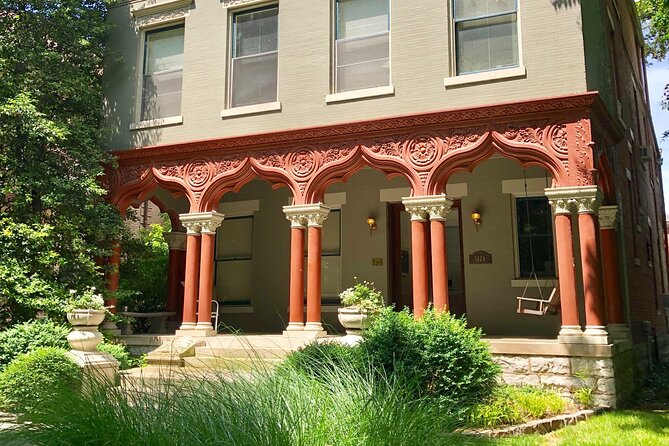
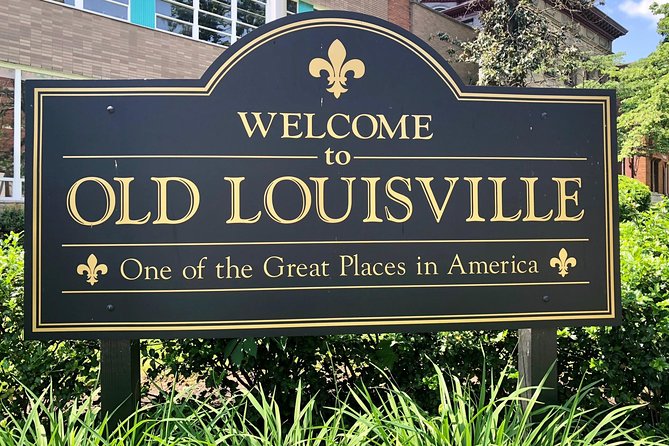
Old mansions have good stories. This walking tour turns Louisville’s grandest neighborhood into an open-air history book, with Victorian homes, local legends, and tales of the wealthy families who once shaped the city. You’ll walk through St. James Court, Ormsby Avenue, Floral Terrace, Millionaires Row, and Central Park with a certified guide who adds the human details you would likely miss on your own.
I like the small maximum of 20 people, which makes it easier to hear the guide and ask questions. I also like the mix of architecture and storytelling, from the ornate Conrad-Caldwell House to the wonderfully odd Witches’ Tree. The main drawback is simple: this is a real walking tour, lasting about 90 minutes to two hours, with no building interiors and no bathroom break during the walk.
The tour costs $25 per person, with a suggested $5 gratuity. That is fair value if you want context rather than a quick drive past old houses. Guides such as David, Gabe, Angelique, Brenda, Frances, and Gage have been praised for keeping a clear pace and bringing the neighborhood’s people and buildings to life.
In This Review
- Key Things to Know Before You Go
- Why Old Louisville Deserves a Guided Walk
- Meeting at Ormsby Avenue and Fourth Street
- Grand Houses and the Stories Behind Them
- The Witches’ Tree and Louisville Folklore
- Conrad-Caldwell House, Also Called Conrad’s Castle
- Bernheim Mansion and the Old Millionaires Row
- The Filson Historical Society’s Beaux Arts Mansion
- Central Park, Olmsted’s Green Center
- What the Guides Do Best
- Price, Group Size, and Physical Demands
- Who Should Book This Old Louisville Walk
- Final Verdict: Book It If You Want Context
- FAQ
- How long does the Old Louisville walking tour last?
- Where does the tour begin and end?
- Does the tour enter the historic homes?
- Can I visit the Conrad-Caldwell House Museum separately?
- How much does the tour cost?
- Is the tour suitable for people with mobility issues?
- What happens if bad weather cancels the tour?
Key Things to Know Before You Go

- Old Louisville covers 40 square blocks: You’ll see a substantial historic district, not just a single street of mansions.
- The Witches’ Tree adds a strange local legend: The twisted trunk is tied to a story about witches, a tornado, and offerings left by visitors.
- The tour stays outdoors: You look at private homes from the sidewalk and stop outside the Conrad-Caldwell House Museum.
- Millionaires Row is packed with architectural detail: The Bernheim Mansion and Filson Historical Society provide two especially handsome stops.
- Central Park was designed by Frederick Law Olmsted: Its shaded paths and native trees offer a quieter change of pace.
- You need good walking stamina: You must be able to walk for about 90 minutes without a bathroom break.
Why Old Louisville Deserves a Guided Walk
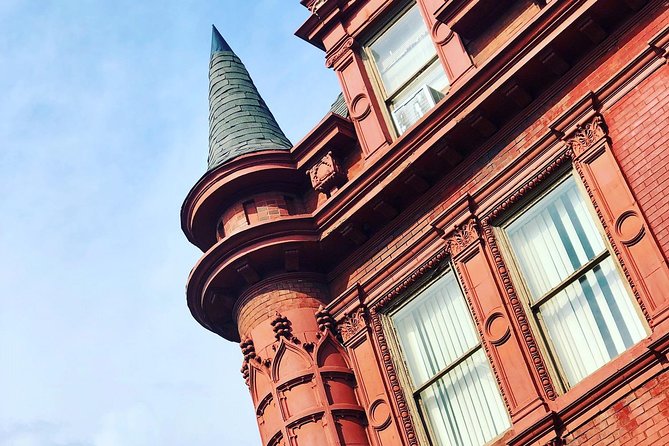
Old Louisville contains more than 1,000 structures across roughly 40 square blocks. That scale matters. You are not looking at one preserved block surrounded by modern buildings. You are moving through a large neighborhood where grand homes, private residences, green spaces, and the ordinary life of a city all share the same streets.
The area is also a transitional neighborhood. It sits near downtown and includes the realities found in a larger American city. At the north edge along Fourth Street, you may encounter panhandlers, people without housing, and others who look different from you. The tour information is refreshingly direct about this, and you should arrive prepared rather than surprised.
That mix is part of the setting. Old Louisville is not a museum sealed away from daily life. You see beautiful architecture, but you also see a living neighborhood with changing fortunes. A guide helps connect those two sides without reducing the district to a postcard.
The best reason to book is the storytelling. You can walk these streets alone and admire the columns, turrets, stained glass, and elaborate stonework. But you will not automatically know who commissioned a house, how the neighborhood changed, or why one strange tree has become a local landmark.
Several people who took the tour more than once found new material in it. One local even returned for a second historical walk. That says something about the amount of information packed into a relatively small area.
More Walking Tours in the USA:
- History and Hauntings of Salem Guided Walking Tour
★ 5.0 · 14,564 reviews - New Orleans Premier Ghost, Voodoo and Vampire Walking Tour
★ 4.5 · 12,856 reviews - Little Havana Food and Walking Tour in Miami
★ 5.0 · 8,882 reviews
Meeting at Ormsby Avenue and Fourth Street
The tour begins at West Ormsby Avenue and South Fourth Street, a central location in Old Louisville. It also ends at the same meeting point, which makes planning easier if you have dinner, a museum visit, or another activity afterward.
The starting area is worth treating with normal city awareness. Keep your belongings secure, stay aware of your surroundings, and do not expect a manicured attraction entrance. The neighborhood’s character changes from block to block.
The tour is offered in English and uses a mobile ticket. Confirmation arrives when you book. Public transportation is nearby, but the supplied information does not specify a particular route or stop, so check your transit app before setting out.
Wear comfortable shoes and plan for weather. The experience requires good weather, and the walk can be canceled if conditions are poor. In that case, you’ll be offered another date or a full refund.
Grand Houses and the Stories Behind Them
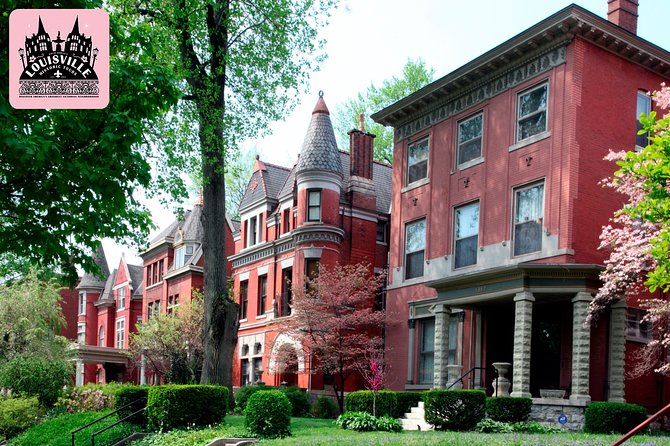
The first and longest part of the experience takes place throughout Old Louisville. Expect about an hour and a half of walking, with stops to look at houses, streets, gardens, and architectural features.
This is where the guides earn the $25 price. The buildings are impressive, but the tour becomes useful when someone explains the original owners and builders. You get a better sense of how wealthy Louisville families expressed status through architecture, landscaping, and grand entrances.
The route includes St. James Court, Ormsby Avenue, Floral Terrace, and Millionaires Row. Each name suggests a different corner of the district, but the larger point is variety. You are not seeing one repeated house style. Old Louisville includes Victorian architecture in many forms, along with Richardsonian Romanesque and Beaux Arts examples.
The pace appears to be moderate rather than rushed. Gabe was praised for speaking clearly and keeping the walk moving at a comfortable speed. Another guide, Brenda, used a microphone, a small but valuable touch when a group is spread along the sidewalk or street noise rises.
You may hear different guides on different dates. David receives especially strong praise for combining humor, local experience, and detailed knowledge of the neighborhood. Angelique has been noted for discussing not only buildings and prominent residents, but also trees, flowers, cats, and the small details that make a place feel lived in.
That variety can be a plus. The route gives you a framework, while the guide’s style shapes the experience. Some guides focus on architecture, others on people and local stories, but the central subject remains the same: how Old Louisville developed and how it continues to change.
The Witches’ Tree and Louisville Folklore
The Witches’ Tree takes only about five minutes, but it may be the most memorable stop for visitors who enjoy local folklore.
A gnarled tree grew where an earlier tree had been cherished by local witches. When the city cut down the original, the story goes, the witches sent a tornado to punish Louisville. People now leave offerings on the twisted trunk to settle the matter.
You do not need to believe the tale to enjoy it. Folklore gives a neighborhood personality, especially when placed beside a discussion of grand houses and civic history. The tree also breaks up the architecture-heavy portion of the route with something stranger and more playful.
This is a good example of what a guide adds. On your own, you might notice an unusual tree. With the story, it becomes part of the city’s shared imagination.
A different kind of day out entirely:
- NYC: SUMMIT One Vanderbilt Tickets
★ 4.7 · 51,195 reviews - NYC: 9/11 Memorial & Museum Timed-Entry Ticket
★ 4.8 · 31,428 reviews - NYC: Empire State Building Tickets – Observatory & Museum
★ 4.7 · 25,757 reviews - NYC: Empire State Building Observation Deck Tickets
★ 4.7 · 22,072 reviews
Conrad-Caldwell House, Also Called Conrad’s Castle
The Conrad-Caldwell House Museum is one of the tour’s key visual stops. You do not enter during this walking experience, but you pause outside and hear about the mansion.
The home is often called Conrad’s Castle, a fitting nickname for a building with a strong presence. The exterior gives you a chance to study the stonework and decorative details at street level, while the guide explains its place in Old Louisville’s past.
If you want to see the inside, you can arrange a separate visit with the Conrad-Caldwell House Museum for an additional fee. This is important when planning your day. The walking tour gives you the neighborhood context and an exterior look, but it is not a mansion tour.
That limitation is reasonable because most Old Louisville homes are private residences. Still, architecture fans should know that the tour does not open doors or take you through furnished interiors. Think of it as a street-level introduction, not a house museum circuit.
Bernheim Mansion and the Old Millionaires Row
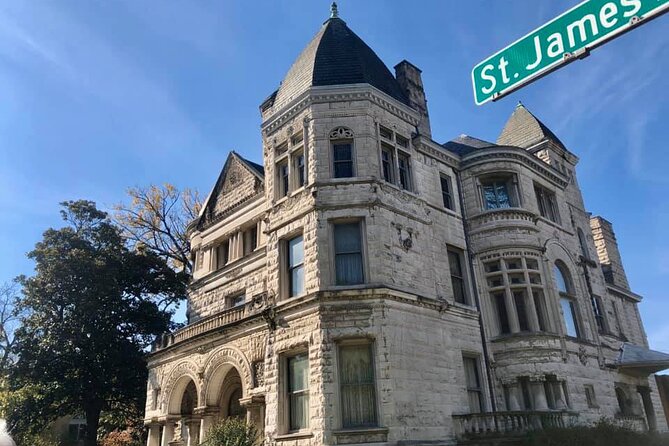
The Bernheim Mansion sits in the heart of what was once Millionaires Row. Its green men, arranged around a triple Roman-arched porch, are the sort of detail you could easily miss without someone pointing them out.
The mansion is a strong example of Richardsonian Romanesque architecture. Look for the heavy forms, rounded arches, and carved ornament that give the house a more solid, medieval feeling than the lighter decorative styles often associated with Victorian buildings.
The stop lasts only a couple of minutes, but the short pause is enough to understand the basic features. The Bernheim Mansion now operates as a bed and breakfast, and the tour does not include admission inside.
This is a recurring pattern throughout Old Louisville. You get a quick, focused explanation, then continue down the street before the walk becomes too static. If you want long periods to photograph each building, you may need to return later on your own.
The Filson Historical Society’s Beaux Arts Mansion
The Filson Historical Society occupies the Ferguson Mansion, built in 1905. At one time, it was considered the grandest home in Louisville.
Its Beaux Arts design gives the tour another architectural style to compare with the Conrad-Caldwell and Bernheim residences. Beaux Arts buildings often favor formal balance and elaborate decoration, and this mansion helps show how Louisville’s wealthy residents used architecture to make a public statement.
The stop lasts about five minutes. You can arrange a separate visit to the historical society, but entry is not part of the walking tour. If you are interested in Louisville’s past beyond the houses, that extra visit may be worth adding, though you should plan it separately.
The guide’s explanation is the main value here. A mansion alone can be beautiful, but knowing who built it and how it was viewed in its own time gives the facade more meaning.
Central Park, Olmsted’s Green Center
Central Park offers a welcome change from rows of stone, brick, and ornament. Frederick Law Olmsted designed this 14-acre park, the same landscape designer associated with New York City’s famous Central Park.
Here you’ll find native tree species and shaded walkways spread across four city blocks. It functions as Old Louisville’s green center and gives the tour a little breathing room after the mansion-lined streets.
Central Park is also home to Shakespeare in the Park each summer. The event has taken place since 1961 and is described as the nation’s oldest free outdoor Shakespeare program. Even if your visit does not coincide with a performance, that detail shows how the park remains part of neighborhood life rather than serving only as historic scenery.
The stop lasts about five minutes. You will not have time for a long park visit during the tour, so consider returning later if you want to walk the paths or spend time under the trees.
What the Guides Do Best
The strongest part of this experience is the guide’s ability to connect facts with stories. The most praised guides are not simply reciting dates. They explain the people behind the houses, answer questions, and use humor to keep a long outdoor talk from feeling like a lecture.
David is repeatedly praised for his energy and command of Old Louisville. Gabe is noted for clear speech and an easy pace. Angelique brings broad curiosity to the route, while Brenda’s microphone helps with hearing every word. Frances has been appreciated for her warmth and for making a multigenerational family group feel included.
One guide has lived in the neighborhood, which adds a personal connection to the material. Another visitor bought the guide’s book after the walk and looked forward to a related documentary. Those details suggest that the company offers more than a generic downtown script.
Of course, guide quality can vary by personality and date. The common thread is strong preparation, a friendly manner, and an ability to keep the group engaged. If you ask questions, you should have a better experience than if you simply follow at the back and listen passively.
Price, Group Size, and Physical Demands
At $25 per person, the tour is reasonably priced for a certified guide and nearly two hours of focused sightseeing. The extra $5 gratuity brings the typical cost to $30 per person, before any separate admission to the Conrad-Caldwell House or Filson Historical Society.
I consider that good value if Old Louisville is new to you. You could walk the streets for free, but the guide supplies the names, stories, and architectural comparisons that turn a pleasant stroll into a useful introduction.
The group maximum is 20 people. That is large enough to create some energy but small enough for a guide to answer questions. Stay near the guide, especially when crossing streets or pausing outside a large house.
The physical demands deserve clear attention. You need to walk for at least 90 minutes without a bathroom break, and the experience is not recommended for people with mobility issues. Service animals are allowed. Since the walk remains outdoors, hot, cold, wet, or otherwise poor weather can affect the experience.
Who Should Book This Old Louisville Walk
I would recommend this tour to first-time Louisville visitors who want to understand a neighborhood before exploring it alone. It also suits people who enjoy architecture, local legends, urban history, and stories about the families behind impressive homes.
It works well for couples, friends, solo visitors, and families with older children or adults who can manage the walking time. The multigenerational group described the experience as a good way to learn about the city together, and the guides appear comfortable handling questions from different ages.
Locals may also find value here. A local took the tour twice and still found new information, especially about architecture and the neighborhood’s past.
I would choose another activity if you want indoor access, a short stroll, or a tour focused only on famous landmarks. You should also reconsider if you need frequent restroom stops or have difficulty walking for 90 minutes.
Final Verdict: Book It If You Want Context
Book this Old Louisville walking tour if you want more than attractive facades. The houses are the draw, but the guide’s stories about former owners, builders, neighborhood characters, trees, legends, and changing city life give the walk its purpose.
At $25, it is a sensible first activity in Louisville. You’ll learn where to return for the Conrad-Caldwell interior, the Filson Historical Society, Central Park, or a slower look at the residential streets.
Skip it only if the walking requirement is a problem or if you strongly prefer indoor attractions. For everyone else, this is a friendly, well-paced introduction to one of Louisville’s most distinctive neighborhoods, with just enough eccentric folklore to keep the mansions from becoming a blur of porches and columns.
FAQ
How long does the Old Louisville walking tour last?
The tour lasts approximately one hour and 40 minutes to two hours. The main Old Louisville portion takes about 90 minutes, with several shorter stops along the way.
Where does the tour begin and end?
It begins at West Ormsby Avenue and South Fourth Street in Louisville, Kentucky. The tour ends back at the same meeting point.
Does the tour enter the historic homes?
No. The walk views the homes from outside because most are private residences. You stop in front of the Conrad-Caldwell House Museum, but interior admission is not included.
Can I visit the Conrad-Caldwell House Museum separately?
Yes. You can arrange a separate mansion visit with the Conrad-Caldwell House Museum for an additional fee.
How much does the tour cost?
The listed price is $25 per person. A $5 gratuity per person is not included, making the usual total $30 per person before any separate admissions.
Is the tour suitable for people with mobility issues?
The tour is not recommended for visitors with mobility issues. You must be able to walk for about 90 minutes without a bathroom break.
What happens if bad weather cancels the tour?
The experience requires good weather. If poor weather causes a cancellation, you’ll be offered a different date or a full refund.
Just added in the USA
- Monterey Bay Whale Watching★ 4.5 · 316 reviews
- Monterey Whale Watching Tour★ 4.5 · 732 reviews
- 17-Mile Drive Electric Bike Guided Tour★ 5.0 · 401 reviews
- Whale Watching Tour★ 4.5 · 497 reviews
- Elkhorn Slough Wildlife Tour★ 5.0 · 424 reviews
- Carmel Small Group Walking Food & Cultural Tour★ 5.0 · 392 reviews
- U-Drive Hells Revenge 4×4 Tour- 2.5 HR TOUR★ 5.0 · 334 reviews
- The Best U-Drive Hell’s Revenge 4×4 Off Roading Tour from Moab★ 5.0 · 909 reviews
Walking Tours, compared.
History and Hauntings of Salem Guided Walking Tour
Read our review →
New Orleans Premier Ghost, Voodoo and Vampire Walking Tour
Read our review →

Freedom Trail History Small Group Walking Tour
Read our review →
Historic Charleston Guided Sightseeing Walking Tour
Read our review →
New Orleans Food Walking Tour of the French Quarter with Small-Group Option
Read our review →
Cambridge: Harvard University Student-Guided Walking Tour
Read our review →Browse the lists this tour appears in