
Reviewed · CHICAGO TOURS
Skip-the-line: Art Institute of Chicago Guided Tour
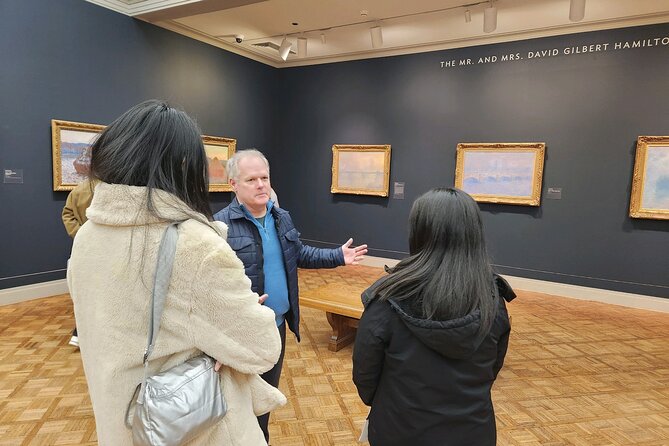
Great art needs a smart route. This two-and-a-half-hour tour gives you a useful path through one of Chicago’s biggest museums, with guides who add artist stories, Chicago context, and clear explanations of major works. I especially like the small group of 12 or fewer and the chance to see paintings by Van Gogh, Hopper, Picasso, O’Keeffe, and Seurat without spending half your visit figuring out the floor plan. The main drawback is the fast pace. You will see a lot, but you may not have time to linger in front of every masterpiece.
At $71.40 per person, the tour costs more than entering the Art Institute on your own, but the price includes admission and skip-the-line access. I like it best for a first visit, a short stay in Chicago, or anyone who wants an art-history primer rather than a quiet afternoon of independent browsing.
In This Review
- Key points to know before booking
- Why the Art Institute works well with a guide
- Starting at 10:30 a.m. on Michigan Avenue
- The opening architectural and decorative works
- Van Gogh, O’Keeffe, and the emotional center of the tour
- Hopper, Albright, and American stories
- Chagall, Picasso, and the museum’s modern collection
- What the small group changes
- The fast pace is both strength and weakness
- Is $71.40 a fair price?
- Who should book this Art Institute tour?
- My verdict: book it for orientation, not lingering
- FAQ
- Where does the tour meet?
- What time does the tour start?
- How long does the tour last?
- Is admission to the Art Institute included?
- Does the tour skip the entrance line?
- How large is the tour group?
- What language is the tour offered in?
- Can I continue visiting the museum after the guided tour?
- What is the cancellation policy?
Key points to know before booking
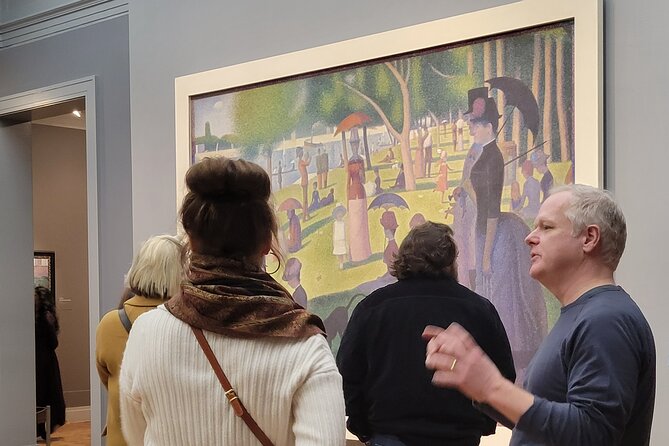
- A greatest-hits route through a huge museum: You may see famous works including Nighthawks, American Gothic, The Bedroom, and Sunday on La Grande Jatte.
- Small groups of 12 or fewer: This gives you a better chance to hear the guide and ask questions than a large coach-style tour.
- Strong guide emphasis: Joel, Bernie, Scout, Colleen, Arnold, Michelle, Robert, and others have received especially warm praise for storytelling and enthusiasm.
- A brisk two-and-a-half hours: The route covers a lot of ground, so comfortable shoes and reasonable fitness matter.
- Admission is included: You can continue exploring after the guided portion, giving the tour more value if your schedule allows.
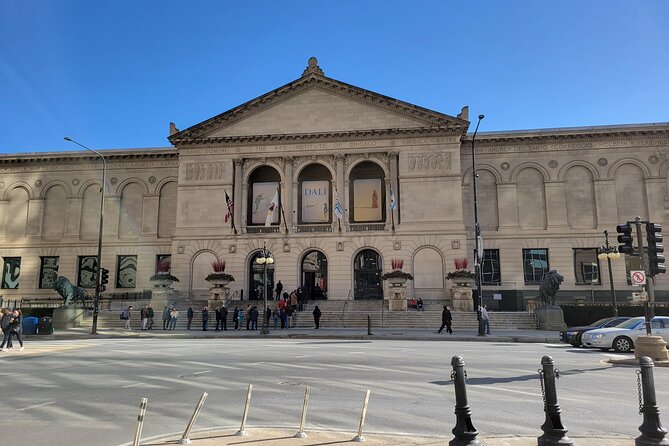
- Simple downtown meeting point: Meet at the Art Institute of Chicago, 111 S Michigan Avenue, at 10:30 a.m.
Why the Art Institute works well with a guide
The Art Institute of Chicago is not a small museum that you can casually sweep through in an hour. Its collection covers many periods, countries, and styles. That variety is a strength, but it can also leave first-time visitors wandering between galleries, unsure which rooms deserve priority.
A guide solves that problem by giving you a route and a story. Instead of treating the museum like a checklist of famous paintings, the tour connects artists, movements, collectors, and Chicago’s role in building the collection. One guide may focus on an artist’s life. Another may explain how a painting changed the way people looked at modern art. The best moments come when those details sharpen what you are already seeing.
The tour is also useful if you do not have a strong art background. Several guides are praised for making complicated subjects easy to follow, using humor, personal stories, and historical context rather than a string of dates and labels. You do not need to know the difference between Impressionism and Post-Impressionism before you arrive.
The current rating is 5.0 from 417 reviews, with 99 percent of visitors recommending the experience. That is unusually strong, and the praise is notably consistent around the guides’ warmth, storytelling, and ability to organize a large museum visit.
A few more options to weigh up in Chicago
- Chicago Architecture River Cruise
★ 5.0 · 15,756 reviews - Chicago River 90-Minute Architecture Tour
★ 4.5 · 9,629 reviews - Chicago River: 1.5-Hour Guided Architecture Cruise
★ 4.8 · 8,046 reviews
Starting at 10:30 a.m. on Michigan Avenue
You meet at the Art Institute of Chicago, 111 S Michigan Avenue. The location is central and close to public transportation, which makes the morning start fairly easy to fit into a day of sightseeing.
Your mobile ticket is confirmed at booking, and admission is included. The skip-the-line feature matters most on a busy day, when buying a ticket and entering on your own can eat into valuable museum time. The exact entry procedure can vary, so arrive with enough time to locate the meeting point and be ready for the 10:30 a.m. start.
The tour is offered in English. Service animals are allowed, and the activity is near public transportation. You should expect to stand and walk for much of the session. The stated fitness requirement is moderate, and that is worth taking seriously. One visitor enjoyed the tour so much that tired feet only became noticeable afterward, which is a friendly warning to wear practical shoes.
The opening architectural and decorative works
The route can begin with the Hartwell Memorial Window by Tiffany Studios. This is a good first stop because it shows that the Art Institute is not only about framed paintings. Tiffany’s glasswork rewards a close look at color, light, and craftsmanship, and a guide can point out details you might pass without noticing.
From there, you may move into European painting, where Gustave Caillebotte’s Paris Street; Rainy Day offers a powerful view of modern city life. Its broad Parisian street, sharply arranged perspective, and figures moving through wet weather make it more than a pretty city scene. It gives the guide a natural way to discuss changing urban life and the new visual language of the late nineteenth century.
Georges Seurat’s Sunday on La Grande Jatte is another major stop. The painting is famous for its pointillist technique, but the useful part of a guided explanation is seeing how tiny marks of color become a solid image from a distance. Stand too close and you see dots. Step back and the scene locks into place.
These early stops show the range of the museum. You are not simply moving from one famous oil painting to another. You may encounter glass, urban realism, and experimental color within a short stretch of the route.
Van Gogh, O’Keeffe, and the emotional center of the tour
Vincent van Gogh’s The Bedroom is one of the most recognizable works in the museum. A guide can help you look past its popularity and notice the unusual perspective, strong outlines, and compressed room. The painting feels simple at first, but its color and shape choices carry a lot of emotional weight.
Georgia O’Keeffe’s Sky Above Clouds gives the tour a very different scale and mood. Its repeated cloud forms can seem almost abstract, yet they are grounded in the artist’s experience of looking down from an airplane. This is the kind of work that benefits from a few minutes of context. Without it, you may see a pattern. With it, you begin to think about distance, flight, and the way landscape changes from above.
The tour may also include Jackson Pollock’s Greyed Rainbow. This is a useful stop for visitors who are unsure how to approach abstract expressionism. A guide can give you a way into the painting by discussing movement, paint handling, and the role of process. You are not required to decide whether you like it. You simply get more tools for looking.
These works also show one of the tour’s limits. There is enough here for a full museum day, but the guided route cannot spend equal time on every major artist. If Van Gogh or O’Keeffe is your main reason for visiting, tell the guide early. The small group makes questions possible, although the route still has to keep moving.
A different kind of day out entirely:
- Chicago: Gangsters and Ghosts Walking Tour
★ 5.0 · 7,155 reviews - Chicago Architecture Center River Cruise aboard First Lady
★ 5.0 · 5,536 reviews - Chicago: Willis Tower Skydeck and The Ledge Ticket
★ 4.6 · 4,350 reviews - Chicago: Architecture River Cruise Skip-the-Ticket Line
★ 4.8 · 4,325 reviews
Hopper, Albright, and American stories
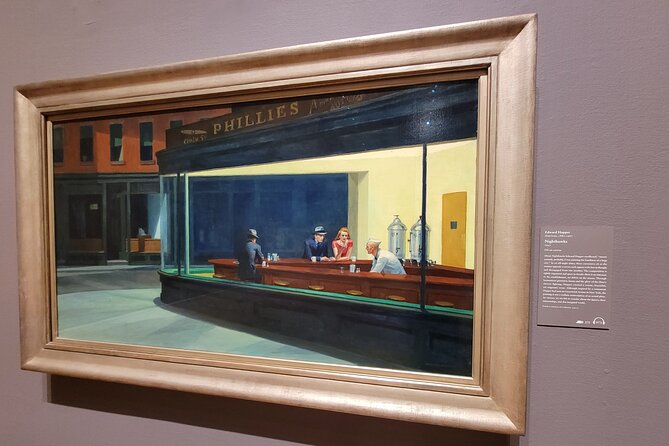
Edward Hopper’s Nighthawks is likely to be one of the most anticipated stops. The painting’s late-night diner, isolated figures, and clean geometry are instantly familiar. The guide can help you consider what makes the scene feel lonely even though several people share the same room. Small details in the lighting, posture, and empty street carry much of the effect.
Ivan Albright’s A Picture of Dorian Gray takes you into darker territory. Its highly detailed, unsettling figure is a sharp contrast to Hopper’s restrained simplicity. The work gives the guide a chance to discuss literary themes, the grotesque, and the ways artists can use surface detail to create discomfort.
Grant Wood’s American Gothic is another essential American work. You may know the pitchfork and stern expressions from countless parodies, but seeing the original lets you study the painting’s precise design and social tone. A good explanation can separate the familiar pop-culture image from the questions Wood was raising about rural identity and American life.
This section of the visit is particularly effective for people who think they are not art experts. The images are familiar, but the guide helps you move from recognition to observation. You begin to notice why these paintings have stayed in the public imagination.
Chagall, Picasso, and the museum’s modern collection
Marc Chagall’s America Windows brings color and glass back into the route. The work was made for the Art Institute and connects modern art with music, theater, literature, and Chicago itself. It is also a reminder that the museum’s modern collection includes large installations, not just paintings on a wall.
Pablo Picasso’s The Old Guitarist offers a quieter, more concentrated experience. Its blue tones and bowed figure are linked to Picasso’s Blue Period, when themes of poverty, sorrow, and social hardship shaped his work. A guide can explain how the restrained palette changes the emotional temperature of the room.
Andy Warhol’s Four Mona Lisas shifts the conversation again. Here, the subject is not only the Mona Lisa itself but also repetition, celebrity, mass production, and the way familiar images change when presented again and again. It is a good example of why a guide can be useful even for a work that appears immediately understandable.
The tour may cover all or some of these pieces, depending on the guide, gallery access, and the pace of the group. That wording matters. You should book this as a highlights tour, not as a promise that every famous work will receive a full explanation.
What the small group changes
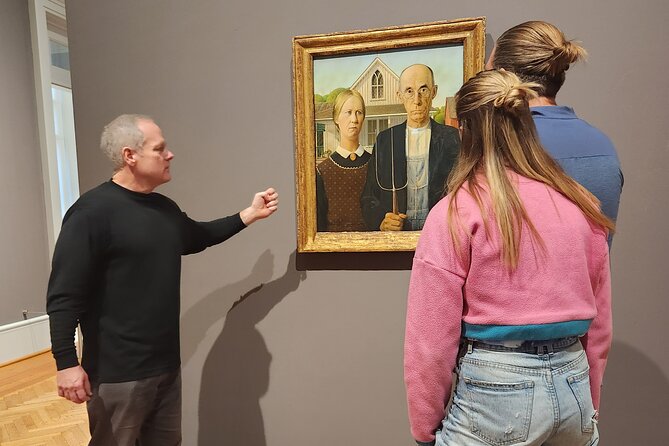
The maximum group size is 12. That is one of the tour’s strongest features. A guide can speak to the whole group without shouting, and you can ask a question without interrupting a crowd of 30 or more people.
Small groups also make it easier to pause briefly at a work that catches your attention. The tour remains brisk, but it feels more like an organized conversation than a lecture delivered to a moving line of people.
The guides receive the most consistent praise. Joel is repeatedly described as warm, funny, and passionate about both art and Chicago. Bernie is praised for knowing the museum layout and directing people efficiently to the most important rooms. Scout is noted for mixing amusing anecdotes with art history and local context.
Colleen is especially valued for navigating the museum before crowds arrive and helping people understand where they are after the tour. Arnold is praised for answering questions and adapting to the group. Michelle and Robert are described as polished, engaging presenters, while another guide, Mark, brought both art-history teaching and personal experience as an artist to the discussion.
The exact guide is not guaranteed, so do not book solely because you hope for one particular person. The overall pattern is encouraging: the experience depends heavily on the guide, and the available guide team appears to place strong emphasis on clear explanations and personal energy.
The fast pace is both strength and weakness
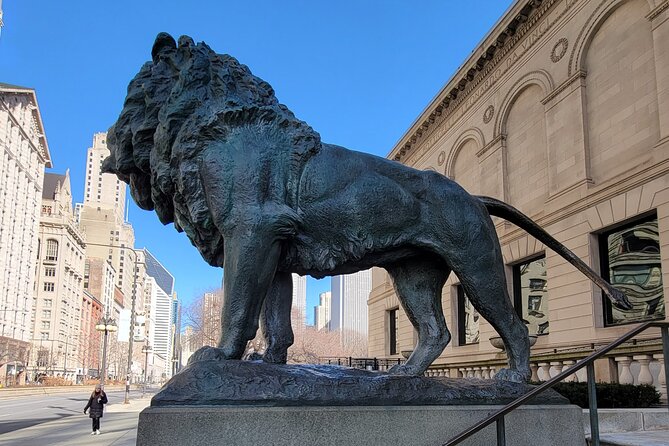
Two hours and 30 minutes is long enough to build a useful picture of the museum, but short enough to fit into a packed Chicago itinerary. That balance is the main reason the tour works for first-time visitors.
You will probably cover many galleries and major works. The benefit is efficiency. You get a clear introduction without spending your morning reading every wall label. The cost is time at individual paintings. You may have just begun to settle into a work when the group needs to move.
I would not choose this tour if your ideal museum day means sitting quietly before three paintings and returning to them several times. I would choose it if you want a strong first pass, then plan to revisit your favorites independently.
Admission remains valid for further exploration after the guided portion, according to the experience details. That makes the schedule more flexible. You can take the tour, learn the museum’s layout, and then return to rooms that interested you. One practical caution: this only adds value if your day allows the extra time. If you have lunch, shopping, or another booking immediately afterward, you may not get much use from the additional access.
Is $71.40 a fair price?
At $71.40 per person, this is not the cheapest way to enter the Art Institute. You are paying for more than the ticket: skip-the-line entry, a semi-private group, and a guide who helps you use your time well.
The price makes the most sense in three situations:
- You have only a few hours in Chicago.
- You feel uncertain about how to approach a major art museum.
- You value stories and interpretation more than exploring alone.
The value is weaker if you already know the collection well or prefer to set your own route. Independent visitors can move slowly, choose unusual galleries, and avoid the pressure of keeping up.
I see the tour fee as a time-saving cost. If a guide helps you reach the museum’s most important works quickly and gives you enough context to appreciate them, the extra money can be worthwhile. If you expect a detailed lecture on every painting, the short schedule may leave you wanting more.
Who should book this Art Institute tour?
This experience suits first-time visitors, couples, families with limited museum stamina, solo visitors who want company, and anyone making a short Chicago visit. It is also a good fit if the names Van Gogh, Hopper, Picasso, and O’Keeffe sound familiar but you would like help understanding what you are looking at.
Families may appreciate the stories and manageable route, though young children who dislike walking or standing could struggle with the length. Art students and serious museum fans may enjoy the guide’s context, but should treat the tour as an introduction rather than a specialist seminar.
You should also be comfortable with English, since that is the language offered. The moderate physical fitness requirement means you should plan for a substantial amount of walking and standing. Public transportation is nearby, and service animals are permitted.
Free cancellation is available if you cancel at least 24 hours before the 10:30 a.m. start. Changes or cancellations inside that window are not accepted for a refund, so check your Chicago schedule before booking.
My verdict: book it for orientation, not lingering
I recommend this tour if you want to see the Art Institute’s famous works, understand why they matter, and avoid losing time in a very large museum. The strongest features are the small group, the included admission, the skip-the-line access, and the guides’ ability to connect art with artists’ lives and Chicago’s story.
Book it with the right expectation. This is a brisk highlights route. You may not see every important artist, and you will not have time to study each painting at length. For the best use of the ticket, take notes on the rooms and works you want to revisit, then stay on after the guided portion if your schedule allows.
If you have just one museum visit in Chicago, this is a practical and engaging way to begin. If you already know exactly what you want to see, save the fee and explore independently.
FAQ
Where does the tour meet?
The tour meets at the Art Institute of Chicago, 111 S Michigan Avenue, Chicago, Illinois 60603.
What time does the tour start?
The scheduled start time is 10:30 a.m.
How long does the tour last?
The tour lasts approximately two hours and 30 minutes.
Is admission to the Art Institute included?
Yes. All admission fees are included in the tour price.
Does the tour skip the entrance line?
Yes. The experience includes skip-the-line entry as part of the semi-private guided museum tour.
How large is the tour group?
The group has a maximum of 12 visitors.
What language is the tour offered in?
The tour is offered in English.
Can I continue visiting the museum after the guided tour?
The experience details state that admission is included, and the tour ends back at the meeting point. The included entry allows you to make further use of the museum visit if your schedule and museum procedures permit.
What is the cancellation policy?
You can cancel at least 24 hours before the experience start time for a full refund. Cancellations or changes made less than 24 hours before the start are not accepted for a refund.
Just added in Chicago
- Original Chicago Architecture Interiors Tour: Dazzling Interiors★ 5.0 · 1,489 reviews
- Delicious Donuts & City Sights: Chicago’s Original Donut Tour★ 5.0 · 1,389 reviews
- BYOB Spray Paint and Sip at Studio W.I.P.★ 5.0 · 401 reviews
- Bikes, Bites & Views: Chicago’s Signature Dishes Bike Tour-Adults★ 5.0 · 732 reviews
- The Escape Game Chicago: Epic 60-Minute Adventures in River North★ 5.0 · 332 reviews
- Field Museum of Natural History Admission Tickets★ 4.5 · 489 reviews
- Chicago Loop District Food Tour with Deep Dish & Beef Sandwich★ 5.0 · 870 reviews
- City Cruises Chicago: Signature Lunch Cruise on Lake Michigan★ 4.0 · 348 reviews
Chicago Tours, compared.
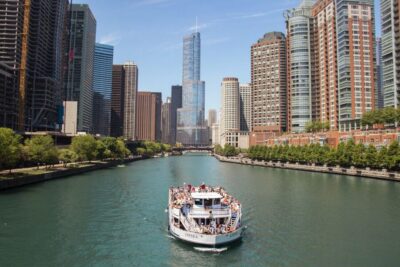
Chicago River: 1.5-Hour Guided Architecture Cruise
Read our review →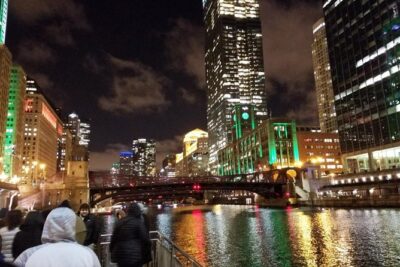

Chicago Architecture Center River Cruise aboard First Lady
Read our review →
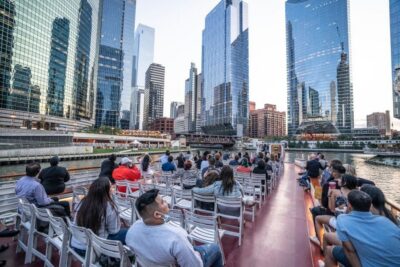
Architecture River Cruise Skip-the-Ticket Line
Read our review →
Browse the lists this tour appears in