
Reviewed · WALKING TOURS
Boston’s Freedom Trail: A Revolutionary Walking Tour
History feels close in Boston. This 2.5-hour Freedom Trail walk links all 16 official sites, from the Golden Dome of the Massachusetts State House to Bunker Hill Monument. I like that the tour does not stop with Paul Revere and John Hancock. It also brings in women, African Americans, immigrants, abolitionists, and other people who helped shape the city.
I especially like the way guides such as Rob, Kenneth, Alissa, Charlie R, Matthew, and Stewart turn a long list of landmarks into a connected story. The humor helps, too, including a few deliberately cheap dad jokes. The main drawback is the pace: you cover a lot of ground, and Matthew in particular was praised for speaking quickly, which could be hard to follow if English is not your first language.
In This Review
- Key things to know before you book
- Starting beneath The Embrace on Boston Common
- The Golden Dome, Park Street Church, and Granary Burying Ground
- King’s Chapel and the Benjamin Franklin statue
- Old Corner Bookstore and Old South Meeting House
- The Old State House and the Boston Massacre Site
- Faneuil Hall and Boston’s public voice
- Paul Revere’s House and the Midnight Ride
- Old North Church and the two lanterns
- Copp’s Hill, the USS Constitution, and Bunker Hill
- What the guides do best
- Is $31 a fair price?
- Practical advice for a better walk
- Who should book this Freedom Trail walk?
- FAQ
- Where does the Freedom Trail tour begin?
- How long does the walking tour last?
- Does the tour visit all 16 Freedom Trail sites?
- Are attraction entry tickets included?
- What language is the tour offered in?
- Is the tour wheelchair accessible?
Key things to know before you book
- All 16 official sites in one walk: You see the complete Freedom Trail route in a single guided outing, including the USS Constitution and Bunker Hill Monument.
- Strong guides make the difference: Rob, Kenneth, Alissa, Charlie R, Matthew, Stewart, Noah, Megan, Julia, Sam, Jim, Jules, and Malcolm were all singled out for humor, energy, clear storytelling, or strong command of Boston history.
- A useful first-day activity: The tour gives you an excellent framework for Boston, then helps you decide which sites deserve a longer visit.
- Historic places, not just museum stops: You stand at the Boston Massacre Site, see the Old North Church steeple, and walk through burial grounds tied to the Revolution.
- Good value at $31: Since the price covers a live guide and the full walking route, it is a sensible way to orient yourself before paying separate admission at selected attractions.
- Wear proper shoes: The route covers a lot of ground in 2.5 hours. Bring water and dress for the weather.
Starting beneath The Embrace on Boston Common

Your meeting point is The Embrace statue, next to the Visitor’s Center on Boston Common at 139 Tremont Street. Look for a guide carrying a Boston History Company flag. The guide will not be wearing a historical costume, so the flag matters.
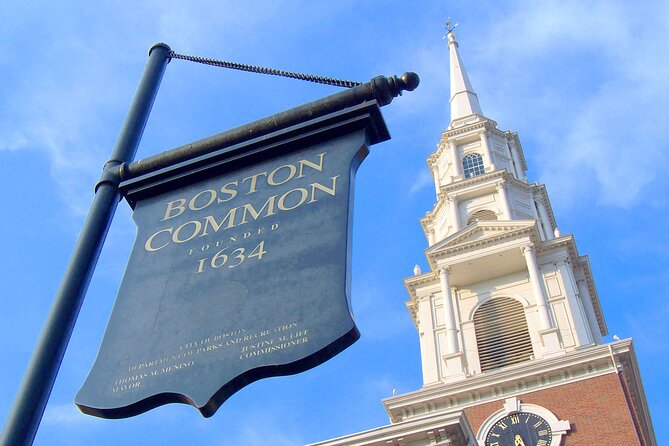
Starting on Boston Common gives the tour a fitting opening. This is the oldest public park in the United States, and it places you right in the center of Boston’s historic core. You begin with the city around you, not inside a dark lecture room. That helps you understand the route as a real urban walk, with modern Boston layered over its colonial streets.
The tour is conducted in English. It is wheelchair accessible according to the activity details, but the same information says it is not suitable for people with mobility impairments. That is worth taking seriously. Even with accessible arrangements, a long city walk can be tiring, and the route covers many stops in a short period.
I would book this near the start of your Boston visit. You can use the tour to get your bearings fast, then return to the places that catch your interest.
More Walking Tours in Boston
- Boston: Freedom Trail History Small Group Walking Tour
★ 5.0 · 6,450 reviews - Cambridge: Harvard University Student-Guided Walking Tour
★ 4.6 · 3,931 reviews - Harvard University Campus Guided Walking Tour
★ 4.5 · 3,632 reviews
The Golden Dome, Park Street Church, and Granary Burying Ground
One early highlight is the Massachusetts State House, with its famous golden dome. The building gives you a visual link between Boston’s colonial past and its role as the capital of Massachusetts. You will see the exterior rather than receive admission to every attraction, since entry tickets are not included.
The route continues to Park Street Church. Its tall presence makes it easy to spot, but the important point is its connection to Boston’s later work in education, abolition, and reform. The tour uses places like this to show that Boston’s story did not end when the Revolutionary War ended.
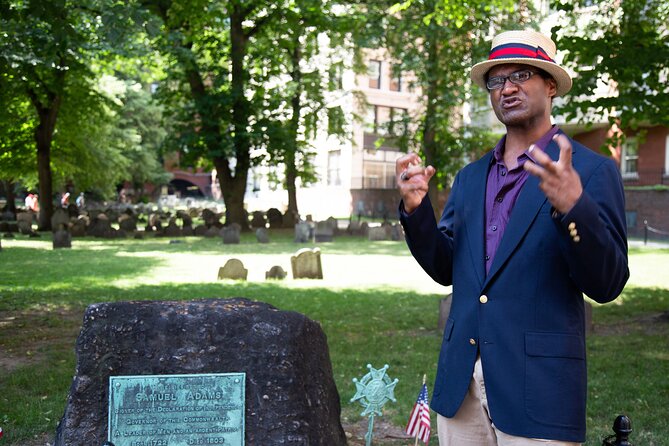
At Granary Burying Ground, you see the final resting places of major figures including John Hancock, Paul Revere, and Samuel Adams. This is one of the most concentrated stops on the walk. A guide can help you sort out who mattered, what they did, and how later generations remembered them.
You should not expect a quiet, extended cemetery visit. The group has 16 sites to cover, so the stop is designed for orientation and storytelling rather than a long pause at each grave. Still, it is a powerful moment. Names that often appear as textbook facts become people connected to one small patch of ground.
King’s Chapel and the Benjamin Franklin statue
King’s Chapel adds another layer to the tour. Its presence helps explain the religious and civic character of early Boston, while the nearby burial ground reinforces how tightly packed the old city once was.
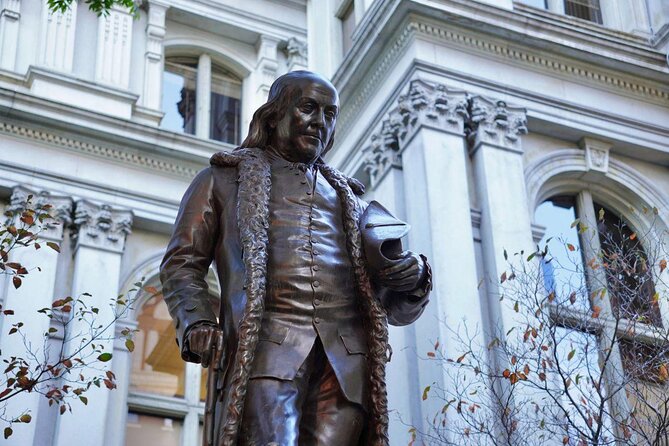
The Benjamin Franklin statue offers a chance to discuss one of Boston’s most famous sons. Franklin’s life connects Boston to printing, public education, civic improvement, and the wider American experiment. The tour also uses him to broaden the story beyond battlefield drama.
This is one of the tour’s strengths. You are not simply marched from one famous patriot to the next. Guides talk about education, immigration, abolition, and the people who did not always receive equal attention in older versions of American history.
Kenneth was praised for answering questions and for being easy to talk with about history, restaurants, bars, and other places in Boston. That kind of local advice can be especially useful here, since you can ask about what to see after the tour while the city is still fresh in your mind.
Old Corner Bookstore and Old South Meeting House
The Old Corner Bookstore is a small-looking stop with a large connection to Boston’s publishing world. It helps show how books, newspapers, and political arguments moved through the city. The American Revolution was fought with weapons, but also with speeches, pamphlets, and public opinion.
Old South Meeting House is one of the key settings connected to the Boston Tea Party. Before the tea was dumped into Boston Harbor, colonists gathered here to debate what to do. The building gives the political crisis a physical setting, rather than leaving it as a familiar name from a school lesson.
I like this part of the walk because it explains how protest grows. You see the places where people gathered, argued, organized, and made choices that carried real risks. The guide’s job is to connect those actions without turning the stop into a dry list of dates.
The tour does not include admission tickets. If you want to enter Old South Meeting House or another attraction, you will pay separately. That is not a problem for a first orientation walk, but you should budget for extra visits if you want interiors and exhibits.
A different kind of day out entirely:
- Boston Duck Boat Sightseeing City Tour with Cruise Along Charles River
★ 4.5 · 9,378 reviews - Boston Hop-On Hop-Off Trolley Tour with 13 Stops
★ 4.5 · 5,576 reviews - Boston: City Cruises Whale Watching Cruise
★ 4.5 · 4,710 reviews - Boston Duck Tour: The Original and World-Famous
★ 4.6 · 3,935 reviews
The Old State House and the Boston Massacre Site

The Old State House is one of Boston’s most dramatic colonial buildings. It sits among modern streets and office towers, which makes its age easy to appreciate. This was a center of government and public life, and its balcony is tied to major declarations in Massachusetts history.
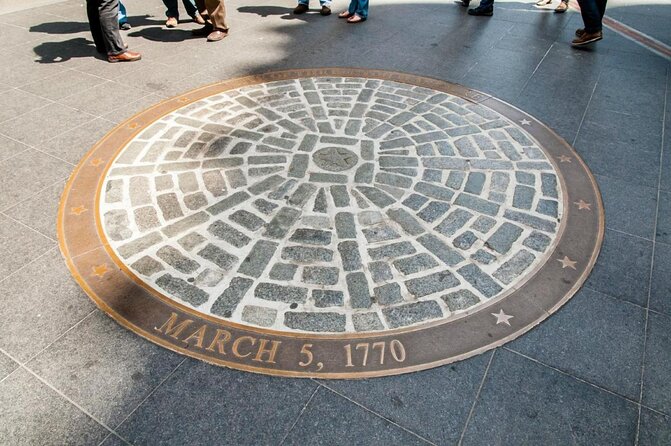
Nearby, the Boston Massacre Site marks the place where British soldiers fired into a crowd in 1770. The event became powerful revolutionary propaganda, though the full story is more complicated than the famous image suggests. A good guide can explain both the facts and the way the incident was used to build opposition to British rule.
This is where the tour’s storytelling matters most. You are standing on an ordinary downtown street, surrounded by traffic and people heading to work. The guide has to make you pause and picture the fear, confusion, and anger of the original event. The best guides described for this tour do that with clear explanations and a light touch, without losing the seriousness of the subject.
The walk also deals with the Boston Tea Party and the explosive events that pushed the colonies toward war. You are not visiting a single isolated monument. You are following a chain of arguments and confrontations through the city.
Faneuil Hall and Boston’s public voice
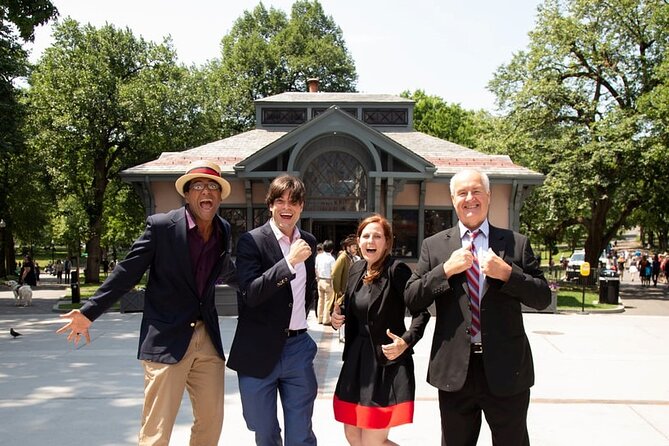
Faneuil Hall is another essential stop. It is tied to public meetings, speeches, protest, and the growth of Boston’s civic culture. Today, the area is also a busy commercial center, so expect modern activity around the historic building.
That contrast is useful. The Freedom Trail is not a preserved theme park. It runs through a living city. You may be listening to a story about eighteenth-century protest while people shop, eat, and move around you. The guide helps you separate the old structure from the modern setting without pretending the city has stopped changing.
Faneuil Hall also supports one of the tour’s larger themes: Boston as a place where public arguments matter. The tour moves from revolutionary resistance to later campaigns for abolition, education, and immigrant opportunity. That wider view gives the walk more substance than a simple parade of patriot names.
For many people, Faneuil Hall is an easy place to return to after the tour. You can use the walk to decide if you want to spend more time inside, though admission is not part of the $31 price.
Paul Revere’s House and the Midnight Ride
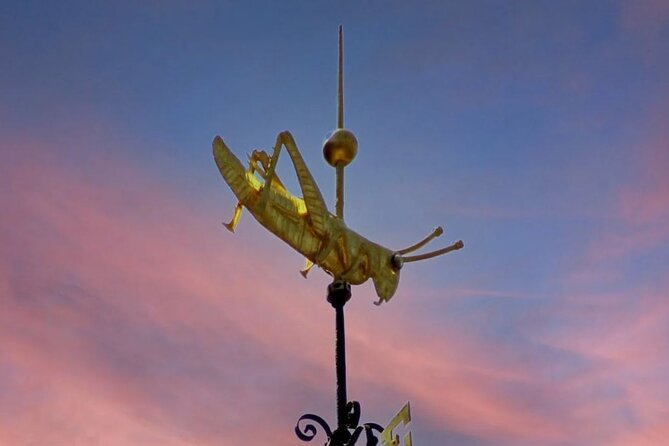
Paul Revere’s House is one of the most personal stops on the route. It is a modest home in the North End, and that modest scale makes Revere seem less like a statue and more like a working resident of Boston.
The guide also tells the story of the Midnight Ride and the network of riders who spread warnings before the fighting began. The tour’s description promises stories of rebels, gangs, and Midnight Riders, so expect more than the standard one-line account of Revere shouting through the night.
You will likely view the house as part of the guided route rather than take a full interior tour, since entry tickets are not included. If you want to go inside, plan time and money for a separate visit.
This is a good place to pay attention to what gets left out of the famous version. Revere was important, but he was not alone. The tour’s broader approach gives you a better sense of collective action, communication, and the risks taken by many people whose names are less familiar.
Old North Church and the two lanterns
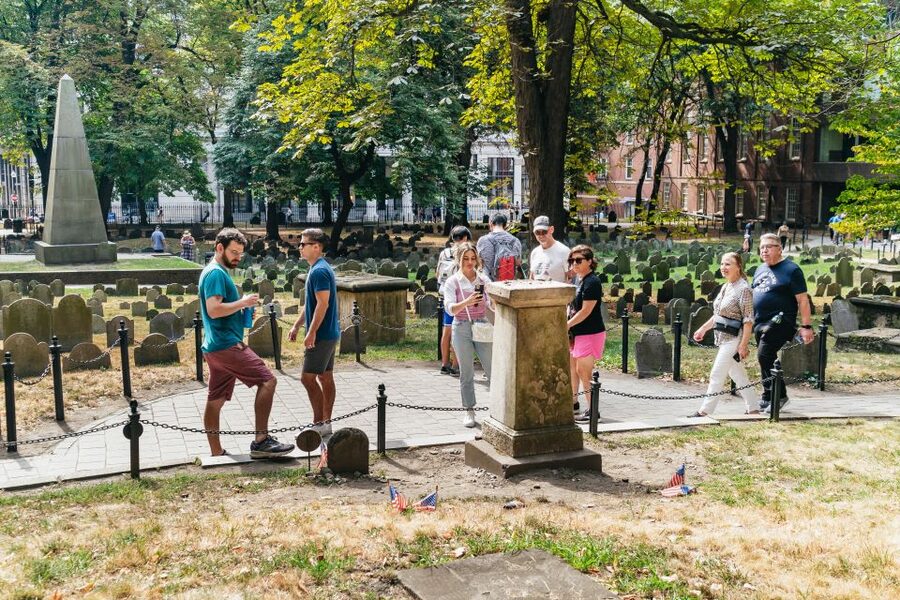
The Old North Church steeple is one of the most recognizable sights on the Freedom Trail. It is linked to the famous signal involving two lanterns, a warning that British troops were moving by sea rather than by land.
The value of seeing the steeple in person is simple: the story suddenly has distance and direction. You can understand why a high church tower mattered in an era before electric lights, telephones, or instant messages.
The tour explains the signal as part of a larger communication system. Midnight riders, church towers, roads, and local networks all mattered. The Revolution was not only a series of famous speeches and battles. It depended on people getting information to one another quickly.
Guides such as Sam, Jim, Jules, and Malcolm were praised for passion and engaging delivery. That is useful at a stop like this, where the physical landmark is striking but the story can be reduced to a single memorized fact without enough explanation.
Copp’s Hill, the USS Constitution, and Bunker Hill
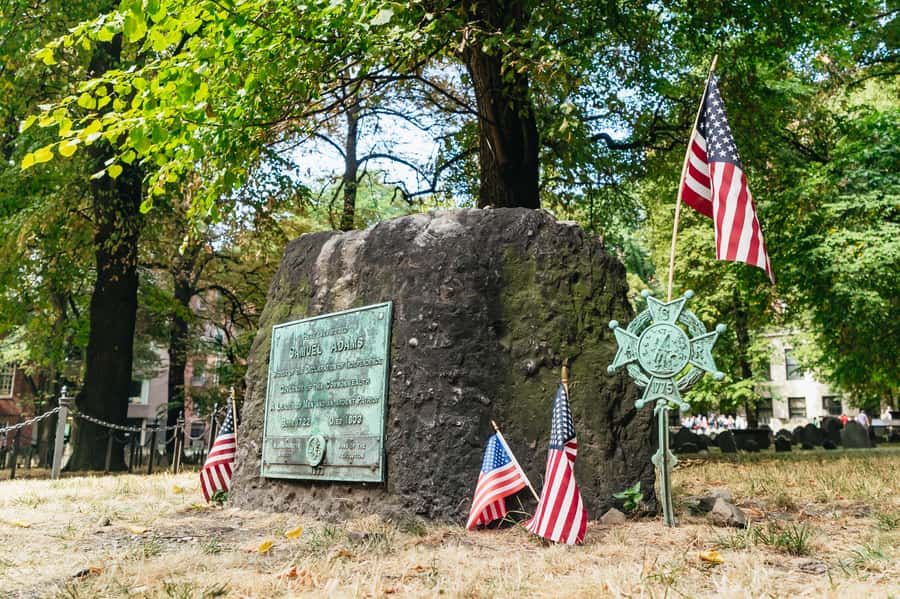
Copp’s Hill Burying Ground shifts the focus toward Boston’s North End and its early residents. Like Granary Burying Ground, it offers a chance to think about ordinary life, death, religion, and social rank alongside the better-known patriot story.
From there, the tour continues toward the USS Constitution. The ship is known as Old Ironsides, and it connects the revolutionary era to the early history of the United States Navy. Seeing it on the route adds variety after a series of churches, meeting houses, government buildings, and burial grounds.
The final major landmark is Bunker Hill Monument. The monument commemorates the Battle of Bunker Hill, one of the defining early clashes of the Revolution. The name is slightly confusing because the fighting took place mainly on Breed’s Hill, but the monument is known as Bunker Hill Monument.
The tour description says you view all 16 official sites, and the walk ends back at the meeting point. Because the route covers so much ground, do not plan a tight appointment immediately afterward. The final portion can feel demanding, especially if you have already spent the morning sightseeing.
What the guides do best
The clearest pattern among the guide feedback is strong delivery. Rob was praised for combining humor with insight, Kenneth for answering questions and offering local suggestions, and Charlie R for presenting detailed material in an engaging way.
Alissa was praised for keeping the group interested for the full 2.5 hours. Noah was described as educational and funny, while Megan, Julia, Stewart, and Sam were all praised for energy, passion, or professionalism. Those details matter because the same route can feel either lively or exhausting depending on how well the guide handles transitions.
I would expect some variation from guide to guide. Walking tours depend heavily on the person leading them, and the experience is built around spoken storytelling rather than a headset or audio guide. The upside is the chance to ask questions and enjoy a less scripted conversation. The downside is that a fast speaker or a large group can make details harder to catch.
If English is not your first language, choose a time when you are rested and stay near the guide. One piece of direct feedback noted that Matthew spoke very quickly, even though the tour itself was highly recommended. That is a practical point, not a criticism of the entire experience.
Is $31 a fair price?
At $31 per person, I consider this good value if you want a full introduction to Boston’s historic center. You receive a live English-speaking guide and a 2.5-hour route covering all 16 official sites. A self-guided walk is cheaper, but it will not give you the same running explanation, chance to ask questions, or help connecting the landmarks.
The price does not include entry tickets. That keeps the basic cost reasonable, but you should not mistake the tour for a bundle of museum admissions. Think of it as a guided city walk that helps you choose where to spend more time later.
The tour can also save planning effort. Instead of mapping the Freedom Trail yourself and reading short descriptions at each stop, you follow one organized route. The value is highest if this is your first time in Boston or if you have only a short layover. One customer used layover time for the tour and found it worthwhile, but you should allow enough time to reach the meeting point and complete the walk without rushing.
Practical advice for a better walk
Wear comfortable shoes. The route covers substantial city ground, and the pace is designed to reach all 16 sites rather than linger at just a few.
Bring water and wear comfortable clothing. Boston weather can change, and the tour spends most of its time outdoors. The guide’s flag should make the meeting point easy to identify, but arrive with the exact location in mind: The Embrace statue beside the Visitor’s Center on Boston Common, 139 Tremont Street.
Video recording is not allowed. You can still take in the buildings and make notes for later, but plan to listen rather than record the presentation.
The activity offers free cancellation up to 24 hours before the start time, and you can reserve now and pay later. Those terms help if your Boston plans are still shifting, but the most important decision is choosing a time when you can comfortably walk for 2.5 hours.
Who should book this Freedom Trail walk?
I would recommend it to first-time Boston visitors, history fans, families with older children, and anyone who wants a clear introduction before exploring independently. It also suits people with limited time who want to see the main Freedom Trail landmarks in one organized outing.
I would be more cautious if you have mobility limitations, dislike group walks, or prefer to spend ten or fifteen minutes inside every historic building. The route is broad rather than leisurely. You see a great deal, but not every stop receives the same amount of time.
Book this tour if you value strong storytelling, historical context, and efficient sightseeing. Skip it if you already know Boston well and would rather wander at your own pace. For $31, the tour gives you a solid map of the city’s Revolutionary story, plus enough wider context to show why Boston mattered long after 1776.
FAQ
Where does the Freedom Trail tour begin?
The tour begins at The Embrace statue beside the Visitor’s Center on Boston Common at 139 Tremont Street. Look for a guide holding a Boston History Company flag.
How long does the walking tour last?
The tour lasts 2.5 hours. Starting times vary, so check availability when booking.
Does the tour visit all 16 Freedom Trail sites?
Yes. The route covers all 16 official historic sites, including the Massachusetts State House, Faneuil Hall, Paul Revere’s House, Old North Church, the USS Constitution, and Bunker Hill Monument.
Are attraction entry tickets included?
No. The price includes the live guide and walking tour only. Entry tickets to attractions are not included.
What language is the tour offered in?
The tour is conducted in English with a live English-speaking guide.
Is the tour wheelchair accessible?
The activity is listed as wheelchair accessible, but it is also marked as not suitable for people with mobility impairments. Bring comfortable shoes, water, and comfortable clothing for the long city walk.
Just added in Boston
- View Boston Observation Deck Admission Tickets★ 4.5 · 314 reviews
- Delicious Donuts of Boston: A Sweet History Walking Tour★ 5.0 · 1,038 reviews
- Boston’s Freedom Trail: A Revolutionary Walking Tour★ 5.0 · 1,343 reviews
- Freedom Trail Walking Tour 250★ 4.5 · 1,118 reviews
- Sunset Sailing Cruise on a Tall Ship in Boston Harbor★ 4.5 · 414 reviews
- Narrated Sunset Cruise of Boston Harbor★ 4.0 · 532 reviews
- City Cruises Salem High Speed Ferry to/from Boston★ 4.5 · 727 reviews
- Boston North End Food Tour of 6+ Tastings, Cannoli, Lobster Roll★ 5.0 · 1,404 reviews
Walking Tours, compared.

History and Hauntings of Salem Guided Walking Tour
Read our review →
New Orleans Premier Ghost, Voodoo and Vampire Walking Tour
Read our review →

Freedom Trail History Small Group Walking Tour
Read our review →
Historic Charleston Guided Sightseeing Walking Tour
Read our review →
New Orleans Food Walking Tour of the French Quarter with Small-Group Option
Read our review →
Cambridge: Harvard University Student-Guided Walking Tour
Read our review →Browse the lists this tour appears in