
Reviewed · HISTORICAL TOURS
Charleston History Tour /
History feels close in Charleston. This two-hour walking tour links grand churches, harbor defenses, colorful houses, and cultural stories in a compact route through the old city. I like the small maximum of 10 people, and I like that the tour covers several sites without extra payment for the places included. The main drawback is that you need a moderate fitness level, and the tour depends on good weather.
The experience is especially appealing if you want context instead of a quick photo walk. Guide Joyce has earned praise for explaining Charleston’s growth, military past, architecture, and culture with warmth and energy. One important caution: a past booking failed when the guide had a medical emergency and could not make contact. That appears to be an unusual case, but it is worth knowing before you rely on the tour for a tightly timed day.
In This Review
- Key points to know before you book
- A compact walk through Charleston’s old center
- Dock Street Theater and Charleston’s performing arts past
- St. Michael’s Church and the city’s religious foundations
- A Constitution-era stop and the making of the United States
- Gullah culture adds a human story
- Rainbow Row and Charleston’s best-known color
- The Battery and White Point Gardens
- French Huguenot Church and a distinct religious tradition
- What the guide can add to the walk
- Value, timing, and who should book
- Should you book the Charleston History Tour?
- FAQ
- How long does the Charleston History Tour last?
- Where does the tour begin?
- Where does the tour end?
- What days and hours is the tour available?
- How many people can join the tour?
- Is food or drink included?
- Are extra payments required at the listed sites?
- Is the tour suitable for everyone physically?
- What happens if the weather is poor or I need to cancel?
Key points to know before you book
- A 10-person maximum keeps the walk personal, with a chance for questions and conversation.
- The route covers major Charleston sights, including Dock Street Theater, St. Michael’s Church, Rainbow Row, the Battery, and White Point Gardens.
- Gullah culture is part of the story, adding an important perspective beyond architecture and military events.
- Included site access helps control costs, since the listed stops do not require extra payments.
- The tour begins and ends at 80 Broad Street, making it easy to fit into a day in Charleston’s historic center.
- Free cancellation is available until 24 hours before departure, but poor weather can affect the schedule.
A compact walk through Charleston’s old center
The tour starts at 80 Broad Street and lasts about two hours. That is a useful length for Charleston. You get a broad introduction without giving up half your day, and you can still add a museum, meal, harbor activity, or independent walk afterward.
The small group size matters here. Charleston’s historic streets reward questions because each building can carry several stories: political, religious, military, architectural, and personal. A maximum of 10 people gives you a better chance to hear the guide clearly than you would in a large coach group.
You should expect to walk between the stops. The tour description calls for a moderate physical fitness level, so wear comfortable shoes and prepare for a steady outing on city streets. The stop descriptions allow roughly five minutes at each named location, which means the value comes from the guide’s explanations and the route as a whole rather than long interior visits.
This is not a food tour, and food and drinks are not included. Plan a snack or meal before or after the walk. The meeting point and endpoint are the same, so you can leave your schedule open around the tour without arranging a separate return transfer.
More History Tours in Charleston
- Charleston’s Old South Carriage Historic Horse & Carriage Tour
★ 5.0 · 10,023 reviews - Historic Charleston Guided Sightseeing Walking Tour
★ 5.0 · 6,216 reviews - Charleston Horse-Drawn Carriage Tour: Explore Historic Charleston
★ 5.0 · 3,561 reviews
Dock Street Theater and Charleston’s performing arts past
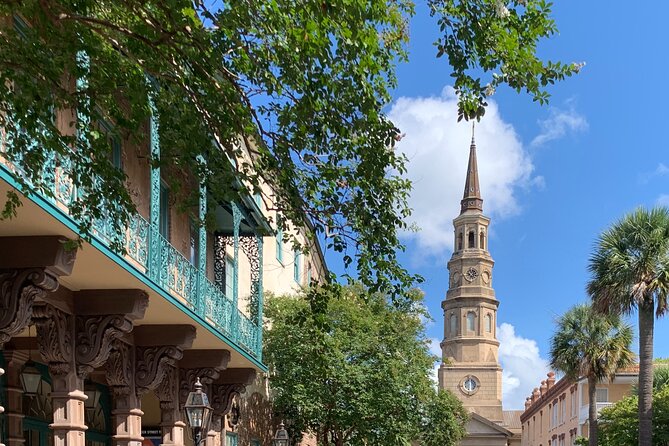
Dock Street Theater is one of the early visual highlights. The ornate playhouse has elegant woodwork and a courtyard, giving you a glimpse of Charleston’s taste for formal design and public entertainment.
The site is associated with the early 19th century, with the tour information dating the featured theater setting to around 1810. The stop is brief, listed at about five minutes, so do not expect an extended performance or a long theater visit. Instead, you get a quick architectural pause and an explanation of why this building matters within the city.
I like this stop because it breaks up the usual run of churches and government buildings. Charleston is not only about politics and war. The theater adds a social layer, showing how public life also took shape through performance, gathering, and display.
The included admission note applies to the sites seen on the tour, but the supplied details do not explain the exact format of access at every stop. If entering Dock Street Theater is important to you, ask the provider what you will see inside on your date. That is a sensible question when the scheduled stop is short.
St. Michael’s Church and the city’s religious foundations
St. Michael’s Church is described as a historic church and the oldest religious building in Charleston. Even with a short stop, it gives the guide a strong opening for discussing the city’s religious and civic development.
The church dates to around 1764, placing it among the older structures on the route. Its age is not just a number. It helps you picture Charleston before the United States had fully formed as a nation, when churches were central parts of community life and the city was still developing its colonial identity.
The tour lists admission as included, so you should not need to budget a separate entrance payment for the planned visit. Still, the five-minute timing suggests that the church is mainly a guided exterior or brief access stop rather than a detailed architectural inspection. If you want time to study every feature, return later on your own if opening conditions allow.
This is also a good example of why a guide can improve a historic walk. Without context, an old church can become another pretty facade. With the right explanation, its date and place in Charleston’s story give the building more meaning.
A Constitution-era stop and the making of the United States
The tour also includes a historic stop built in 1771 and connected with the ratification of the United States Constitution. The supplied details do not identify the building by name, so I would confirm that point with the operator if this is the main reason you are booking.
Even without a named site, the subject is important. Charleston’s story is not separate from the country’s founding debates. A building tied to Constitution ratification gives the walk a direct link to the political arguments that shaped the early United States.
This part of the route should appeal to you if you enjoy seeing national history in a local setting. Instead of treating the Constitution as something that happened only in distant textbooks, the guide can place it in Charleston’s streets and buildings.
Because the stop is not fully described, keep your expectations measured. You can count on the historical subject, but not on a specific interior, exhibit, or presentation format unless the provider confirms it before departure.
A different kind of day out entirely:
- Haunted Evening Horse and Carriage Tour of Charleston
★ 4.5 · 3,678 reviews - Fort Sumter Admission and Self-Guided Tour with Roundtrip Ferry
★ 4.5 · 3,343 reviews - Charleston: Fort Sumter Entry Ticket with Roundtrip Ferry
★ 4.7 · 2,879 reviews - Ghosts of Charleston Night-Time Walking Tour with Unitarian Church Graveyard
★ 4.5 · 2,835 reviews
Gullah culture adds a human story

One of the most valuable parts of the experience is its attention to the Gullahs of Charleston. This gives the tour a cultural focus that many architecture-heavy walks lack.
The supplied details do not name a separate Gullah site or explain how long this portion lasts. It may be presented as part of the walking commentary rather than as a distinct stop. Either way, it signals that Charleston’s story is not limited to old buildings, wealthy families, and military defenses.
I appreciate that the tour includes this subject alongside architecture and political history. You get a broader picture of the people and traditions that shaped Charleston. If this is a priority for you, ask how the Gullah history is handled and how much time the guide normally gives it.
That question is not a criticism. A two-hour route has limits, and the tour covers many subjects. Knowing the balance in advance helps you choose between this broad city introduction and a specialized cultural tour.
Rainbow Row and Charleston’s best-known color
Rainbow Row is made up of nine attached buildings, and all but one predate the American Revolution. Their colored facades make this one of the easiest stops to recognize and photograph.
The buildings are more useful than a simple photo backdrop. Their age and connected layout give the guide a chance to explain how Charleston’s commercial streets developed and how early buildings were adapted over time. The five-minute stop is short, but the location works well in a general orientation tour because it shows you a memorable part of the city’s built character.
You should expect an exterior viewing point rather than a private house visit. The attraction is the row itself, its colors, proportions, and position within the historic street plan. If you want quiet photographs, you may prefer to return later, since a guided stop has to keep moving.
Rainbow Row also helps make the route feel varied. After the formal setting of St. Michael’s Church and the theater, these bright facades bring a lighter visual change without losing the connection to Charleston’s early past.
The Battery and White Point Gardens
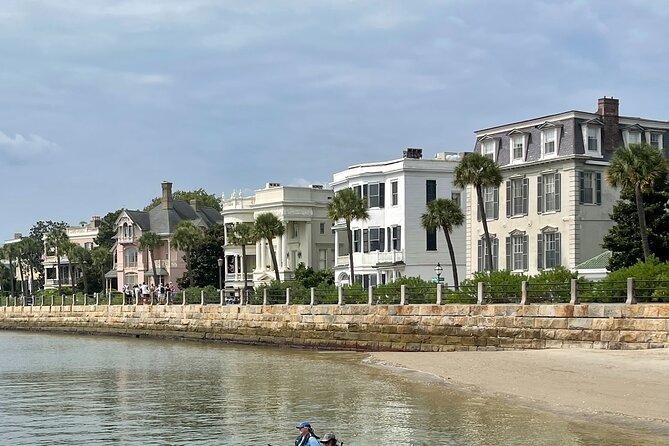
The Battery is a defensive seawall and promenade along Charleston Harbor. White Point Gardens adds open public space, making this section a welcome change from close-set buildings and narrow streets.
The military angle is one reason this stop works so well. Charleston’s waterfront was not only scenic. It was also tied to defense, harbor access, and the city’s strategic position. The tour’s broader military focus, praised in the feedback about Joyce’s guiding, should have a natural place here.
The stop is listed at about five minutes, so this is an introduction rather than a long waterfront stroll. You will likely have time to understand the setting and take in the view, but not to linger at every feature. If the harbor is a major reason for your visit, return independently after the tour.
Weather matters most at this exposed part of the route. The operator says the activity requires good weather and may offer a new date or full refund if conditions force cancellation. Bring practical clothing for the season, since the experience is outside and the tour does not include drinks.
French Huguenot Church and a distinct religious tradition
The French Huguenot Church adds another strong architectural and cultural stop. Built in 1844, it is described as the oldest Gothic Revival church in South Carolina and the only independent Huguenot Church in the country.
That combination makes it more than another historic church. It connects Charleston to French Protestant history and to a religious community with a distinct identity. The Gothic Revival design also gives you a contrast with the earlier church architecture elsewhere on the route.
Again, the stop is planned for about five minutes. That is enough for a guide to point out why the church matters, but not enough for a full study of its design or denomination. If religious history interests you, this is a useful starting point, not a replacement for a dedicated church or architecture tour.
The included admission note means you should not face extra site charges for the planned experience. Ask about interior access if that matters to you, since the information provided does not spell out whether each stop involves entry or an exterior explanation.
What the guide can add to the walk
The clearest praise for the experience centers on Joyce. Her style is described as enthusiastic, pleasant, and able to connect Charleston’s development, military facts, architecture, and culture. That range is important because this route asks one guide to move across several subjects in a short time.
A good guide also controls the pace. With five-minute stops, explanations need to be focused. Joyce’s strength, based on the available feedback, is making the walk feel like a friend is showing you the city while still providing useful historical detail.
The overall rating is 4.9 from 388 reviews, with 98 percent recommending the experience. Those numbers point to strong satisfaction, though no tour is risk-free. One serious negative report describes a guide who did not appear and could not be reached. The provider apologized and explained that the guide had been taken to the hospital.
I would treat that as an unfortunate exception rather than the main picture, but I would still save the confirmation details and contact information. Confirmation is sent within 48 hours of booking, subject to availability, so check your message before building a tightly packed itinerary around the tour.
Value, timing, and who should book
No tour price is provided here, so I cannot judge the exact cost in dollars. I can judge the structure. For a two-hour guided walk with a maximum of 10 people and no additional payments for the listed sites, the experience offers good value if you want a city overview with human context.
You are paying mainly for the guide’s time, route planning, and interpretation. The included site access is helpful, but the walk is not built around long admissions or extended indoor visits. If you prefer to explore at your own pace, two hours with a group may feel restrictive.
I would recommend it for:
- First-time visitors who want a clear introduction to central Charleston
- People who care about architecture, churches, military history, and civic history
- Solo visitors or couples who prefer a small group
- Anyone interested in hearing about Gullah culture within a wider city story
- People with only a morning or afternoon available
I would think twice if you want a slow photography walk, a food experience, a deep focus on one church, or a fully indoor activity. The route covers a lot, but its breadth means each stop receives limited time.
The tour runs Monday through Saturday from 9:00 AM to 5:00 PM during the listed operating periods from March 15 through December 31, 2025, and again from March 15 through December 31, 2026. It is not listed for Sundays, so check your date carefully.
Should you book the Charleston History Tour?
Book it if you want a friendly, compact introduction to Charleston that goes beyond colorful houses and pretty church fronts. The strongest reasons are the small group, the range of subjects, the Gullah cultural element, and the chance to hear a guide such as Joyce connect the city’s political, military, architectural, and social stories.
Skip it if you need a long indoor visit at every stop or cannot manage a moderate walking outing. Also leave room in your plans for weather changes. For most first visits, though, this is a sensible way to get your bearings, learn what deserves a second look, and finish back at the same central meeting point.
FAQ
How long does the Charleston History Tour last?
The tour lasts approximately two hours.
Where does the tour begin?
It begins at 80 Broad Street, Charleston, South Carolina 29401.
Where does the tour end?
The activity ends back at the meeting point at 80 Broad Street.
What days and hours is the tour available?
It is listed Monday through Saturday from 9:00 AM to 5:00 PM during the operating periods from March 15 through December 31, 2025, and from March 15 through December 31, 2026.
How many people can join the tour?
The maximum group size is 10 people.
Is food or drink included?
No. Food and drinks are not included.
Are extra payments required at the listed sites?
No. The listed sites seen during the experience do not require additional payments.
Is the tour suitable for everyone physically?
The tour recommends a moderate level of physical fitness.
What happens if the weather is poor or I need to cancel?
The activity requires good weather. If the operator cancels because of poor weather, you will be offered another date or a full refund. You can cancel for a full refund up to 24 hours before the start time. Confirmation is sent within 48 hours of booking, subject to availability.
Just added in Charleston
- Middleton Place Admission with Self Guided Tour and Lunch★ 4.5 · 326 reviews
- Charleston Ghosts of Liberty Guided Walking Tour★ 4.5 · 473 reviews
- 2-Hour Guided Kayak Eco Tour in Charleston★ 5.0 · 954 reviews
- Charleston’s Best Highlights: History, Culture & Architecture★ 5.0 · 422 reviews
- Undiscovered Charleston: Half Day Food, Wine & History Tour with Cooking Class★ 5.0 · 948 reviews
- Savor the Flavors of Charleston Walking Food Tour★ 4.5 · 881 reviews
- Afternoon Schooner Sightseeing Dolphin Cruise on Charleston Harbor★ 4.5 · 620 reviews
- Real Hauntings of Charleston! (Small Group Ghost Tour)★ 5.0 · 724 reviews
Historical Tours, compared.


History and Hauntings of Salem Guided Walking Tour
Read our review →
Charleston’s Old South Carriage Historic Horse & Carriage Tour
Read our review →

Big Island in a Day: Volcanoes Waterfalls Sightseeing and History
Read our review →
Freedom Trail History Small Group Walking Tour
Read our review →
Historic Charleston Guided Sightseeing Walking Tour
Read our review →
Starship Landmark 90 Minute Sightseeing Cruise
Read our review →Browse the lists this tour appears in