
Reviewed · WALKING TOURS
Entire Freedom Trail Walking Tour: Includes Bunker Hill and USS Constitution
Boston’s Revolution is best understood on foot. This four-hour tour follows the complete 2.8-mile Freedom Trail from Beacon Hill to Charlestown, linking famous sites with the people, arguments, and accidents that pushed the colonies toward war.
I like two things right away: you see the entire trail in one outing, and guide Mark connects the stops into a clear cause-and-effect story instead of handing you a pile of disconnected dates. I also like the small extra details, from overlooked figures to places just outside the standard path. The main drawback is simple: four hours of walking is a real commitment, especially for younger children or anyone who prefers a quick sightseeing loop.
In This Review
- Key points to know before you book
- Starting at the Massachusetts State House
- Granary Burying Ground and the people behind the revolt
- Old City Hall, Old South, and the argument over power
- Faneuil Hall and Boston’s public voice
- Paul Revere House and the road toward Lexington
- Copp’s Hill and the Battle of Bunker Hill
- Finishing at the USS Constitution
- How the four-hour pace feels
- What makes Mark’s guiding style effective
- Is $79 a fair price?
- Who should book this Boston walking tour?
- Final verdict: book it for the story, not just the landmarks
- FAQ
- How long is the Entire Freedom Trail Walking Tour?
- Where does the tour begin?
- Where does the tour end?
- What time does the tour start?
- Is admission to the historic buildings included?
- Does the tour include Bunker Hill and the USS Constitution?
- How many people can join the tour?
- Can I cancel for a refund?
Key points to know before you book
- The route covers the full 2.8-mile Freedom Trail, beginning at Park Street and finishing at the USS Constitution in Charlestown.
- Mark is the central strength of the tour, using maps, humor, personal study, and extra context to make the Revolution easier to follow.
- The tour is limited to 16 people, a useful size for crossing city streets, asking questions, and staying connected to the guide.
- The walk is mostly manageable and fairly flat, but expect plenty of steps, roughly 10,000 according to one past participant.
- Interior admission is not included, so you will see the historic buildings and hear their stories, but entry fees are separate.
- The tour costs $79 per person, which is a fair price if you want one guide to cover the whole trail, Bunker Hill, and the USS Constitution.
Starting at the Massachusetts State House

Meet at 10:00 a.m. near Park Street on Beacon Street. This is a sensible starting point because the Massachusetts State House sits above Boston Common and gives you an immediate lesson in how the city developed.
The State House you see today was designed by Charles Bulfinch, an important early American architect. The tour also places it alongside the other buildings that served as Massachusetts government headquarters, helping you understand that Boston’s political story did not begin and end with the Revolution.
You spend about 10 minutes here. Interior admission is not included, so this is mainly an exterior stop and introduction. That is worth knowing if you hoped to tour the building’s inside.
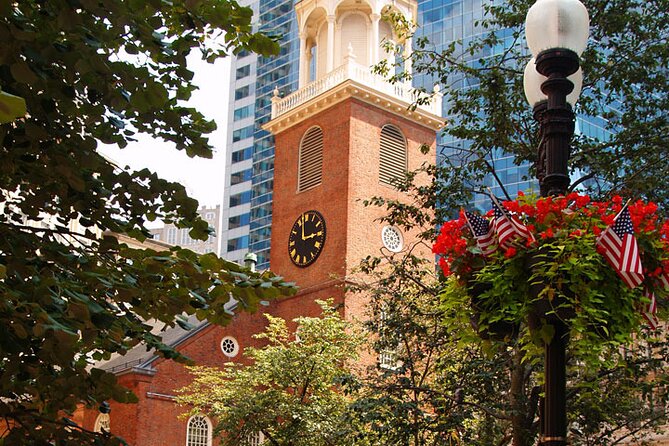
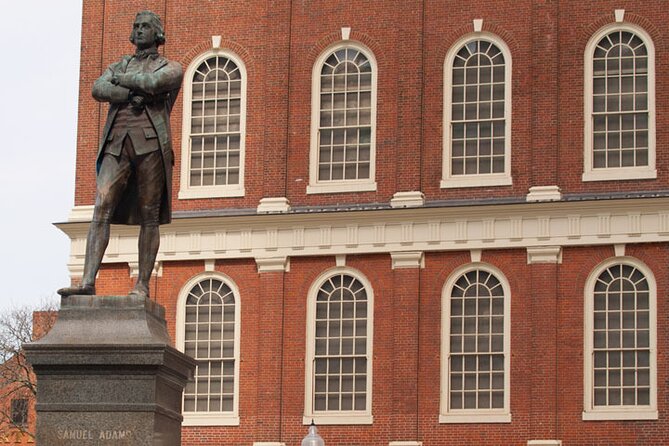
At Park Street Church, the focus shifts from government to public argument. When it was built, the church was the tallest building in the country. Its connection to the abolition movement also reminds you that Boston’s political conflicts did not end when the British left.
The nickname Brimstone Corner came from the forceful sermons associated with the area, along with a surprising use of the church’s cellar. That detail gives Mark room to add the kind of odd local fact that helps a place stick in your memory.
More Walking Tours in Boston
- Boston: Freedom Trail History Small Group Walking Tour
★ 5.0 · 6,450 reviews - Cambridge: Harvard University Student-Guided Walking Tour
★ 4.6 · 3,931 reviews - Harvard University Campus Guided Walking Tour
★ 4.5 · 3,632 reviews
Granary Burying Ground and the people behind the revolt
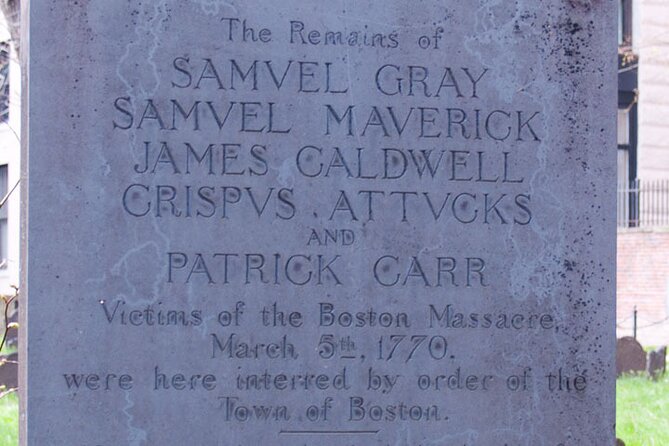
Granary Burying Ground is one of the tour’s strongest stops because the names of the Revolution become physical and immediate. Samuel Adams, Paul Revere, John Hancock, and victims of the Boston Massacre are buried here.
Rather than simply pointing out famous graves, Mark introduces the roles these people played. That matters because Boston’s independence story was not made by a single hero. It involved merchants, politicians, printers, soldiers, religious figures, and ordinary residents caught in a dangerous dispute.
The stop lasts about 10 minutes and is free to enter. You will want comfortable shoes and a little care underfoot in an old cemetery. This is also one of the easier places to pause for photographs without losing the thread of the tour.
King’s Chapel adds an earlier layer of tension. The 1749 Anglican church represents the struggle between Puritan Boston and royal authority, including a dispute over land taken for an unwanted church in the 1680s.
That story helps explain why resentment toward British rule had roots well before the Boston Tea Party. You are not just hearing about a war that suddenly appeared in 1775. You are tracing decades of religious, political, and legal friction.
Old City Hall, Old South, and the argument over power
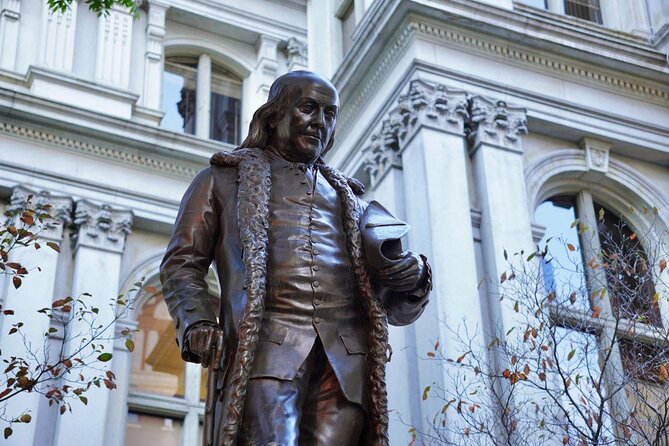
At Old City Hall, the tour points out a statue of Benjamin Franklin and a marker connected to the oldest continuously operating school in the colony. This is a short stop, but it adds texture to the civic world around the Freedom Trail.
The setting also shows how much of Boston’s story is packed into a small downtown area. In a few blocks, you move from government buildings to burial grounds, churches, schools, and meeting halls.
Old South Meeting House is one of the key political stops. Colonial meeting houses were not just places for worship. They were public forums where preachers and politicians could address large crowds.
Samuel Adams used this Puritan meeting house before the Boston Tea Party. The tour presents the meeting as part of the chain of events that made open conflict increasingly likely. That is a useful way to approach the Revolution, because the famous acts did not happen in isolation.
Interior admission is not included here. You will hear the story from outside unless you choose to pay separately for entry, making this tour a good overview but not a substitute for a full museum visit.
The Old State House brings the political dispute into sharper focus. It once housed the hated British government, and it was the setting for a major 1761 court battle over colonial rights.
It was also the site of the 1770 Boston Massacre. Mark does not reduce that event to a simple slogan. The tour asks you to consider what happened, how the incident was presented, and why the event became such a powerful tool for colonial resistance.
That willingness to examine competing interpretations is one of the tour’s best features. You get a story with tension and uncertainty, not a polished parade of predictable heroes.
Faneuil Hall and Boston’s public voice
Faneuil Hall Marketplace is another place where the tour connects buildings to speech and protest. Samuel Adams argued against taxation without representation here, and Frederick Douglass later spoke about abolition.
This is a valuable reminder that the Freedom Trail is not only a Revolutionary War route. It also follows Boston’s longer tradition of public debate, reform, and disagreement.
The marketplace can be a busy city setting, so you should expect some noise and foot traffic around this part of the walk. A small group helps, and Mark’s experience guiding people through a busy city is useful here.
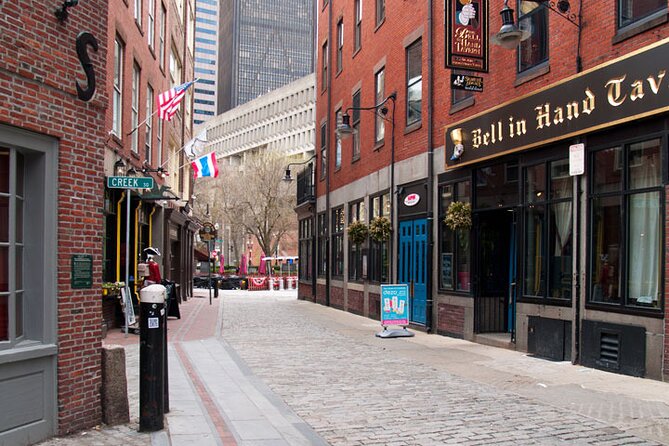
The Blackstone Block provides some of the tour’s less obvious material. You hear about the Massachusetts Spy newspaper, a bar known as the Headquarters of the Revolution, and the home of Ebenezer Hancock, John Hancock’s brother.
Ebenezer’s house was used to store money sent by the French to support the Revolution. Details like this make the political story more practical. Wars require money, communications, meeting places, and people willing to handle dangerous work behind the scenes.
This is also where the tour appears to go beyond a basic list of official trail markers. If you have already read a little about Paul Revere and Samuel Adams, these supporting characters and less celebrated locations can give you something new.
A different kind of day out entirely:
- Boston Duck Boat Sightseeing City Tour with Cruise Along Charles River
★ 4.5 · 9,378 reviews - Boston Hop-On Hop-Off Trolley Tour with 13 Stops
★ 4.5 · 5,576 reviews - Boston: City Cruises Whale Watching Cruise
★ 4.5 · 4,710 reviews - Boston Duck Tour: The Original and World-Famous
★ 4.6 · 3,935 reviews
Paul Revere House and the road toward Lexington
The Paul Revere House is one of Boston’s oldest remaining homes. Revere bought the 1680 post-medieval house in 1770, and he raised sixteen children there with two wives.
The stop is brief, about five minutes, and admission is not included. That means you should not expect a long interior visit as part of the $79 price. Instead, the guide uses the house as a doorway into Revere’s life and the larger network of artisans, riders, printers, and political activists around him.
At Old North Church, the familiar lantern story comes into view. Patriots used the church to signal across the water toward Charlestown that British troops were on the move toward Cambridge, Lexington, and Concord.
This stop works especially well because you can connect the physical geography to the story. The narrow water crossing, the church tower, and the route toward Charlestown all help explain why signals and timing mattered.
The walking route is not designed as a theatrical performance. Mark’s approach is more direct and grounded. He uses stories, maps, and context, while also making room for questions and photographs. Several people have found that style more engaging than a memorized script.
Copp’s Hill and the Battle of Bunker Hill

Copp’s Hill Burying Ground is a short but important bridge between Boston and Charlestown. From here, the guide explains the geography of the Battle of Bunker Hill and points out a grave marker with its own story.
The geography matters. You are preparing to leave the older downtown core and follow the Revolution toward the battle site. The walk becomes a lesson in distance, position, and why the name Bunker Hill can be confusing.
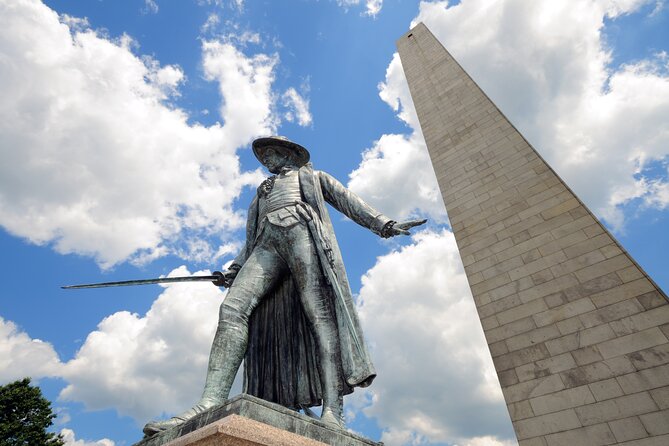
The battle was actually fought on Breed’s Hill. The British won, but their losses were about three times those of the Patriots. That outcome captures the early war in miniature: the colonial forces could suffer defeat while still proving that British troops would pay heavily for every advance.
Bunker Hill Monument is the point where the tour’s earlier political arguments become armed conflict. The monument itself is free to visit, and the stop lasts about 10 minutes.
Do not expect a long museum session here. The value comes from Mark’s explanation of the battle, the terrain, and the significance of the casualties. If you want an extended visit inside the monument or additional exhibits, plan that separately.
Finishing at the USS Constitution
The USS Constitution is the final stop, and it gives the tour a satisfying closing point. Old Ironsides is the oldest commissioned warship in the world and served the United States in both domestic and foreign waters.
After four hours of walking through political speeches, cemetery stones, church towers, and battlefield geography, the ship gives you a tangible reminder that the new nation had to defend itself after independence was declared.
The tour concludes at the USS Constitution in the Charlestown Navy Yard, near the USS Constitution Museum at Building 22. Admission to interiors is not included, so confirm what you want to see before arriving. The supplied details identify the ship as the final stop, but this tour should be treated as a guided overview rather than a full museum or ship tour.
Ending here also affects your day’s planning. You do not return to Park Street, so arrange your next activity from Charlestown rather than assuming you will finish downtown.
How the four-hour pace feels
Four hours sounds long on paper. In practice, the time is divided among many stops, with most explanations lasting around 5 to 10 minutes. That keeps the walk from becoming one continuous lecture.
The tour covers about 2.8 miles, though the full outing can feel longer because you stop, turn, cross streets, enter burying grounds, and move through crowded areas. One participant estimated about 10,000 steps. You should wear walking shoes and be ready to stay on your feet.
The pace has been described as manageable even for older adults, with mostly flat walking. Still, moderate physical fitness is required. Children under 12 may struggle unless they already enjoy detailed history, while teenagers with an interest in the Revolution should find plenty to hold their attention.
A maximum of 16 people is a real advantage. Mark can keep track of the group, answer questions, and help people stay together in city traffic without the stiffness of a large coach tour.
The tour is offered in English only. Mobile tickets make arrival straightforward, and the meeting point is near public transportation. Service animals are allowed.
What makes Mark’s guiding style effective
The strongest praise centers on Mark’s command of the subject and his ability to explain cause and effect. He has studied Revolutionary War history for years and uses his own material, maps, and connecting stories.
That does not mean the tour is dry. His style includes humor and practical local suggestions, including restaurant advice after the walk. He has also been praised for including women’s contributions, lesser-known historical figures, and locations not always emphasized on a standard Freedom Trail route.
I especially value the reported balance between detail and pace. Mark covers a lot, but the aim is not to bury you in dates. He keeps the story moving from royal authority, to colonial protest, to armed resistance, and finally to the young nation’s military life.
He also provides water when needed, keeps an eye on the group, and helps people who have trouble locating the starting point. Those are small touches, but they matter during a long city walk.
Is $79 a fair price?
At $79 per person, this is not the cheapest way to see the Freedom Trail. You can walk much of the route independently for free by following the marked line through Boston.
The value comes from the structure. One guide covers the complete route, explains the political and military sequence, adds locations beyond the basic trail, and gets you all the way to Bunker Hill and the USS Constitution. You also avoid spending time piecing together the story from separate plaques and guidebooks.
The price is easier to justify if this is your first Boston visit or if your group wants a serious introduction to the Revolution. It is less compelling if you mainly want to photograph the landmarks, enter every building, or move at your own pace.
Remember that interior admissions are separate. The tour gives you the outside context and a guided route, not a package covering every historic building’s admission charge.
Who should book this Boston walking tour?
You should book it if you want the complete Freedom Trail in one continuous story. It suits couples, families with history-minded teenagers, solo visitors, and older walkers who can handle several hours on foot.
It is also a good choice if you want more than the standard names. Mark’s extra attention to women, lesser-known figures, newspapers, money, and political meeting places adds depth without turning the tour into a university lecture.
Think twice if you dislike long walks, need frequent private breaks, or want extensive interior time at the Old State House, Old South Meeting House, Paul Revere House, or USS Constitution. You may prefer a shorter orientation walk followed by self-guided visits inside.
The tour requires good weather. If poor conditions cancel it, you can choose another date or receive a full refund. You can also cancel for a full refund up to 24 hours before the start time. Book early if your Boston dates are fixed, since the experience is often reserved well ahead of time.
Final verdict: book it for the story, not just the landmarks
I would book this tour if I wanted Boston’s Revolution explained clearly from beginning to end. The route is long, but it earns its length by connecting Park Street, the old civic center, the North End, Bunker Hill, and Old Ironsides.
The best reason to go is Mark’s teaching style. He brings strong subject knowledge, humor, maps, and lesser-known details without relying on excessive theatrics. Bring good shoes, water, weather protection, and enough curiosity for a four-hour lesson on foot.
If that sounds like your kind of sightseeing, $79 is a solid value. If you only want a quick look at the famous stops, walk the trail independently and spend your money on the interiors that interest you most.
FAQ
How long is the Entire Freedom Trail Walking Tour?
The tour lasts approximately four hours and covers the entire 2.8-mile, or 4-kilometer, Freedom Trail from Boston to Charlestown.
Where does the tour begin?
The meeting point is on Beacon Street near Park Street in Boston, Massachusetts.
Where does the tour end?
The tour ends at the USS Constitution in the Charlestown Navy Yard, near the USS Constitution Museum at Building 22.
What time does the tour start?
The scheduled start time is 10:00 a.m.
Is admission to the historic buildings included?
No. Admission to interiors is not included. The tour includes the narrated walking route and visits to the listed locations, while interior entry fees are separate.
Does the tour include Bunker Hill and the USS Constitution?
Yes. The route includes Bunker Hill Monument and finishes at the USS Constitution, also known as Old Ironsides.
How many people can join the tour?
The tour has a maximum group size of 16 people.
Can I cancel for a refund?
Yes. You can cancel at least 24 hours before the start time for a full refund. Poor weather cancellations offer a different date or a full refund.
Just added in Boston
- View Boston Observation Deck Admission Tickets★ 4.5 · 314 reviews
- Delicious Donuts of Boston: A Sweet History Walking Tour★ 5.0 · 1,038 reviews
- Boston’s Freedom Trail: A Revolutionary Walking Tour★ 5.0 · 1,343 reviews
- Freedom Trail Walking Tour 250★ 4.5 · 1,118 reviews
- Sunset Sailing Cruise on a Tall Ship in Boston Harbor★ 4.5 · 414 reviews
- Narrated Sunset Cruise of Boston Harbor★ 4.0 · 532 reviews
- City Cruises Salem High Speed Ferry to/from Boston★ 4.5 · 727 reviews
- Boston’s North End Food and History Walking Tour★ 5.0 · 459 reviews
Walking Tours, compared.

History and Hauntings of Salem Guided Walking Tour
Read our review →
New Orleans Premier Ghost, Voodoo and Vampire Walking Tour
Read our review →

Freedom Trail History Small Group Walking Tour
Read our review →
Historic Charleston Guided Sightseeing Walking Tour
Read our review →
New Orleans Food Walking Tour of the French Quarter with Small-Group Option
Read our review →
Cambridge: Harvard University Student-Guided Walking Tour
Read our review →Browse the lists this tour appears in