
Reviewed · WALKING TOURS
The Full Revolutionary Story Epic Small Group Boston Walking Tour
History works better in the open air. This Boston walk links the Revolution to the streets where it happened, using a chronological route, strong storytelling, and small-group attention. I especially like the way it follows events in historical order instead of simply ticking off Freedom Trail stops, and I like that it leaves the brick path to show modern Boston, the Greenway, Financial District, and Harborwalk. The main catch is simple: three-plus hours on foot demands good shoes, stamina, and weather-ready clothing.
Tyler, Mike, Chris, and Tom are among the guides praised for making the story lively rather than dusty. Maps, character cards, visual aids, and even Lego soldiers have been used to explain complicated events. The tour is educational and serious, but not stiff. It is not a children’s version of the Revolution, so younger visitors need to enjoy sustained history talk.
In This Review
- What makes this Boston walking tour different
- Starting at City Hall Plaza with Boston in view
- King’s Chapel and the first Boston stories
- Old City Hall, Franklin, and the arguments of a new nation
- Old South Meeting House and the turn toward rebellion
- The modern city around Post Office Square
- The Greenway and the walk into the North End
- Old North Church, Lexington, Concord, and Bunker Hill
- Boston Harbor and the North End finish
- How much walking and time you should expect
- Is $55 a fair price?
- Who should book this tour?
- Final verdict on The Full Revolutionary Story
- FAQ
- How long does The Full Revolutionary Story tour last?
- Where does the tour begin?
- Where does the tour end?
- How many people can join the tour?
- Is transportation included?
- Are museum entrances included?
- Is the tour suitable for children?
- What happens if the weather is poor?
What makes this Boston walking tour different
- The Freedom Trail is told chronologically: You move through the causes, tensions, protests, and battles in the order they unfolded.
- Small groups cap at 15 people: That gives the guide a better chance to answer questions and keep the group together.
- The route leaves the standard trail: You see the Greenway, Post Office Square, the Financial District, North Square, and Boston Harbor.
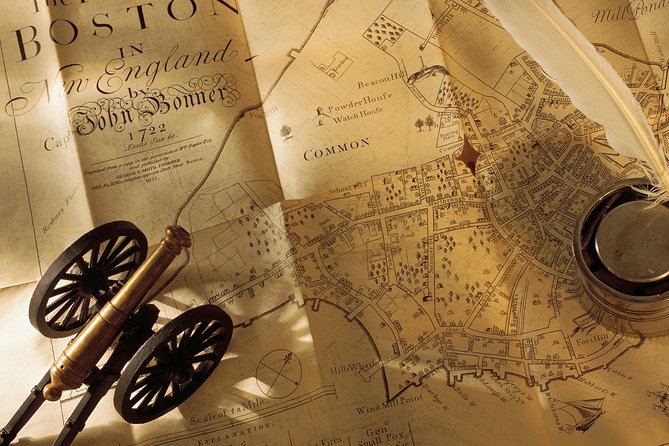
- The history is taught with visual aids: Maps, character badges, and simple props help make battles and political disputes easier to follow.
- The North End finish is useful: You end near restaurants, public transportation, restrooms, and Boston Harbor.
- The price covers a long lesson and a full city walk: At $55, this is good value if you want context, not just photographs.
Starting at City Hall Plaza with Boston in view
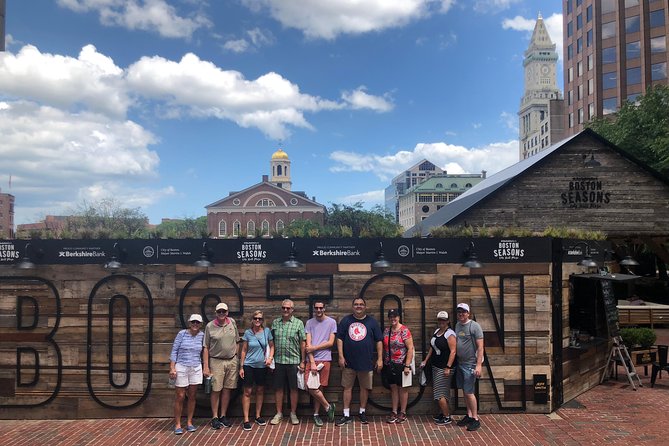
Your meeting point is City Hall Plaza, directly across from Faneuil Hall. Look for the guide between Five Iron Golf and City Hall, near the seasonal beer garden and the large BOSTON sign. The Bill Russell statue is nearby, making a good opening photo with Faneuil Hall behind you.
This is a smart start. You get a present-day Boston landmark before stepping into the colonial story. Boston City Hall itself, famous for its unusual architecture, becomes an early reminder that the city is not a preserved museum. Old and new sit close together here, sometimes gracefully and sometimes in architectural arguments.
The first stop takes you to King’s Chapel Burying Ground. Here the guide introduces the people who settled Massachusetts Bay and explains the Puritans, whose religious beliefs and social rules shaped the colony. This early context matters. The Revolution did not appear from nowhere in 1775. It grew out of older arguments about authority, religion, property, rights, and who had a voice in public life.
More Walking Tours in Boston
- Boston: Freedom Trail History Small Group Walking Tour
★ 5.0 · 6,450 reviews - Cambridge: Harvard University Student-Guided Walking Tour
★ 4.6 · 3,931 reviews - Harvard University Campus Guided Walking Tour
★ 4.5 · 3,632 reviews
King’s Chapel and the first Boston stories
You then pass Boston’s first Anglican church and hear about Brimstone Corner, known for its fiery sermons. The stop also connects Boston’s revolutionary era to the later fight against slavery, including William Lloyd Garrison’s 1829 public address against slavery at the site.
That wider frame is one of the tour’s strengths. You are not asked to treat the Revolution as a neat parade of heroic names. The route points toward competing beliefs, public pressure, and the long, unfinished work of democracy.
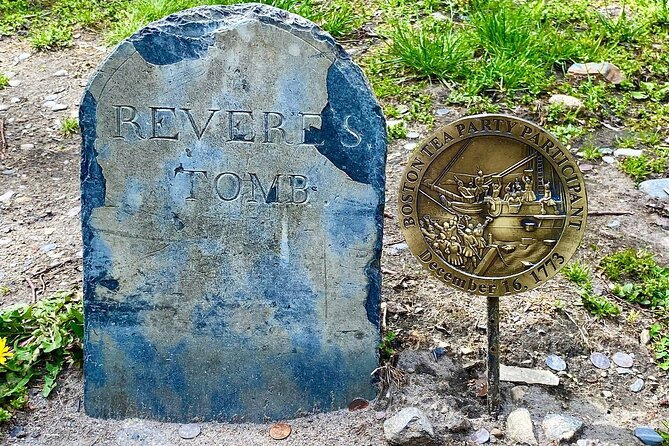
At Granary Burying Ground, the guide visits the graves of Paul Revere, John Hancock, and Samuel Adams. This is a familiar stop, but the discussion goes beyond names on a sign. You learn who the Sons of Liberty were and how their public image fits into the larger political struggle.
The cemetery is compact, and the stop lasts about 15 minutes. It is one of the busier places on the route, so listen closely and stay near the guide. The value comes from the explanation, not from wandering around alone and trying to match every grave to a famous person.
Old City Hall, Franklin, and the arguments of a new nation
Old City Hall provides a striking architectural backdrop for a discussion of democracy and the barriers built into early political life. This is a useful pause in the usual patriotic story. The tour asks you to consider who could participate, who was excluded, and how difficult self-government proved to be.
Near the Benjamin Franklin statue, you learn about America’s first public school and Franklin’s connection to it. The stop is short, but it gives the famous inventor, printer, and statesman a local setting. Franklin becomes more than a portrait on a bill or a name attached to a founding-era anecdote.
The route then reaches the Old State House, the oldest public building in the country according to the tour description. This was the center of Massachusetts politics, where British authority and American rights collided in speeches and debate.
At the Boston Massacre site, the guide lays out the different groups caught in the crisis: British soldiers, local citizens, loyalists, and patriot leaders. The goal is not to flatten the event into a simple good-versus-bad scene. You get a sense of how rumor, anger, military occupation, and political organizing could push a tense city toward violence.
The route also passes a former publishing house associated with Ralph Waldo Emerson, Henry Wadsworth Longfellow, Nathaniel Hawthorne, and other literary figures. It is a useful reminder that Boston’s identity reaches beyond the Revolution. Politics, literature, education, medicine, finance, and shipping all grew together in this small but influential city.
Old South Meeting House and the turn toward rebellion
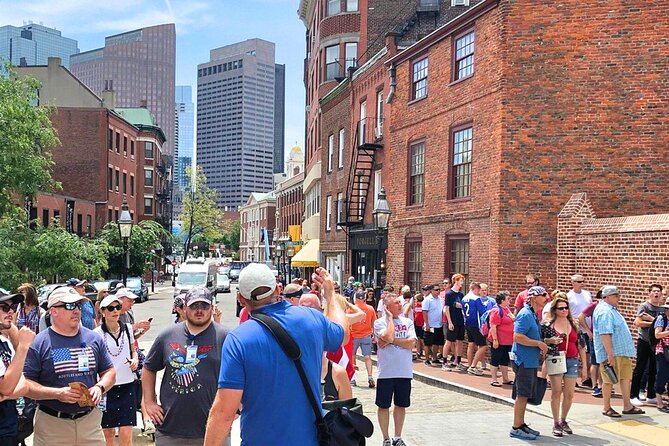
Old South Meeting House is where the Boston Tea Party story begins. The meeting house was a place for public argument, and the tour presents the Tea Party as the point when protest moved toward open revolt.
This stop works best when you understand the buildup. Taxes, trade rules, enforcement, and political representation had already sharpened the conflict. The tea was not an isolated outburst. It was a public act that made compromise much harder.
Museum admission is not generally included, although the tour description notes a built-in break for entry into Faneuil Hall and Quincy Market. The walk itself focuses on outdoor interpretation, so you should not expect a series of indoor museum visits. That keeps the group moving, but it also means you will spend most of the day exposed to sun, wind, rain, or cold.
A different kind of day out entirely:
- Boston Duck Boat Sightseeing City Tour with Cruise Along Charles River
★ 4.5 · 9,378 reviews - Boston Hop-On Hop-Off Trolley Tour with 13 Stops
★ 4.5 · 5,576 reviews - Boston: City Cruises Whale Watching Cruise
★ 4.5 · 4,710 reviews - Boston Duck Tour: The Original and World-Famous
★ 4.6 · 3,935 reviews
The modern city around Post Office Square

At Post Office Square and through the Financial District, the guide connects the revolutionary story to modern Boston. Education, health care, and finance now fill the downtown core, yet the old political disputes remain underfoot.
I like this section because it prevents the tour from becoming a parade of colonial buildings with no connection to current life. The old city was crowded, argumentative, commercial, and ambitious. Modern Boston still has that mix, only with taller buildings and more traffic.
Faneuil Hall follows. Known as the Cradle of Liberty, it represents the place where public protest could turn into organized political action. The building is both a historic symbol and a working urban attraction, so expect crowds and plenty of commercial activity around it.
Quincy Market comes next, with a blunt warning that tourist traps abound. That honesty is useful. The market can be fun for a quick look or snack, but you should not confuse its present-day food stalls with an authentic colonial experience. Treat it as a convenient break, not the heart of the tour.
The Greenway and the walk into the North End
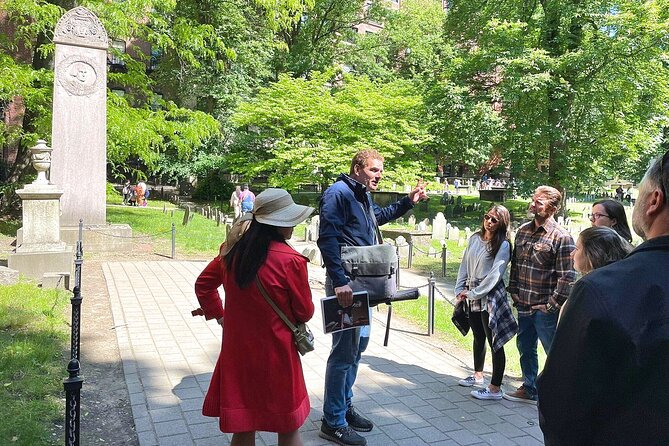
The Rose Fitzgerald Kennedy Greenway offers a welcome change from sidewalks and stone buildings. This long public garden runs through the center of Boston, showing how the city has reshaped itself while keeping its historic core close by.
From there, the route heads toward the North End. The Paul Revere House sits in North Square, one of the oldest and most charming squares in the city. The house is associated with the famous midnight rider, but the guide’s larger point is that the real person was more complicated and impressive than the simplified legend.
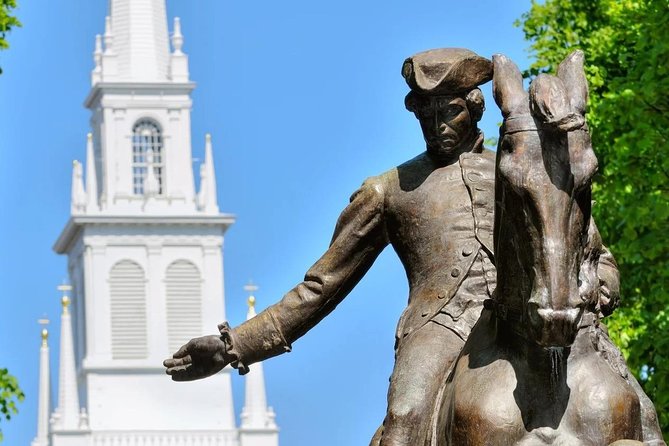
You also visit North Square Park, described as the oldest residential square in America, then stop at the Paul Revere statue for a classic photo. These places are close together, but the meaning changes from stop to stop. The house gives you domestic and neighborhood context. The square shows the old street pattern. The statue gives you the polished public memory.
The North End is one of the best parts of the route for anyone who wants history with food. It is Boston’s Little Italy, with pizza, seafood, clam chowder, Italian specialties, and cannoli. The tour ends nearby, so save lunch or dinner for afterward and ask the guide for recommendations.
Old North Church, Lexington, Concord, and Bunker Hill
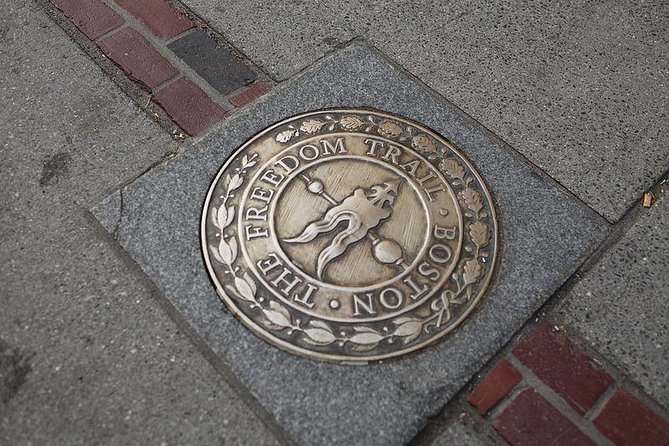
At Old North Church, the guide explains the signal associated with Paul Revere’s ride, then carries the story toward Lexington and Concord and the first major fighting. The familiar phrase about one lantern or two becomes part of a larger account of warnings, messengers, militia, and confusion.
The tour does not use costumes or present a staged reenactment. Instead, it uses explanation, maps, and props to help you picture the events. That approach suits anyone who wants to understand the sequence rather than pose for a theatrical photograph.
The route also passes the second-oldest burial ground in Boston from the outside. You do not enter this cemetery, but the terrace across the street offers views toward Charlestown and Boston Harbor.
Bunker Hill Monument receives a full discussion of the Battle of Bunker Hill, described as the largest battle of the American Revolution. Guides have used Lego soldiers and maps to show troop positions and the shape of the fighting. That may sound playful, but it solves a real problem: battles are hard to understand when you are standing on an ordinary city street with no diagram.
The tour also gives you an overview of the USS Constitution, known as Old Ironsides. It was not part of the American Revolution, and you see it from across Boston Harbor rather than visiting the ship. The guide offers tips for seeing it properly later, which is helpful if you have another block of time in Boston.
Boston Harbor and the North End finish
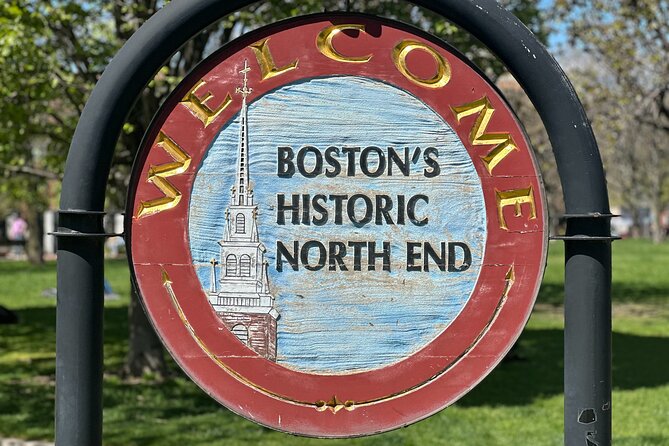
The final stretch follows Boston Harbor and the Harborwalk. You get views of the water, piers, wharfs, waterfront parks, Charlestown, and the city skyline. After several hours of political arguments and battlefield explanations, the harbor gives the story a physical ending: the British are finally pushed out of Boston.
The walk finishes at Lewis Wharf in the North End. This location is practical. Public restrooms are nearby, the Aquarium subway stop is less than a five-minute walk away, and the original meeting point is less than ten minutes away on foot. Parking is also available close to the endpoint.
A small surprise tea party on Boston Harbor is included as part of the ending. The supplied details do not describe exactly how it is presented, so think of it as a light closing touch rather than a full meal or formal event.
How much walking and time you should expect
The advertised duration is about three to three and a half hours, though one guide has gone into overtime while keeping the group engaged. The route covers a lot of ground, including downtown, the North End, the harbor, and the Bunker Hill discussion.
You should wear comfortable walking shoes. The route includes city sidewalks, standing at outdoor sites, and extended periods of listening. It is not a good choice if you have serious mobility limits. The tour requires moderate physical fitness, and there is no transportation included.
The experience runs in English and uses mobile tickets. Children of all ages can join if accompanied by an adult, but this is a serious history lesson rather than a simplified kids’ show. Older children and teenagers who enjoy stories, maps, and participation may get a lot from it.
Weather matters. The tour requires good weather, and poor conditions can lead to a rescheduled date or full refund. You can cancel for a full refund up to 24 hours before the start time. Bring layers and rain protection when the forecast looks uncertain, since most of the experience takes place outdoors.
Is $55 a fair price?
At $55 per person, this is not the cheapest way to see the Freedom Trail. You can follow much of the brick path on your own for free. But that comparison misses the main product: you are paying for a three-hour narrative, a small group of no more than 15 people, a chronological route, and interpretation that connects famous events to less obvious places.
The guides are praised for historical training, energy, humor, and clear teaching. Tyler has a master’s degree in American history and previously worked as a curriculum coordinator. Chris is described as a trained historian, while Mike is repeatedly praised for his passion, visual aids, and ability to make the time pass quickly.
I would consider the price good value if you want the causes and consequences explained. It is less compelling if your main aim is a quick checklist of photographs or indoor access to historic buildings. Museum admission beyond the stated Faneuil Hall and Quincy Market break is not included, so budget separately if you want to explore sites in detail.
Who should book this tour?
Book it if you want Boston’s Revolution told as a connected story rather than a collection of plaques. It suits history fans, first-time visitors, couples, solo visitors, and families with older children. It is also a strong first-day activity because it gives you a map of downtown, the North End, the waterfront, and several places you may want to revisit.
The tour is especially good for people who enjoy questions without easy answers. You will hear about patriots, loyalists, soldiers, merchants, religious settlers, enslaved people, political organizers, and ordinary citizens caught in public conflict.
Skip it if you dislike long outdoor walks, need frequent indoor breaks, or want a short introduction. Three and a half hours is a serious commitment. Cold, rain, or strong wind can make the route harder, even when the guide keeps the group interested.
Final verdict on The Full Revolutionary Story
I would book this tour for a first or second visit to Boston if the Revolution is high on your list. The best feature is the structure: events come first, and the sites support the story. The North End food advice, harbor views, modern city stops, and visual teaching tools add more value than a standard straight-line Freedom Trail walk.
Choose a day with decent weather, wear sturdy shoes, and arrive ready to listen. If you want a thoughtful history lesson that still leaves you near Boston’s best post-tour food, $55 is a fair price.
FAQ
How long does The Full Revolutionary Story tour last?
The tour lasts approximately three to three and a half hours. Some tours may run slightly longer if the guide continues the discussion.
Where does the tour begin?
It begins at City Hall Plaza, at 1 City Hall Square in Boston. The meeting area is between Five Iron Golf and City Hall, near the seasonal beer garden and the large BOSTON sign.
Where does the tour end?
The tour ends at Lewis Wharf in Boston’s North End, near Boston Harbor. The endpoint has nearby public restrooms, parking, public transportation, and restaurants.
How many people can join the tour?
The maximum group size is 15 travelers.
Is transportation included?
No. This is a walking tour, and transportation is not included.
Are museum entrances included?
Museum entry is not generally included. The experience does include a built-in break for entrance into Faneuil Hall and Quincy Market, according to the tour information.
Is the tour suitable for children?
Children may join, but they must be accompanied by an adult. The tour is suitable for all ages, though it is not designed as a simplified children’s history program.
What happens if the weather is poor?
The tour requires good weather. If the provider cancels because of poor conditions, you can choose another date or receive a full refund. You can also cancel up to 24 hours before the start time for a full refund.
Just added in Boston
- View Boston Observation Deck Admission Tickets★ 4.5 · 314 reviews
- Delicious Donuts of Boston: A Sweet History Walking Tour★ 5.0 · 1,038 reviews
- Boston’s Freedom Trail: A Revolutionary Walking Tour★ 5.0 · 1,343 reviews
- Freedom Trail Walking Tour 250★ 4.5 · 1,118 reviews
- Sunset Sailing Cruise on a Tall Ship in Boston Harbor★ 4.5 · 414 reviews
- Narrated Sunset Cruise of Boston Harbor★ 4.0 · 532 reviews
- City Cruises Salem High Speed Ferry to/from Boston★ 4.5 · 727 reviews
- Boston’s North End Food and History Walking Tour★ 5.0 · 459 reviews
Walking Tours, compared.

History and Hauntings of Salem Guided Walking Tour
Read our review →
New Orleans Premier Ghost, Voodoo and Vampire Walking Tour
Read our review →
Freedom Trail History Small Group Walking Tour
Read our review →
Historic Charleston Guided Sightseeing Walking Tour
Read our review →
New Orleans Food Walking Tour of the French Quarter with Small-Group Option
Read our review →
Cambridge: Harvard University Student-Guided Walking Tour
Read our review →Browse the lists this tour appears in