

Reviewed · HISTORICAL TOURS
Charleston historical walking tour with a Professor of History at The Citadel
Charleston rewards curious walkers. This three-hour tour pairs the city’s streets with Eric Lager, Ph.D., a history professor at The Citadel, giving you more than a quick parade of dates and pretty buildings. I like the small maximum of 12 people, and I like that you can ask detailed questions as you walk. The main tradeoff is simple: you cover a lot of ground and absorb a great deal of information, so this is not a light, slow-paced stroll.
The $40 price is a strong value for an expert-led introduction to Charleston, especially since taxes and fees are included. You will need to bring water, and admission is not included at several buildings, so plan on seeing some interiors only if you arrange those costs separately.
In This Review
- Key points to know before you book
- Why a Citadel history professor changes the walk
- Starting at Mills House and Dock Street Theater
- Pink House and Washington Square
- City Hall and the old statehouse
- St. Michael’s Church and the Washington connection
- The Old Exchange, the dungeon, and the French Huguenots
- Walking through the French Quarter
- Hibernian Hall and the road to secession
- Finishing at the Battery with Fort Sumter in view
- What the $40 price really gets you
- How demanding is the three-hour walk?
- Who will appreciate this Charleston walk most?
- Booking advice and cancellation terms
- Should you book this tour?
- FAQ
- How long does the Charleston history walking tour last?
- How many people can join the tour?
- Who leads the walking tour?
- Where does the tour start and finish?
- Does the tour go to Fort Sumter?
- Are admission fees included?
- What happens if the weather is poor?
Key points to know before you book
- A real professor leads the walk: Eric Lager teaches at The Citadel and holds a Ph.D. in history, giving the tour unusual depth.
- The group is capped at 12: You should be able to hear the guide and ask questions without shouting across a crowd.
- The route covers Charleston’s biggest historical themes: Colonial Charleston, the Revolution, religion, architecture, slavery-era Charleston, secession, and the Civil War all enter the story.
- Fort Sumter is viewed from the Battery: This tour does not take you by boat to the fort.
- The route ends near Rainbow Row: You finish at 39 East Battery, well placed for more sightseeing in the historic district.
- Allow three hours and wear sensible shoes: The tour requires moderate physical fitness and takes place outdoors in changeable weather.
Why a Citadel history professor changes the walk
Charleston has no shortage of tours. Some focus on ghosts, some on architecture, and others on a quick collection of famous names. This one takes a broader view, using buildings and streets to explain how the city developed over roughly four centuries.
Eric Lager is identified as a professor of history at The Citadel, and that academic background shapes the experience. He is not simply pointing out a church and giving you its construction date. He connects politics, religion, architecture, war, and the people who shaped Charleston. That approach is especially useful in a city where one block can contain traces of several different eras.
You should also expect room for questions. The small group makes it easier to ask about a particular building, a historical figure, or a connection to the American Revolution and Civil War. Several comments about the tour point to Eric’s humor, personal manner, and willingness to discuss subjects beyond the basic route.
That said, academic depth is not for everyone. If you prefer a casual stroll with occasional facts and plenty of unscheduled photo time, this may feel packed. The tour aims to teach, and it succeeds by moving steadily from stop to stop.
More History Tours in Charleston
- Charleston’s Old South Carriage Historic Horse & Carriage Tour
★ 5.0 · 10,023 reviews - Historic Charleston Guided Sightseeing Walking Tour
★ 5.0 · 6,216 reviews - Charleston Horse-Drawn Carriage Tour: Explore Historic Charleston
★ 5.0 · 3,561 reviews
Starting at Mills House and Dock Street Theater
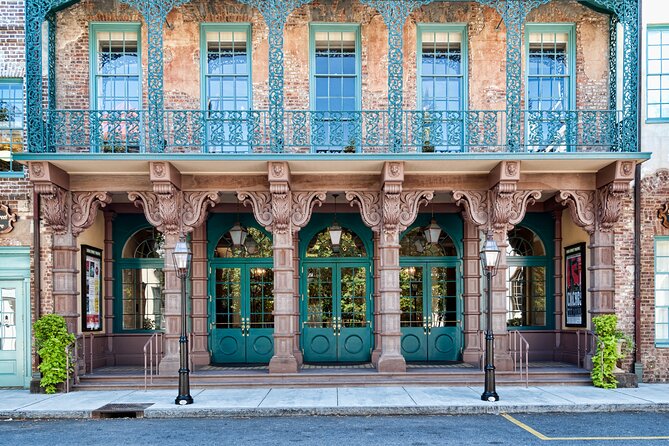
The meeting point is 108 Meeting Street, outside the Mills House Charleston, Curio Collection by Hilton. The hotel gives the opening minutes a useful Civil War connection, since it played a role during the early part of that conflict.
From there, the walk reaches Dock Street Theater. This stop opens the door to Charleston’s theatrical past and the complicated characters connected with the first theater built in North America. The point is not simply to admire the façade. You begin to see how entertainment, status, and public life worked in the old city.
Each of these first stops receives about 10 minutes. That is enough time for a focused explanation, but not a lengthy interior visit. If you want to linger over architectural details or take many photographs, you may need to do so after the tour.
Pink House and Washington Square
The Pink House Gallery is a short five-minute stop. The building dates to about 1712 and is described as one of Charleston’s oldest. It is a good example of how this tour uses small details to fill out the larger story. A modest-looking structure can carry more historical weight than a grand monument.
Washington Square allows about 15 minutes and shifts the focus to public space and civic memory. Its monuments provide a way to discuss people and events honored by Charleston over time. This is one of the stops where Eric’s broader teaching style should be most useful, since a square can tell you as much about later generations and their choices as it does about the original city.
I would pay attention to how the guide handles changing interpretations of the past. Charleston’s public monuments and historic buildings are not neutral decoration. They reflect what different periods chose to remember, celebrate, or leave out.
City Hall and the old statehouse
Charleston City Hall has had several lives. Before becoming City Hall, the building served as a meat market and a bank. That unusual sequence makes it an efficient lesson in the changing needs of a growing city.
The stop at Charleston County Courthouse adds a political layer. The building once served as the old South Carolina statehouse, so the discussion moves from local government to the state’s larger role in national affairs.
Both stops last about 10 minutes. You are not simply collecting postcard views. You are following the way Charleston’s buildings changed function as the city’s economy and government changed. I find that kind of explanation more useful than a list of dates because it helps you read the city on your own later.
More Walking Tours in Charleston
- Ghosts of Charleston Night-Time Walking Tour with Unitarian Church Graveyard
★ 4.5 · 2,835 reviews - Hidden Alleyways and Historic Sites Small-Group Walking Tour
★ 5.0 · 2,335 reviews - Highlights of Charleston Guided Walking Tour
★ 5.0 · 2,206 reviews - Charleston Haunted Booze and Boos Ghost Walking Tour
★ 5.0 · 1,569 reviews
St. Michael’s Church and the Washington connection
St. Michael’s Church is one of the route’s major architectural and religious landmarks. Completed in 1761, it is Charleston’s oldest church edifice. The 10-minute stop gives Eric a chance to explain the church’s place in the city’s religious life and its relationship to Charleston’s colonial past.
The Heyward-Washington House follows. George Washington stayed here during his visit to Charleston in 1791. The house is an admission-not-included stop, so the tour may focus on its exterior and historical importance rather than taking you inside.
That distinction matters. If you have already planned a paid house visit, this walk can help you understand why the site matters before you enter. If you are counting every dollar, you can still see the building from the route, but you should not assume admission is covered by the $40 tour price.
The Old Exchange, the dungeon, and the French Huguenots
The Old Exchange and Provost Dungeon is another compact stop, listed at about five minutes. It was the last public building built by the British in North America, and the site is linked to the ratification of the Constitution in 1788.
The short time here means the guide has to choose the most useful details. That can be a plus, since the stop stays focused, but anyone wanting an extended examination of the building will want to return later. Admission is not included.
The French Huguenot Church receives about 10 minutes. Charleston’s French Huguenot community is an important part of the city’s story, and this church is identified as the first built in the Gothic Revival style. The stop adds religious diversity to a route that might otherwise focus too heavily on military and political history.
I especially like this part of the walk because it helps explain Charleston as a meeting place for different European traditions. The city’s architecture and institutions did not come from one single source.
Walking through the French Quarter
The French Quarter gets about 15 minutes, making it one of the longer area-based stops. Here, the pleasure is in seeing how the individual buildings, streets, and churches work together.
This is also a moment when the tour shifts from single landmarks to the character of a neighborhood. You can take in the compact streets and old façades while Eric explains the forces that shaped the district. The French Quarter is attractive, but the guide’s role is to keep it from becoming a simple backdrop for photographs.
The area can be busy, and the walking surface may require care. Keep your attention on the guide, since the group is moving through a working part of the city rather than a closed museum.
Hibernian Hall and the road to secession
Hibernian Hall brings the story into the political tensions that helped lead to disunion. The building is connected with the seeds of secession and also offers a lesson in Greek Revival architecture.
This is an important transition in the route. Charleston’s Civil War story did not begin at Fort Sumter in 1861. Political arguments, regional loyalties, economic interests, and ideas about government had been building for years. A guide with a background in nineteenth-century American and European history can give that transition more context than a quick battlefield reference.
Admission is not included at Hibernian Hall. The stop itself is about 10 minutes, so you should think of it as a guided exterior lesson unless you make separate arrangements.
Finishing at the Battery with Fort Sumter in view
The final stop is the Battery, at 39 East Battery, near the Rainbow Row section of Charleston. From here, you can look across the harbor toward Fort Sumter National Monument, where the first shots of the Civil War were fired.
A crucial practical detail: the tour does not take you out to Fort Sumter. You see it from the Battery. The tour therefore works well as a city history walk, but it does not replace a boat trip and fort visit if you want to walk the site itself.
The Battery is a fitting ending because it links Charleston’s grand waterfront setting with the national crisis that defined its later history. After the tour, you are already near Rainbow Row and other historic streets, so the location makes it easy to continue exploring on foot.
What the $40 price really gets you
At $40 per person, this is priced above a basic group stroll but below the cost of many private guides. The value comes from the guide’s academic background, the small group, and the sheer amount of context packed into approximately three hours.
Taxes and fees are included. Bottled water is not, and there is no private transportation. Since the route is a walking tour through central Charleston, the lack of transportation is not a serious flaw, but you should arrive ready to walk and bring your own drink.
Admission is not included at the Heyward-Washington House, Old Exchange and Provost Dungeon, Hibernian Hall, and Fort Sumter National Monument. In Fort Sumter’s case, the tour only views the fort from the Battery, so the extra cost would relate to a separate visit rather than this route.
I consider the price especially fair for people who want to understand Charleston rather than simply photograph it. If you ask questions and take advantage of Eric’s expertise, you receive the sort of context that can improve the rest of your stay.
How demanding is the three-hour walk?
The tour requires a moderate level of physical fitness. You will be outside for about three hours, walking between stops and standing while the guide talks. The route does not include private transportation, and the stop timings show that the experience moves at a steady pace.
Wear comfortable shoes. Bring water, sunscreen, or a rain layer according to the forecast. The tour requires good weather, and poor conditions can lead to a different date or a full refund.
Cold weather is worth taking seriously. A recent tour took place in temperatures around 40 degrees, yet the pace and presentation still made the experience worthwhile. Rain has also not necessarily prevented the walk, but the formal policy allows cancellation when weather makes the experience unsuitable.
The tour is offered in English. Service animals are allowed, and the meeting point is near public transportation. The information provided does not promise a fully accessible route, so you should confirm specific mobility needs before booking.
Who will appreciate this Charleston walk most?
I would choose this tour early in a Charleston visit if you enjoy history, architecture, politics, religion, or the Civil War. The route gives you a working framework for later visits to houses, churches, museums, and Fort Sumter.
It is particularly well suited to:
- History enthusiasts who want more than basic facts
- People interested in architecture and how buildings changed use
- Couples and solo visitors who prefer a small group
- Families or friends willing to listen and ask questions
- Anyone who wants a city orientation led by an academic historian
The tour may be less suitable if you want a relaxed sightseeing loop with little talking. It also may not fit if you have limited walking ability or dislike spending several hours outdoors.
The small-group limit of 12 is one of the best features. You are close enough to hear, and Eric has more room to respond to questions than a guide leading a large crowd. That personal exchange is a major part of the value.
Booking advice and cancellation terms
This experience is often reserved about 22 days in advance, so I would not leave it until the last moment if your Charleston dates are fixed. Confirmation is provided at booking.
You can cancel for a full refund up to 24 hours before the start time. Cancellations or changes made within 24 hours are not refunded or accepted. If bad weather cancels the tour, you are offered another date or a full refund.
Because the route ends near Rainbow Row, I would avoid scheduling a tight lunch reservation immediately afterward. The stated duration is approximately three hours, and the tour has been described as lasting three hours or a little longer.
Should you book this tour?
Book it if you want Charleston explained by a serious historian who can connect buildings to larger political and social events. Eric Lager’s academic training, humor, and willingness to answer questions make this a strong choice for people who like substance.
Skip it if your ideal city walk is mostly photographs, shopping, and short anecdotes. Also remember that you will not enter Fort Sumter on this tour, and several other historic sites have admission costs outside the $40 fee.
For most history-minded visitors, I would place this near the top of the Charleston list. Take it early, bring water, wear good shoes, and let the rest of your sightseeing grow from the story you hear on these streets.
FAQ
How long does the Charleston history walking tour last?
The tour lasts approximately three hours. The listed stops account for much of that time, with the remaining time used to walk between locations and hear the guide’s explanations.
How many people can join the tour?
The tour has a maximum of 12 travelers. This keeps the group small enough for easier listening and personal questions.
Who leads the walking tour?
The tour is led by Eric Lager, Ph.D., a professor of history at The Citadel. His background includes American and European nineteenth-century history.
Where does the tour start and finish?
It starts at 108 Meeting Street in Charleston, South Carolina. It finishes at 39 East Battery, near Rainbow Row.
Does the tour go to Fort Sumter?
No. You view Fort Sumter National Monument from the Battery in Charleston Harbor. The tour does not travel out to the fort.
Are admission fees included?
All fees and taxes for the tour are included, but admission is not included at the Heyward-Washington House, Old Exchange and Provost Dungeon, Hibernian Hall, or Fort Sumter National Monument.
What happens if the weather is poor?
The experience requires good weather. If it is canceled because of poor conditions, you can choose another date or receive a full refund. You can also cancel up to 24 hours before the start time for a full refund.
Just added in Charleston
- Middleton Place Admission with Self Guided Tour and Lunch★ 4.5 · 326 reviews
- Charleston Ghosts of Liberty Guided Walking Tour★ 4.5 · 473 reviews
- 2-Hour Guided Kayak Eco Tour in Charleston★ 5.0 · 954 reviews
- Charleston’s Best Highlights: History, Culture & Architecture★ 5.0 · 422 reviews
- Undiscovered Charleston: Half Day Food, Wine & History Tour with Cooking Class★ 5.0 · 948 reviews
- Savor the Flavors of Charleston Walking Food Tour★ 4.5 · 881 reviews
- Afternoon Schooner Sightseeing Dolphin Cruise on Charleston Harbor★ 4.5 · 620 reviews
- Real Hauntings of Charleston! (Small Group Ghost Tour)★ 5.0 · 724 reviews
Historical Tours, compared.


History and Hauntings of Salem Guided Walking Tour
Read our review →
Charleston’s Old South Carriage Historic Horse & Carriage Tour
Read our review →

Big Island in a Day: Volcanoes Waterfalls Sightseeing and History
Read our review →
Freedom Trail History Small Group Walking Tour
Read our review →
Historic Charleston Guided Sightseeing Walking Tour
Read our review →
Starship Landmark 90 Minute Sightseeing Cruise
Read our review →Browse the lists this tour appears in