
Reviewed · WORKSHOPS
Surfing Lessons On Waikiki Beach
Waikiki makes first waves feel possible. This 90-minute surfing lesson combines a sandy, shallow beach with hands-on coaching, and I like that boards, leashes, and a locker are included. I also like the small advertised group size of five, which can give you more time with an instructor than a large beach class.
The main concern is value. At $129 per person, you are paying for a short lesson, and the quality can depend heavily on the instructor, surf conditions, and how many people are actually placed in the group. Most feedback is highly positive, but a few serious complaints involve weak supervision and crowded sessions.
In This Review
- Key things to know before you book
- Meeting at Big Wave Dave Surf & Coffee
- Why Waikiki works for a first lesson
- The 20-minute beach lesson
- Getting on the board in Waikiki
- How much water time will you get?
- Safety is the deciding factor
- Equipment, lockers, and extra costs
- Is $129 a fair price?
- Who will enjoy this most?
- Booking, weather, and cancellation details
- Should you book the Waikiki lesson?
- FAQ
- Where does the surfing lesson begin?
- How early should I arrive?
- Is a surfboard included?
- Can I store my belongings during the lesson?
- Do I need to know how to swim?
- How many people are in the group?
- What happens if the weather is poor?
Key things to know before you book
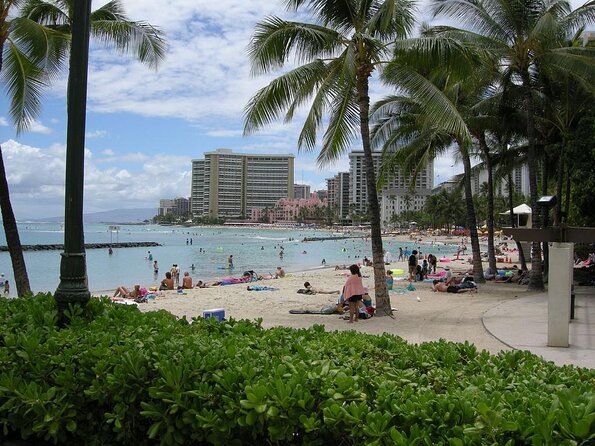
- Waikiki is built for beginners: The south-facing shore has shallow water and a sandy bottom, making falls less intimidating than on a rocky or reef-filled beach.
- You get the main gear: A surfboard and leash are included, along with locker use for your belongings.
- The lesson begins on land: Expect about 20 minutes of safety guidance, paddling practice, board control, and standing technique before entering the water.
- Morning and afternoon conditions differ: One useful tip is to choose morning for higher tides, while afternoon sessions may offer smaller waves for a gentler start.
- You must be able to swim: This is not a dry-land introduction. You need moderate fitness and enough swimming ability to manage yourself in the ocean.
- The group size needs checking: The stated limit is five, though some recent experiences involved larger groups or a change to another company.
Meeting at Big Wave Dave Surf & Coffee
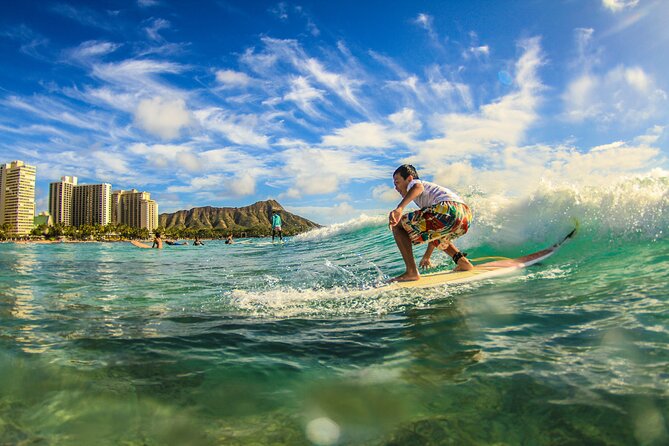
Your lesson begins at Big Wave Dave Surf & Coffee, at 226 Lewers Street, Suite 154, near Waikiki Beach Walk. The shop is convenient for many Waikiki hotels and sits close to public transportation, though it can be somewhat easy to miss inside a ground-floor hotel setting.
Plan to arrive about 20 minutes early. That gives you time to check in, store your belongings, collect your board and leash, and deal with any last-minute rental needs. The locker is a practical touch because a phone, wallet, and hotel key are not good companions in salt water.
Bring or rent a rash guard if you have one. It is not included, and the listed rental price is $5. An optional lock is also $5, though you can bring your own. These are small costs, but they matter when the base price is already fairly high.
The shop also serves food and coffee, which is useful before or after an active lesson. Do not count on generous bathroom access, though. One account described the facilities as limited, so use your hotel bathroom before walking over.
From the shop, you walk a short distance to the beach. The meeting point is convenient, but convenience should not be confused with a private waterfront setup. You are joining the busy Waikiki shore, where surf schools, swimmers, catamarans, and other beach users share the same water.
A few more options to weigh up in Oahu
- Oahu Grand Circle Island and Haleiwa Tour: 9-Hr Deluxe Experience
★ 5.0 · 17,387 reviews - Oahu: Grand Tour Around Island 16 Locations plus Snorkeling
★ 5.0 · 8,669 reviews - Parasailing Experience in Waikiki, HI
★ 5.0 · 7,692 reviews
Why Waikiki works for a first lesson
Waikiki’s south-facing coast is a sensible place to learn. The bottom is soft and sandy, and the water is shallow in the beginner area. That combination lets you focus on balance and timing without adding the worry of stepping onto sharp reef or landing on rocks.
The conditions are not identical all day. One helpful tip from an experienced participant is to book in the morning if you want higher tides and choose the afternoon if you prefer smaller waves. That is not a promise of perfect conditions, since ocean conditions change, but it gives you a useful starting point when choosing a time.
The beach is also busy. A good instructor must manage where each person paddles, keep riders separated, and account for other water activity. Several people praised instructors for reading the waves, giving each person a safe line, and making sure everyone received a fair turn.
That busy setting can also work against you. A launch point may be shared with a catamaran operation, and a boat arriving while you are paddling can add stress. If you are nervous in open water, ask clearly where you should paddle and how to return to shore before the lesson begins.
The 20-minute beach lesson
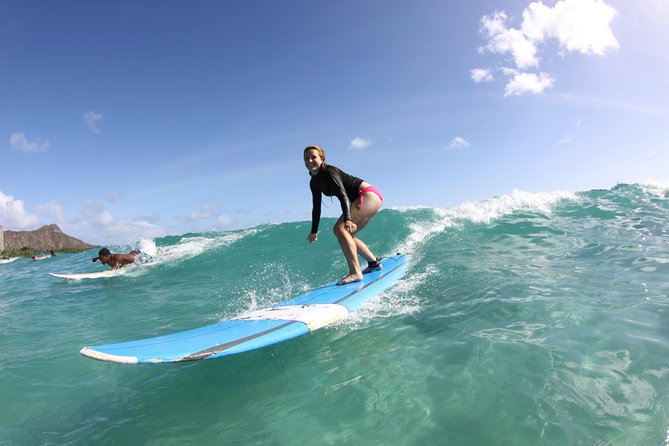
The first part takes place on land and lasts about 20 minutes. This is more important than it may sound. You learn basic water safety, surfing etiquette, paddling, turning the board, handling waves, and the movement needed to stand.
A solid beach briefing should answer practical questions before you need the answers in the water:
- How do you hold the board when a wave comes?
- Which direction should you paddle?
- How do you avoid another surfer?
- What should you do if you fall?
- How do you get back to shore safely?
- Where should you wait for your turn?
The strongest experiences came from instructors who explained the standing motion clearly and then helped people catch waves. Several first-timers were standing repeatedly by the end of the session, including teenagers and adults who expected the sport to be harder.
Your instructor may also share information about ocean life and Hawaiian surf culture. That adds something beyond the mechanics of standing on foam. Surfing in Hawaii is not just a beach activity, and learning the local etiquette helps you act responsibly in a crowded lineup.
Listen closely during this part. A quick or flat explanation can leave you confused once waves, wind, and other boards enter the picture. One poor account described instructions as too brief and unclear, especially about where to paddle. That is a safety issue, not just a teaching preference.
Getting on the board in Waikiki
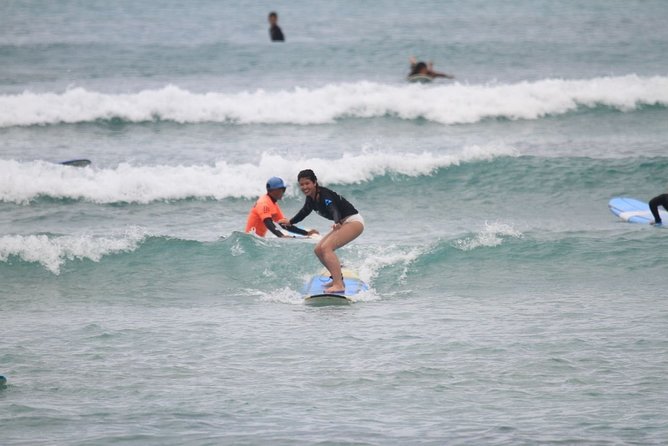
After the beach briefing, you carry the board to the water and begin practicing with the instructor nearby. The goal is simple: paddle into a small wave, push up, place your feet correctly, and ride as long as you can.
You will probably fall. That is part of the lesson, not a sign that you failed. The soft bottom and shallow water help make early mistakes manageable, though you still need to follow directions and control the board with its leash.
The best coaches do more than shout encouragement from the beach. They read the approaching waves, position you, tell you when to paddle, and sometimes give the board a helpful push. Instructors named Josh, Joshua, Alex, Cody, Tanner, Mouse, and Derek received especially warm praise for patience, clear guidance, or positive energy.
Derek was singled out for helping two people catch countless waves. Josh was praised for building confidence with teenage surfers, while Mouse was appreciated for making parents feel comfortable about young adults in his care. These details point to the most important factor in your day: attentive instruction matters more than the board brand or the shop’s coffee.
The lesson is advertised as a small group with a maximum of five. That is a good size for a beginner class because you should receive regular turns without waiting behind a long line. However, some accounts describe groups of six, seven, or even nine, and one person reported being moved to a different company and receiving less time than expected.
I would confirm the actual group size when you check in. If the number is larger than five, ask how many instructors will be in the water and how turns will be divided. That question is reasonable at this price.
A different kind of day out entirely:
- Salute to Pearl Harbor Including USS Arizona
★ 4.5 · 7,433 reviews - Majestic Circle Island Tour with Lunch
★ 5.0 · 7,014 reviews - Oahu’s Ultimate Tour: Dole, Turtle Snorkel, Pali Lookout & More
★ 4.5 · 5,461 reviews - Oahu Circle Island Tour with Turtle Snorkeling— Small-Groups
★ 5.0 · 5,214 reviews
How much water time will you get?
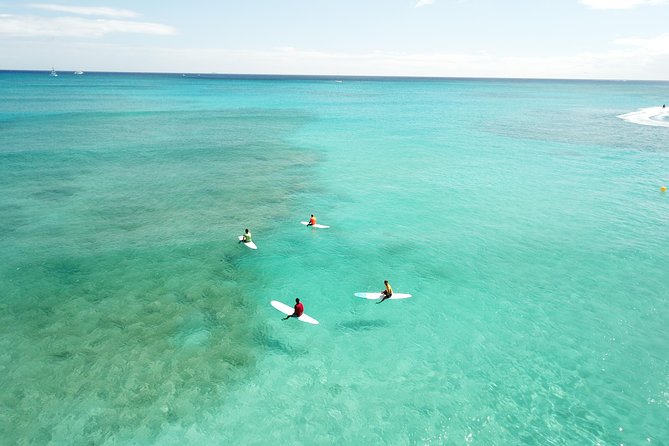
The total duration is about 1 hour and 30 minutes, including the land briefing and preparation. The actual time standing on a board is shorter, since you will also paddle, wait for waves, recover from falls, and move into position.
Several positive experiences describe a full and enjoyable hour in the water. People stood on multiple waves and finished feeling ready to practice with a partner. Other accounts describe only three or four attempts, with poor-quality waves and long waits.
That difference may come from surf conditions, group size, the launch area, or the instructor’s organization. You should not book this expecting a private coaching session with a wave on demand. You are buying a structured first lesson in a public surf zone.
At its best, the class gives you several successful rides and enough confidence to try again later. At its weakest, it can feel expensive for limited chances. If you want the best odds, choose a time with conditions suited to your ability, arrive ready, and speak up if you are unsure where to go.
Safety is the deciding factor
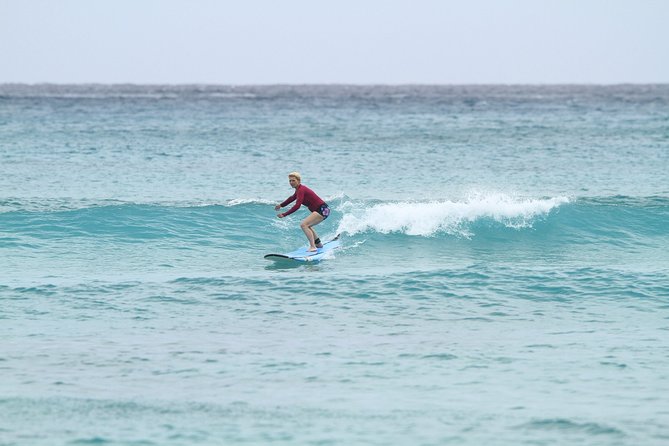
You must be able to swim, and you should have moderate physical fitness. Surfing requires repeated paddling, pushing your body up from the board, balancing, and returning to position after a fall. Even a gentle beginner session can leave you tired.
The instructor should remain aware of every person in the group. Most feedback describes coaches as caring, patient, helpful, and attentive. In one particularly serious complaint, however, a nervous beginner was left without enough support in turbulent conditions and headed toward a concrete wall while struggling to turn.
That account is not consistent with the many positive descriptions, but it is too serious to ignore. Ask the instructor to show you the safe route back to the beach, the area boundaries, and what to do if you cannot turn the board. If you feel overwhelmed, say so early rather than trying to keep up.
The videographer mentioned in one complaint was not described as providing safety help. Photography is optional and requires advance reservation, so do not assume a photographer is part of the instructional team.
Equipment, lockers, and extra costs
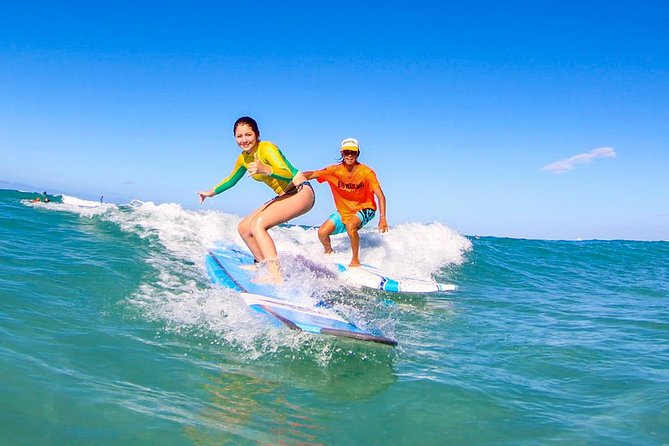
The basic equipment package is straightforward. You receive a surfboard and leash, and you can use a locker for personal belongings. That means you do not need to transport your own board to Waikiki or arrange a separate rental before class.
The provided boards are beginner-style foam boards according to the feedback, though one person questioned the quality. Most accounts describe the boards as good or nice, so I would treat equipment quality as a possible variable rather than a confirmed problem.
Budget for the extras if you want them:
- Rash guard rental: $5
- Optional lock: $5
- Photography: available only with advance reservation
A rash guard is useful for comfort and sun protection, but you can bring your own. If you use the locker, check whether you need the optional lock or should bring one from home.
Is $129 a fair price?
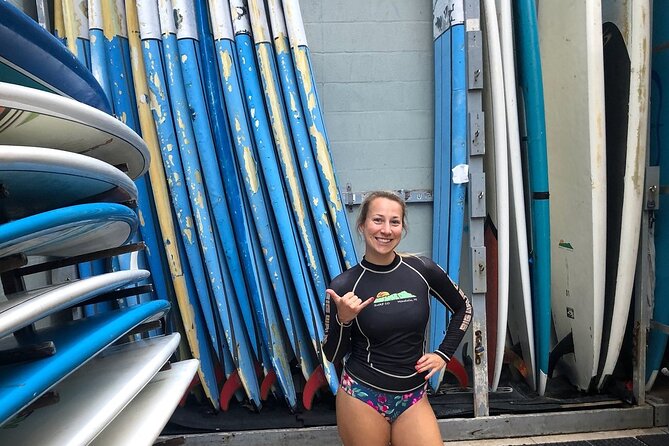
At $129 per person, this lesson is not a bargain beach activity. The price makes more sense if you value the included board, leash, locker, professional instruction, and the chance to learn in a famous beginner setting without arranging separate equipment.
The small-group promise is central to the value. With five people or fewer, the instructor can give each person more attention and help with wave timing. That is why an overcrowded session changes the calculation. Six or more people may still be fun, especially with several instructors, but it weakens the reason to pay a premium.
Two people pay $258 before extras. A family of four pays $516, so the difference between a well-run lesson and a disorganized one becomes substantial. Positive experiences describe nearly everyone standing up, including children and teens, which makes the price easier to accept for a vacation highlight.
The 4.7 rating from 317 ratings, with 92 percent recommending the activity, suggests that most people leave happy. Still, the low scores point to real risks: inconsistent instruction, unclear water directions, group size, changing operators, and limited wave time.
I would book it if a first Waikiki wave is a priority and you want equipment and instruction handled in one package. I would compare options if your main goal is maximum water time or private attention.
Who will enjoy this most?
This lesson suits first-time surfers, families with older children, couples, and solo visitors who want a guided introduction. Children aged 10, 12, 15, 16, and 17 were specifically described as enjoying lessons, though the supplied details do not state a formal minimum age.
It also suits adults who are not naturally athletic but can swim and are ready for a physical hour. One older adult received praise for having the lesson adapted to his ability, which is encouraging if you are concerned about age.
You may want another option if you are uncomfortable swimming, have trouble with repeated paddling, or need one-on-one supervision. You should also think twice if crowded water makes you anxious and the company cannot confirm a group of five or fewer.
Booking, weather, and cancellation details
You receive confirmation at booking, and the activity is offered in English. It is typically reserved about 11 days ahead, so booking early is sensible for a preferred morning or afternoon time.
Free cancellation is available until 24 hours before the start time. Cancel at least 24 hours ahead for a full refund. Changes or cancellations inside that period are not accepted and are not refunded.
The lesson requires suitable weather. If poor weather causes cancellation, you are offered another date or a full refund. That policy is useful for an ocean activity, since forcing a lesson into bad conditions would not be worth the risk.
Should you book the Waikiki lesson?
I would book this lesson for a first taste of surfing, especially if you can secure a group of five or fewer and choose a time that matches your comfort level. Waikiki’s sandy bottom, shallow beginner water, included gear, and strong record of encouraging instructors give you a good chance of standing up.
Before paying, confirm the group size, the instructor arrangement, and where the class will enter the water. Ask for clear instructions about returning to shore. If the company cannot answer those questions, or if your booking is shifted to another operator, compare alternatives.
The winning formula here is simple: a patient coach, manageable waves, and a properly supervised group. When those pieces come together, you can leave with your first Waikiki ride and enough confidence to keep practicing. At $129, that can be a fine vacation memory, but it is not a price that leaves much room for poor organization.
FAQ
Where does the surfing lesson begin?
The lesson begins at Big Wave Dave Surf & Coffee, 226 Lewers Street, Suite 154, Honolulu, near Waikiki Beach Walk.
How early should I arrive?
You should check in about 20 minutes before the lesson begins so you have time to prepare, store belongings, and collect your board and leash.
Is a surfboard included?
Yes. The price includes the required surfboard and leash.
Can I store my belongings during the lesson?
Yes. Locker use is included, though an optional lock costs $5. You may also bring your own lock.
Do I need to know how to swim?
Yes. You must be able to swim, and the activity recommends a moderate level of physical fitness.
How many people are in the group?
The stated maximum is five people. Some reported sessions were larger, so confirm the group size when you check in.
What happens if the weather is poor?
If the activity is canceled because of poor weather, you can choose another date or receive a full refund. You can also cancel for a full refund up to 24 hours before the start time.
Just added in Oahu
- Oahu: Waikiki Turtle Canyons Cruise and Snorkel Excursion★ 4.8 · 825 reviews
- Waikiki, Hawaii: Deluxe Snorkel and Wildlife Cruise★ 5.0 · 352 reviews
- Waikiki Trolley Green Line Diamond Head Shuttle★ 5.0 · 606 reviews
- Waikiki Green Sea Turtle Snorkeling Tour – Boat Excursion★ 5.0 · 408 reviews
- Premier Waikiki Sunset Party Cruise with Live DJ and Full Bar★ 5.0 · 322 reviews
- Waikiki Beach Sunset Sail★ 5.0 · 378 reviews
- Wild Dolphin Watching and Snorkel Safari Off West Coast of Oahu★ 5.0 · 795 reviews
- Chief’s Official Pearl Harbor Self-Guided Multimedia Tour★ 4.0 · 407 reviews
Workshops, compared.

New Orleans Demonstration Cooking Class with Meal
Read our review →
Instructor-Led Line Dancing Class with Souvenir Video
Read our review →
New Orleans Hands-On Cooking Class with Meal
Read our review →

Undiscovered Charleston: Half Day Food, Wine & History Tour with Cooking Class
Read our review →

Browse the lists this tour appears in